If you read the news, you might get the sensation that the world is currently being pulled apart. Here in Iceland, that’s literally the case.
Our first stop after leaving Reykjavík was the rift valley encompassing Þingvellir National Park. The letter “Þ” is pronounced “th,” so the English version would be Thingvellir, probably one of only five Icelandic words I can correctly say.
Running through the center of the rift valley here is a crack in the earth. To the left in the photo, below, is the North American Plate; on the right is the Eurasian Plate. This is where the earth separates Americans from Europeans.
These two tectonic plates are slowly moving away from each other at a rate of about an inch per year. So, when I come back for my hundredth birthday in 2056, this gap will be almost a meter wider.

The orange colored areas on the map, below, mark the location of the youngest rock in Iceland where volcanic activity is most likely to be found as the plates separate. The current eruption at Grindavík is just below “RVB” on the map, below, at its bottom left. Thingvellir NP is the red dot the black arrow is pointing to.
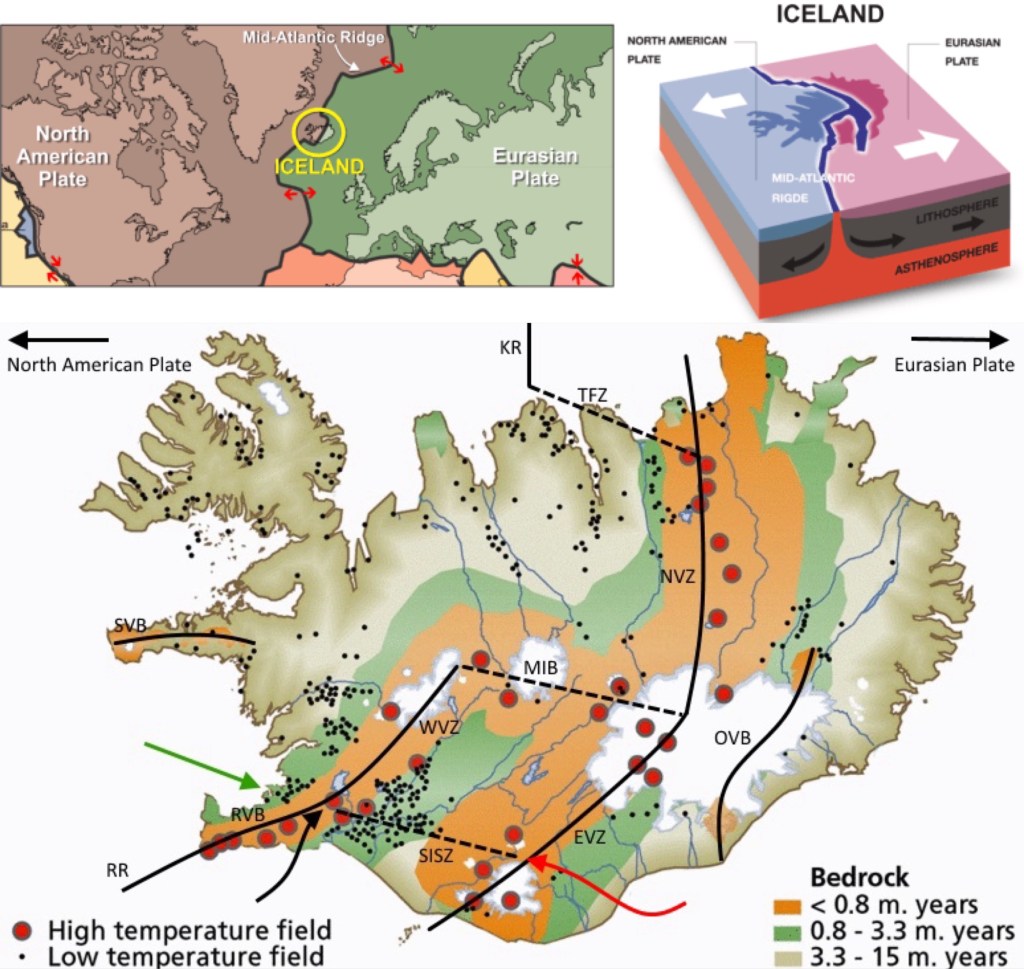
Besides being geologically important, Thingvellir is also historically significant. This is where the Alþingi (“Althingi”), the Icelandic parliament, first met in 930 AD. Wikipedia will tell you that the Alþingi is the oldest surviving legislature in the world, which is true if you ignore the 641 year hiatus between 1262 AD and 1903 AD when it did not meet.
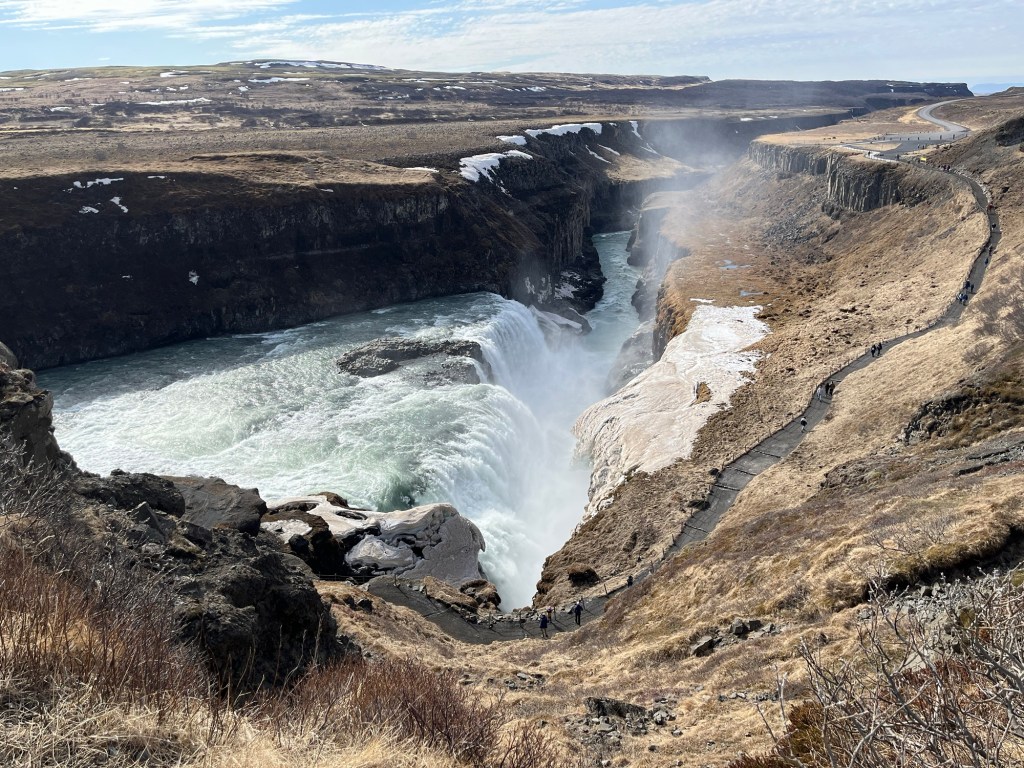
After Thingvellir, we drove east to Gullfoss. One word you will quickly learn in Iceland is “foss.” It means “waterfall,” and they’re everywhere. “Gull,” by the way, means “gold,” hence, Gullfoss is the Golden Waterfall.

Wikipedia has this to say about the volume of water flowing through this system: “The average amount of water running down the waterfall is 141 cubic metres (5,000 cu ft) per second in the summer….” I have no idea how much that is. It’s simply incomprehensible. Let’s just say it’s A LOT OF WATER! Do not try to go over these falls in a barrel!
After Gullfoss, we backtracked a few miles to appropriately named Great Geysir, the namesake of all geysers. The Great Geysir is now mostly dormant, but it’s nearby little brother, Strokkur, below, erupted about every 20 minutes while we were there, throwing boiling water about 100 feet in the air.
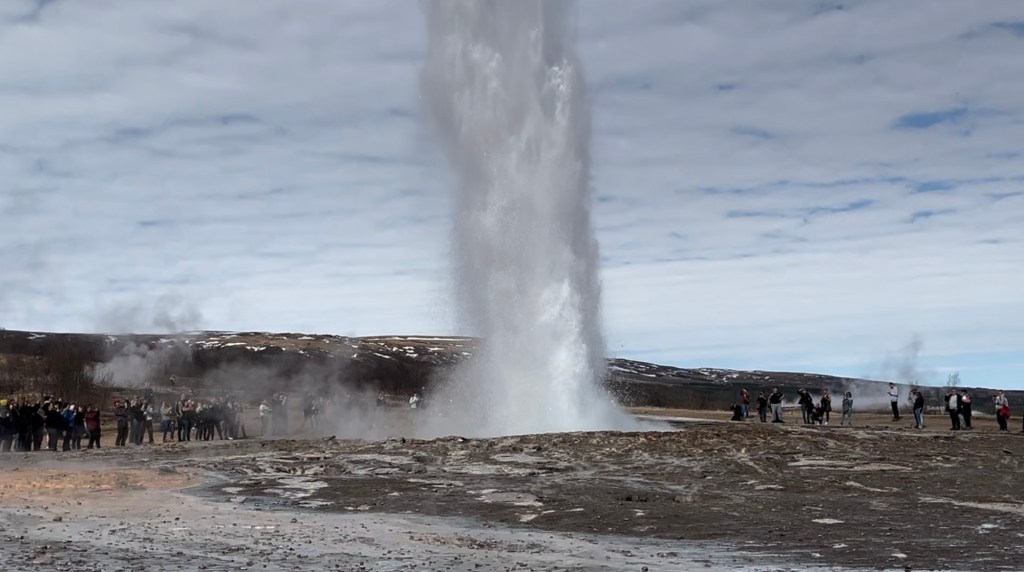
While the eruption of Strokkur is not as spectacular as that of Old Faithful in Yellowstone NP, it is certainly more accessible. Take a look at that photo above. People were gathered all around the geyser within 20 feet of the pool. Those downwind were getting drenched.
We walked around to the upwind side, just in time to see a massive, boiling bubble roil to the surface and explode into the air. Impressive.

We spent the night here at the Geysir Hotel before turning south.
 The Road Less Traveled
I always enjoy your travel blog.
I have one favor to ask for your records: kindly update my email to: craig.shiple@gmail.com.
While bellsouth.net still officially works, it’s anytime now ATT states that they plan to retire their ‘babybell’ extension.
Hi to Dale, see you soon.
Craig
When we were in Iceland, I commented to one of our guides about how hard it was to pronounce the words. He told me to just put heavy emphasis on the first syllable and then you can mumble the rest. Worth a try…
Looks awesome!
I posted a comment on your blog about electric cars (which was a great post, by the way) that, for some reason, named me as “anonymous.” Just thought you might want to know where that comment came from.
Thanks!