We checked into an airport hotel, Courtyard Marriott Keflavík, the afternoon of May 10 in advance of our flight back to Florida the next day on Iceland Air.
Settled into our room, I checked the weather and news and learned that a solar storm was predicted with the expectation that the aurora borealis, that is, the Northern Lights, would be visible from Iceland that night!
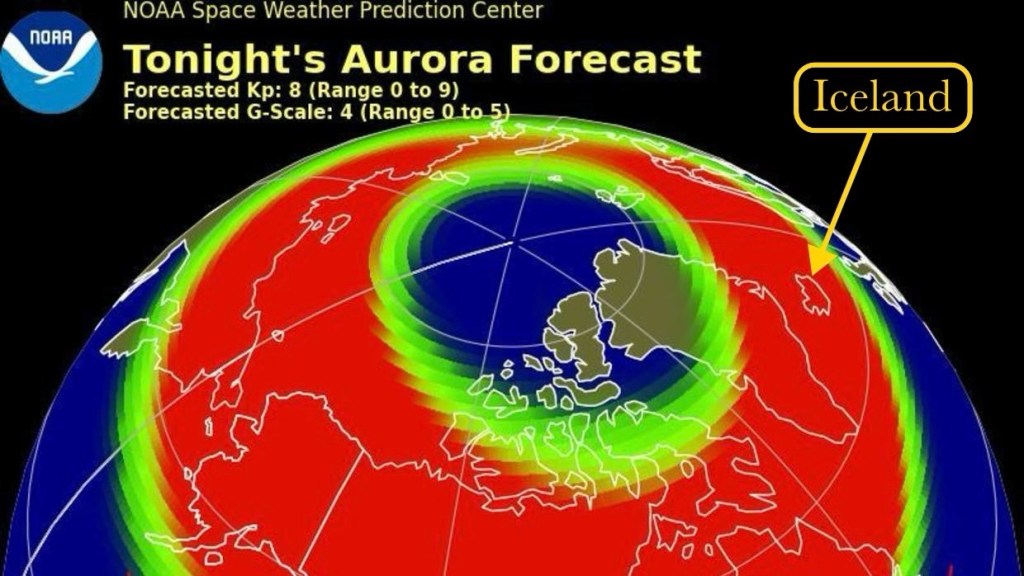
We had been told by locals when we first arrived in Iceland that the season for seeing the Northern Lights ended in early April with the First Day of Summer. So the possibility that we might still get a chance on our last night to see an aurora was quite a surprise. I suppose Icelanders consider the aurora “season” to be over in April because of the spring equinox in March and the gradual lengthening of days that follows.
All of our lodgings had blackout curtains since it stayed light outside until almost midnight, and darkness ended around 3:00 a.m. Even though there were only about four hours of darkness on the night of May 10, I got out of bed several times to check the sky for the aurora.
Alas, a low pressure system settled over the entire country and clouds covered the heavens. No Northern Lights for us. I had to imagine what it would look like had the sky cleared:

Our tour around the country on the Ring Road took us 2,200 miles, including side trips, as shown, below:

For those who might want to do something similar, I have a few comments:
Driving – The Ring Road is easy to drive and no different from driving in the USA (right hand side of the road). Intersections are normally traffic circles. The main pavement is well maintained. There were very few potholes. We encountered no unpaved sections on the main road. Signage is good and you can easily drive around the entire island using just a map, the vehicle’s GPS, or your phone’s or the car’s navigation system. Make sure to observe the speed limit, which is normally 90 kph (55 mph). I always used the cruise control. There aren’t that many police on the road outside of the cities, but they will ticket foreigners and the fines are expensive. The roads have no shoulders and the lanes seem a little narrower than in the USA, so it’s difficult for the driver to look at passing scenery. Use the few turnouts for taking photos, but pay attention, the turnouts are not marked – they just suddenly appear. There’s not much traffic and people are generally good drivers. If you plan to drive off the main Ring Road at all, get the windshield insurance coverage. Tour drivers really haul a** on those roads and gravel flies all over when they go by. We got pinged, but it didn’t crack the windshield.
Parking & Tolls – We never had a problem finding parking at any of the sights we went to. There are no attendants at the parking lots, but there does not seem to any problem with theft, even in the absence of security. Nevertheless, we didn’t tempt any would-be thieves by leaving anything visible in the car. Most of the parking lots require payment. Since there’s no attendant, you either pay at a kiosk or use a phone app (Parka) to pay for parking. Not all of the lots are well-marked, so be sure to look around for signs indicating whether or not you have to pay for parking. There are a couple tunnels. The one on the north side of the island has a toll that has to be paid online.
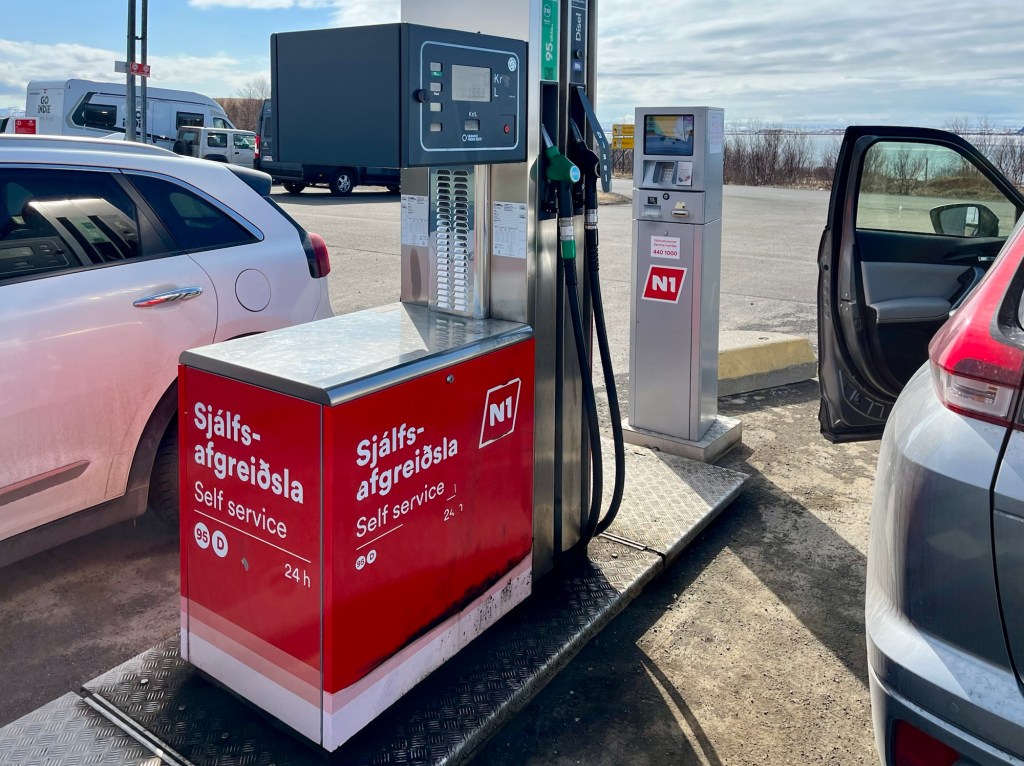
Fuel – Gas is expensive, around $9.00/gal while we were there, and gas stations are few and far apart. I never let the tank drop below half-full. The gas pumps are all fully automated. Many stations had no attendants at all. And the pumps are a little tricky. I often encountered two credit card readers with only one being compatible with my American credit card. They call gasoline “petrol” or “95” (which is the octane rating). Do not confuse the nozzle with the diesel one: gasoline is green.
Food – There are very few restaurants along the Ring Road and most of them are affiliated with the hotels. The gas stations that are more than automated pumps usually had convenience food items. They are known for their hotdogs, although I was not impressed, being the hotdog aficionado that I am. Surprisingly, Icelanders, unlike residents of the Pacific Northwest, are not big coffee drinkers. I think we passed just two coffee shops on the drive. The gas station convenience store coffee is lousy. For the most part, we opted to pay for the breakfast buffets at our hotels. There is no à la carte option for breakfast and grocery stores are very rare. Lunches consisted of sandwiches that we made from items at the breakfast buffets. We also filled tumblers with coffee for the road. We ate dinner at local restaurants when we could find them; otherwise, we ate at the hotels. Meals are expensive, averaging around $50 each, including a glass of wine or a beer.
Weather – We were in Iceland from late-April to mid-May. Except in the highlands, we encountered almost no snow or uncomfortable cold. It was generally in the high-30s to low-40s in the morning, warming to the high-40s to low-50s in the afternoon. It can get windy, and we encountered drizzly rain a couple times. We layered up and shed clothing as conditions required. I normally wore a t-shirt under a moderately heavy long-sleeve shirt, with a windproof/water repellant, lightly insulated jacket. I only wore my “puffy” down jacket once or twice and could have gotten along without it. We wore hiking boots most of the time, also hats, but didn’t need gloves.
Miscellaneous – Internet is available everywhere. Everybody speaks English. American credit cards are universally accepted. I got local currency from an ATM in Reykjavík, but didn’t need it. Icelanders are generally friendly and helpful, but you won’t run into many of them. Nearly all the service workers at the hotels, restaurants and gas stations are from Poland or one of the other Eastern European countries. Iceland is the most automated country I have ever been to. It’s almost as if they’re planning to do away with workers entirely. I found it a little weird.
The northernmost tip of Iceland is inside the Arctic Circle, so our flight back to Orlando, Florida, was probably the northernmost flight we have been on:
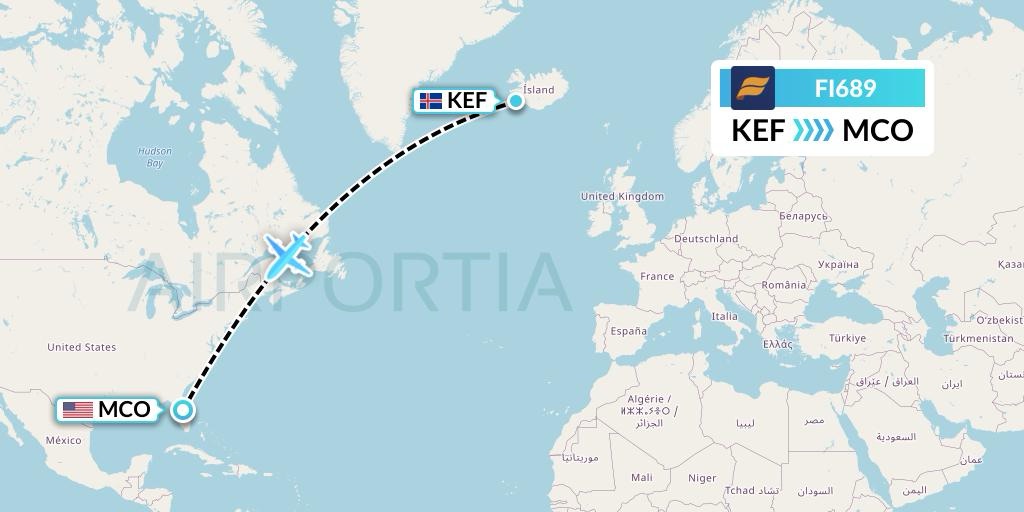
But it’s not a long one, as flights over the Atlantic go. We were in the air for just under eight hours and, surprisingly, over water for only about two hours.
It was a great trip, but I guess, for us, the Northern Lights will have to await another northern flight.
 The Road Less Traveled
Outstanding suggestions. This is definitely on our “bucket” list. Well done Ulmers!