Inhabited since 700 BC, Samarkand is one of the oldest cities in Central Asia. Arab armies captured it in 710 AD. At that time, Samarkand was a diverse religious community of Zoroastrians, Buddhists, Hindus, Manichaens, Jews and Nestorian Christians.
In most cases, upon conquering territory, new Arab rulers would neither settle nor impose Islam on the locals. Instead, they would require indigenous leaders to pay tribute; otherwise, the conquered were left alone.
But that was not the case in Samarkand. Here, the conquering Umayyad Arab Caliph, Qutayba ibn Muslim, established an Arab garrison and administrative center, razing other religious orders’ temples. The entire population was converted to Islam and a mosque was built.
Various Arab, Persian and Turkic rulers came and went over the following centuries until 1220 AD when Genghis Khan and his hordes arrived. Genghis slaughtered thousands and conscripted the survivors into his army. Samarkand was incorporated into the Mongol Empire as part of the Chagatai Khanate until Tamerlane arrived on the scene in the 1300s AD., making Samarkand the seat of his growing domain.
I mentioned in my last post that Tamerlane slaughtered entire communities that resisted his army. What I didn’t say was that he almost always spared craftsmen, artists and architects, deporting them back to Samarkand which soon gained notoriety as the center of Islamic culture.
The heart of Samarkand during the Timurid Dynasty was the Registan, a public square where proclamations were read and enemies executed.
The central square of the Registan is surrounded on three sides by madrassas, that is, Islamic religious schools. It is considered to be the hub of the Timurid Renaissance, the result of Tamerlane’s collection of artisans from his conquered lands.
From left to right in the photo below, the three madrassas of Registan Square (and their dates of construction) are the Ulugh Beg Madrassa (1417–1420), the Tilya-Kori Madrassa (1646–1660), and the Sher-Dor Madrassa (1619–1636).
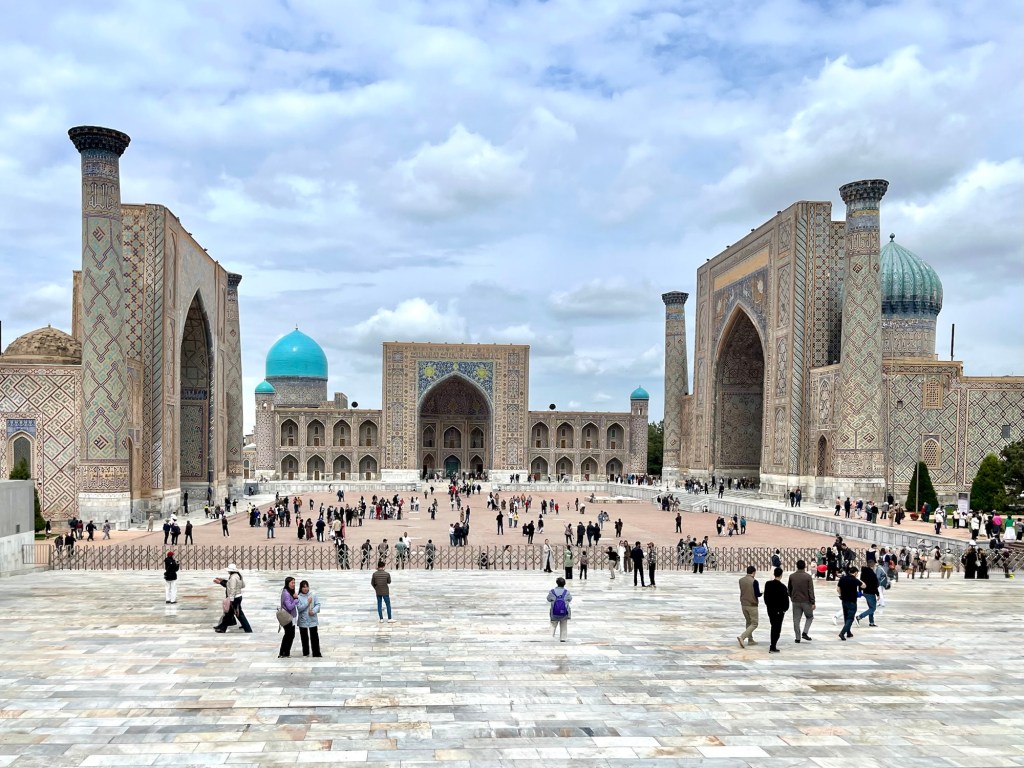
The Timurid Renaissance lasted for the duration of Tamerlane’s empire, from the mid-1300s to the early 1500s. It ushered in a general revival of the arts and sciences in the Islamic world, occurring slightly prior to the European Renaissance.
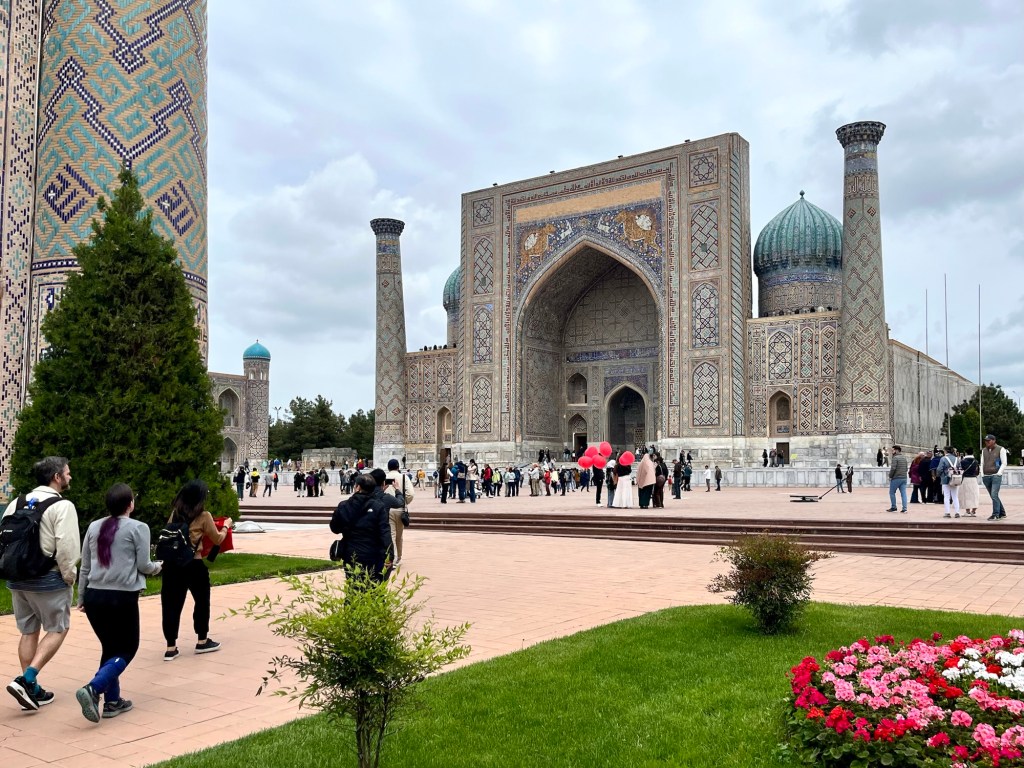
The two madrassas in the photo below, the Tilya-Kori Madrassa and the Sher-Dor Madrassa were built after the collapse of the Timurid Empire.
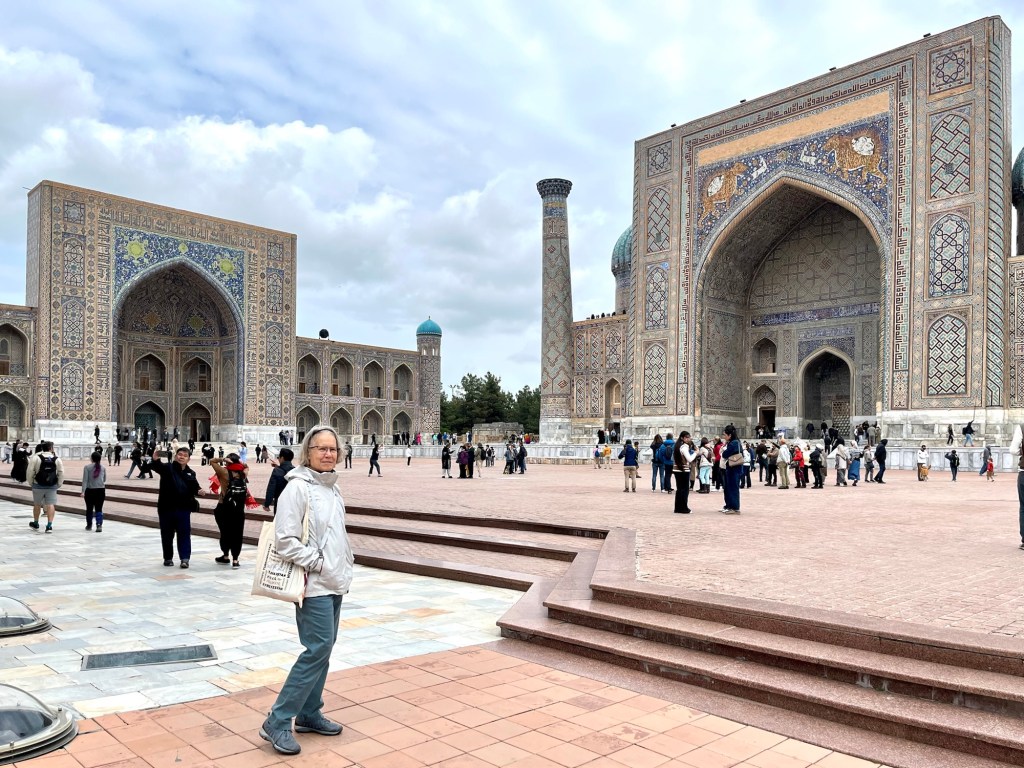
The two photos above, and the one below, were taken in sequence as we entered Registan Square from the left (the west).
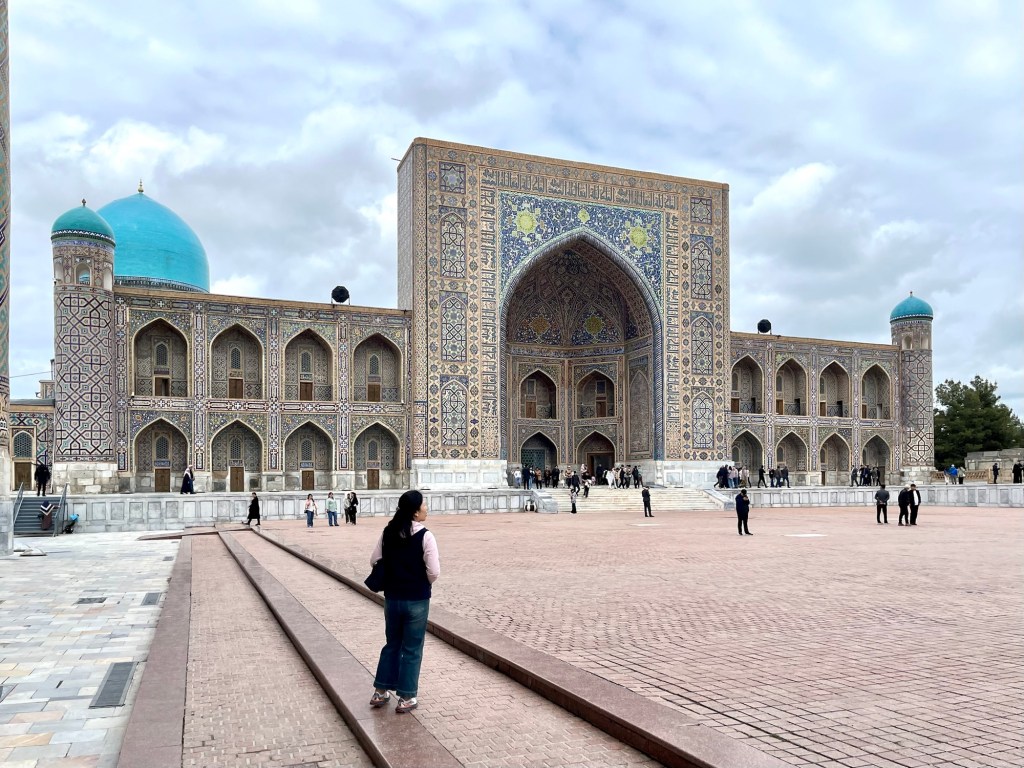
From the location photographed above, we turned left and entered the Ulugh Beg Madrassa. You may recall that I mentioned Ulugh Beg in my last post. He was one of Tamerlane’s grandsons and was entombed in Gur Emir with him.
Ulugh Beg (1394-1449 AD) was the ruler of the Timurid Empire for the last two years of his life. He was a respected mathematician and astronomer and built the first madrassa in Registan Square, which bears his name. He also built nearby the finest astronomical observatory in Central Asia of the time, essentially a giant sextant. Most historians attribute the Timurid Renaissance to the efforts of Ulugh Beg.
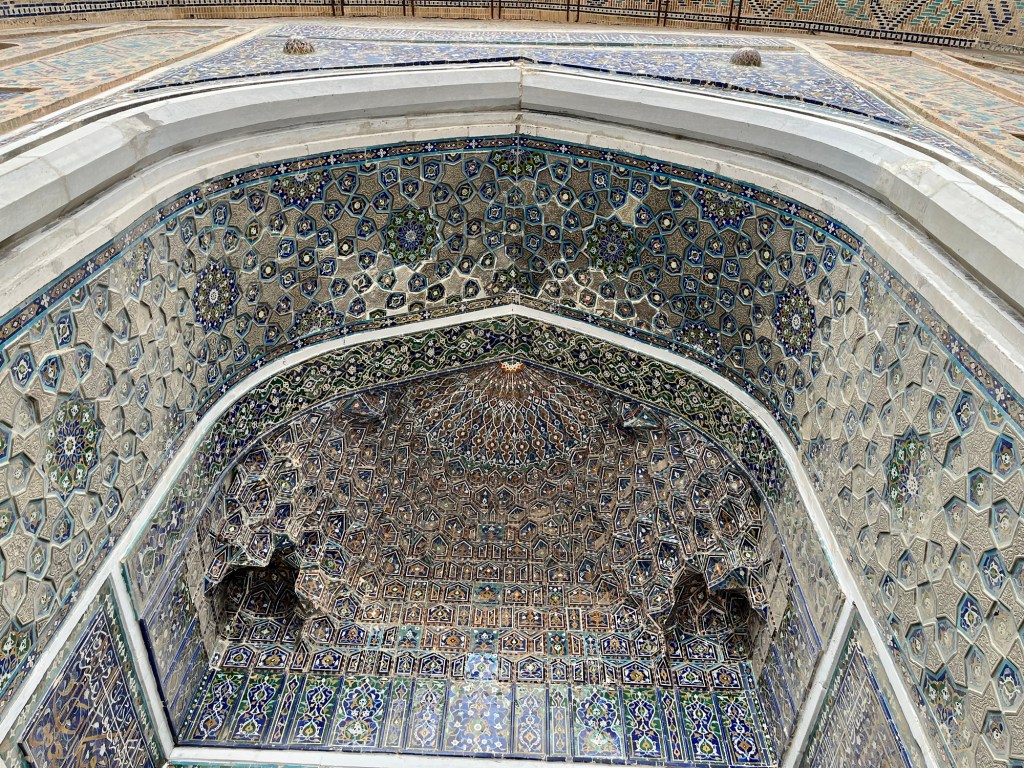
This is the entry arch into the Ulugh Beg Madrassa:
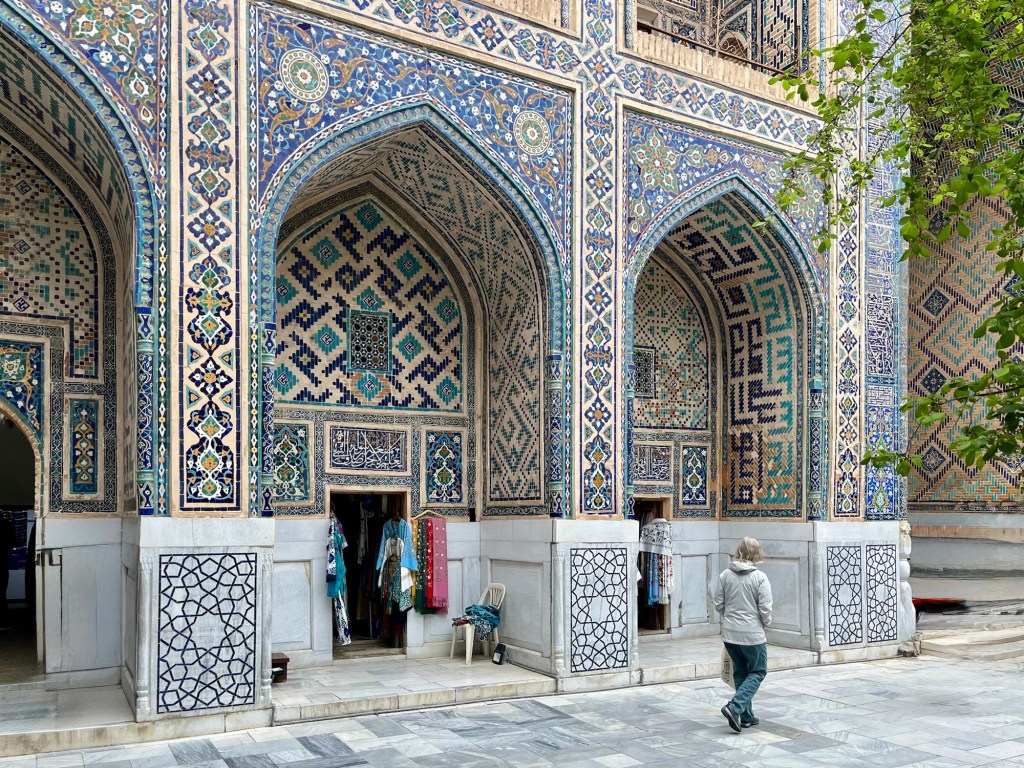
In centuries past, the rooms facing into the interior of the Ulugh Beg Madrassa, shown below, were dormitories for religious students. Today they are souvenir shops.
We exited from the north side of the Ulugh Beg Madrassa…

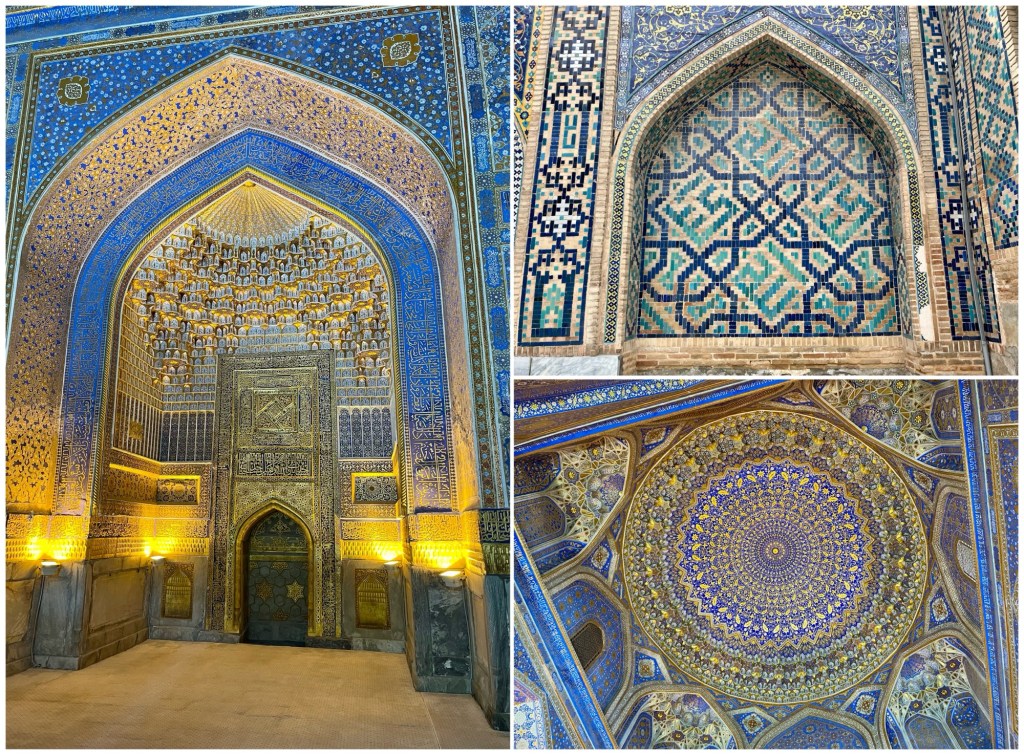
… and entered the Tilya-Kori Madrassa.
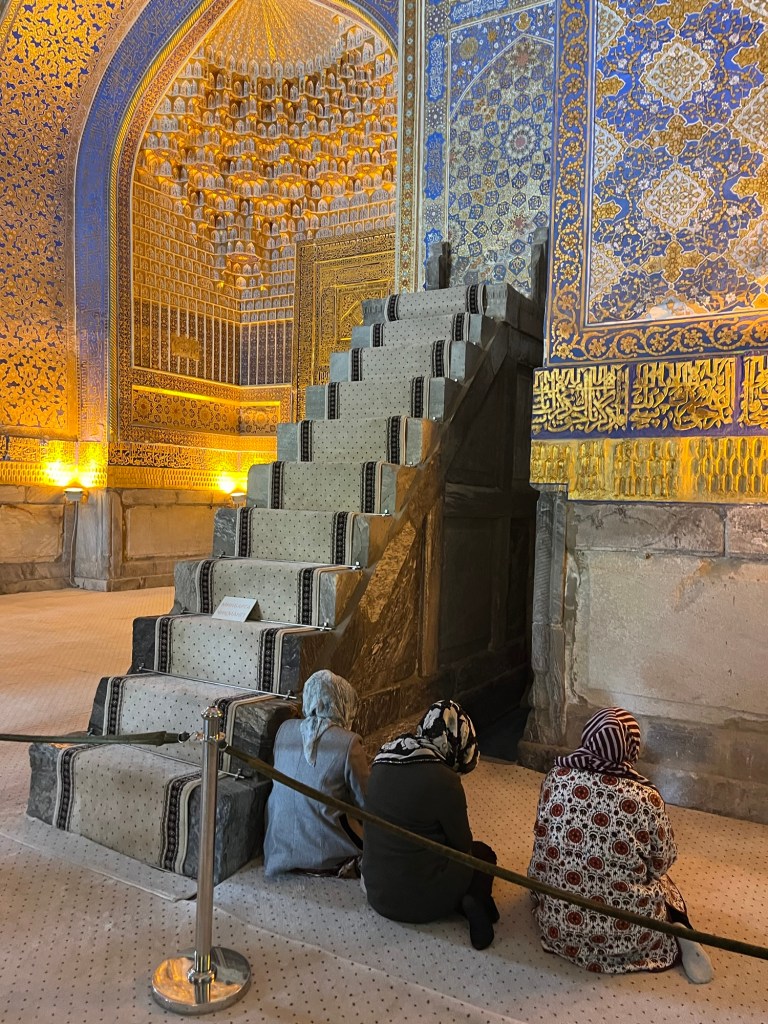
Blue is a much more prominent color in the later madrassas and mosques.
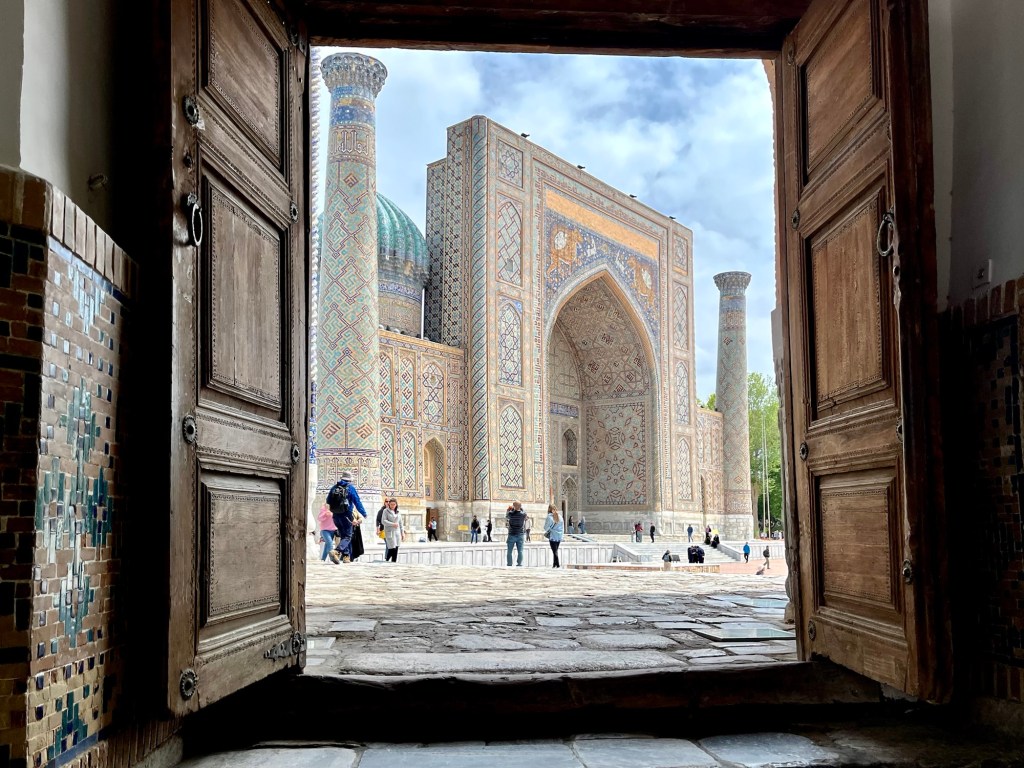
There was a great view of the Sher-Dor Madrassa from here.
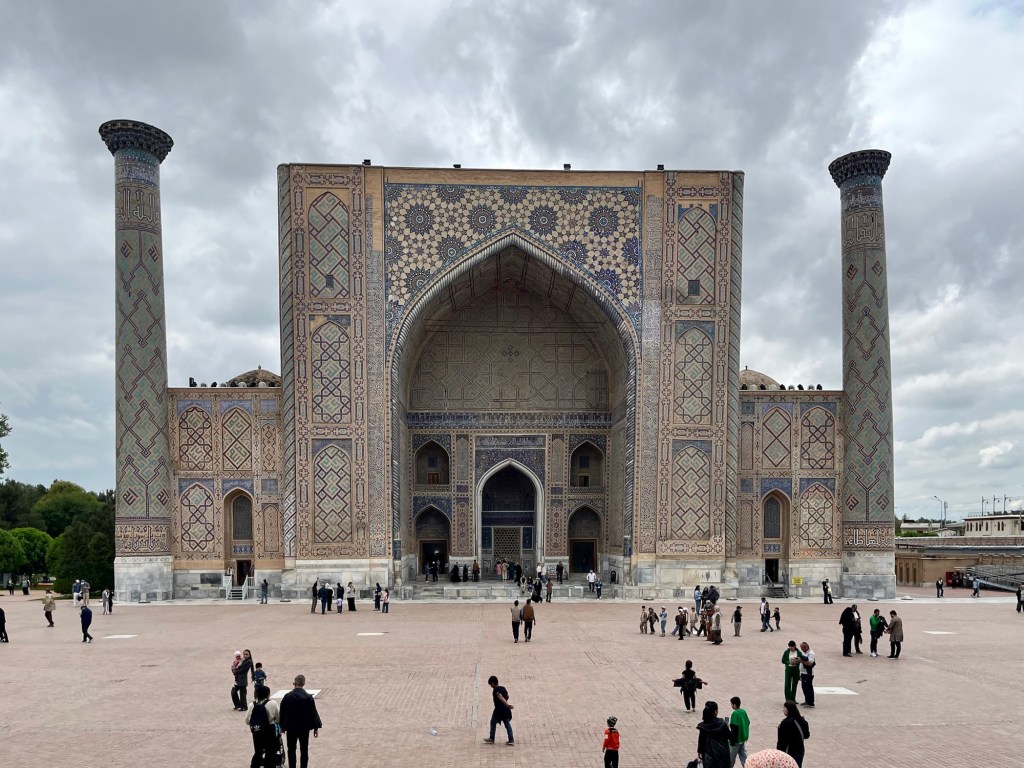
Back outside, I remembered to take a picture of the Ulugh Beg Madrassa from the front as we left the complex:
Our final stop in Samarkand was the Bibi-Khanym Mosque, originally constructed by Tamerlane around 1400 AD and named for one of his wives. It was and is one of the largest mosques in the Islamic world.
Unfortunately, the mosque was not maintained and over the centuries earthquakes, erosion, and construction and design flaws resulted in the building being reduced to ruble. In 1974, the Uzbek Soviet government began restoration; it continued beyond independence and was still being restored into the 2010s.
Here’s the entry to Bibi-Khanym:
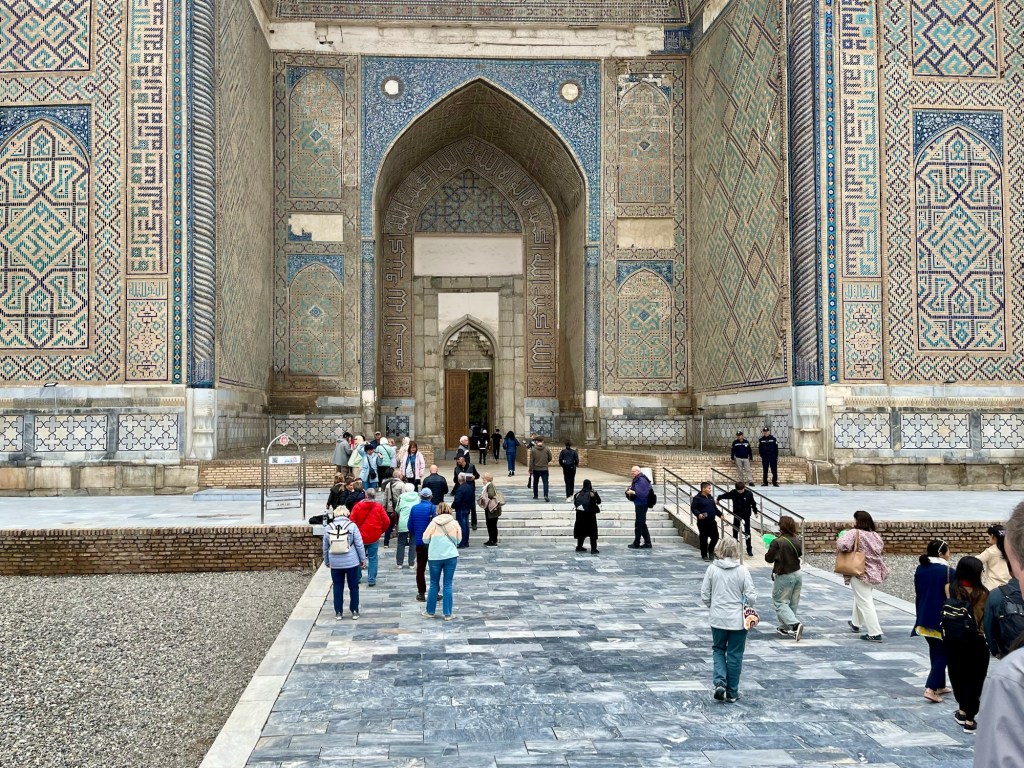
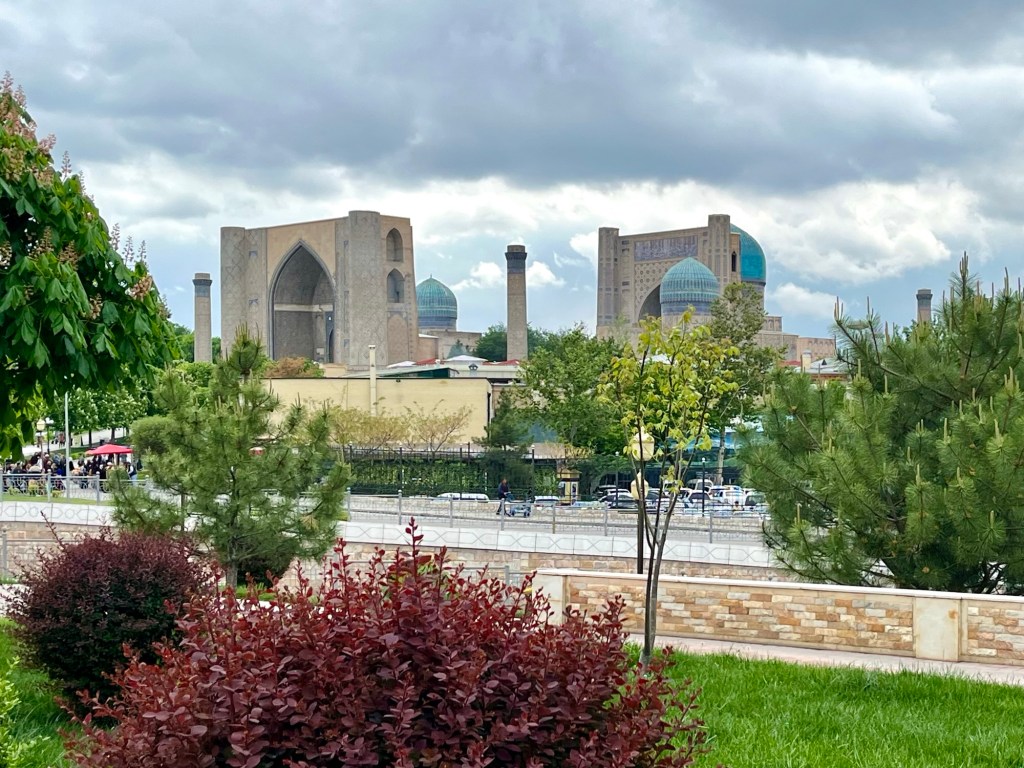
The Bibi-Khanym Mosque is so big, I had to get far away in order to photograph it:
In 2001, historic Samarkand was added to the UNESCO World Heritage list as the “Crossroads of Culture.” Today Samarkand is Uzbekistan’s third largest city with a metro population of nearly one million.
We ended our time in Samarkand with a visit to Konigil Village to see how paper is made from the Mulberry tree, then returned to our hotel to prepare for our visit tomorrow to Tajikistan.
 The Road Less Traveled