In my last post, I mentioned that Ismail Samani united the various Sogdian city-states of Central Asia into a single dynasty in 892 AD.
Samani made the fortress city of Bukhara the capital of his family’s brief dynasty, which lasted until the end of the first millennium, that is, until 999 AD.
Like Samarkand to its east, Bukhara was an ancient settlement, prominent on the Silk Road and dating back to the early years of the Roman Republic. Also like Samarkand, Bukhara was conquered by Arab invaders in the early 700s and its residents were eventually converted to Islam.
The Samanid Empire (892-999 AD) itself was a Persian Islamic dynasty, during which Bukhara became the cultural center of the Islamic world, remaining its epicenter until it was overtaken by the rise of nearby Samarkand under Tamerlane (Timur) in the 1300s.
The Timurid Empire ended in 1507 AD when it was conquered by the Uzbek Shaybanids, descendents of Genghis Khan.
The Shaybanids, in turn, made Bukhara the capital of their fledgling empire, which ultimately included most of Central Asia, northern Persia (Iran) and Afghanistan. The Shaybanid dynasty subsequently became known as the Khanate of Bukhara.
The historic center of Bukhara, which includes about 140 ancient historic buildings and architectural treasures, was designated a UNESCO World Heritage site in 1993,
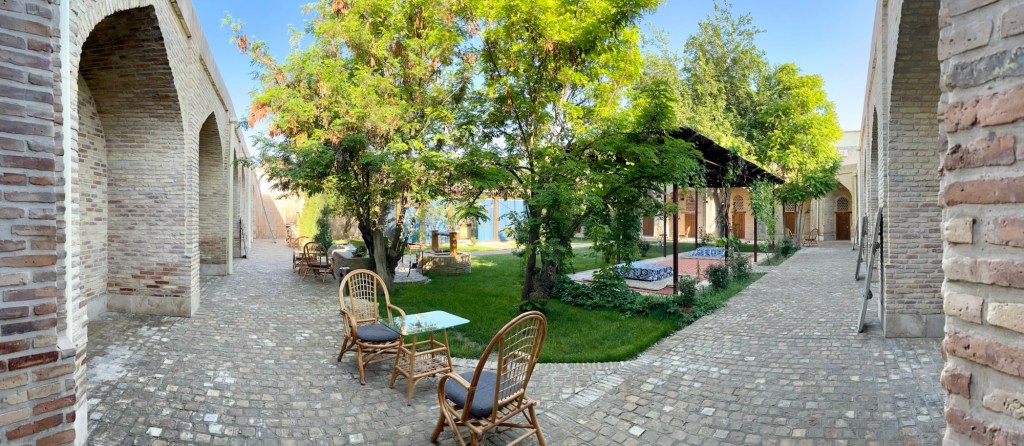
After crossing the border from Tajikistan back into Uzbekistan Monday afternoon, we drove to Bukhara and checked into the Marhaba Boutique Hotel, a restored madrassa from the 1400s. Our room was one of the former student dorms. Here’s a view of the inner courtyard from our door:
The following morning, we got moving early for a walking tour of the old town. Bukhara is Ahror’s home, so he knew the history of the place and all the best places to see.
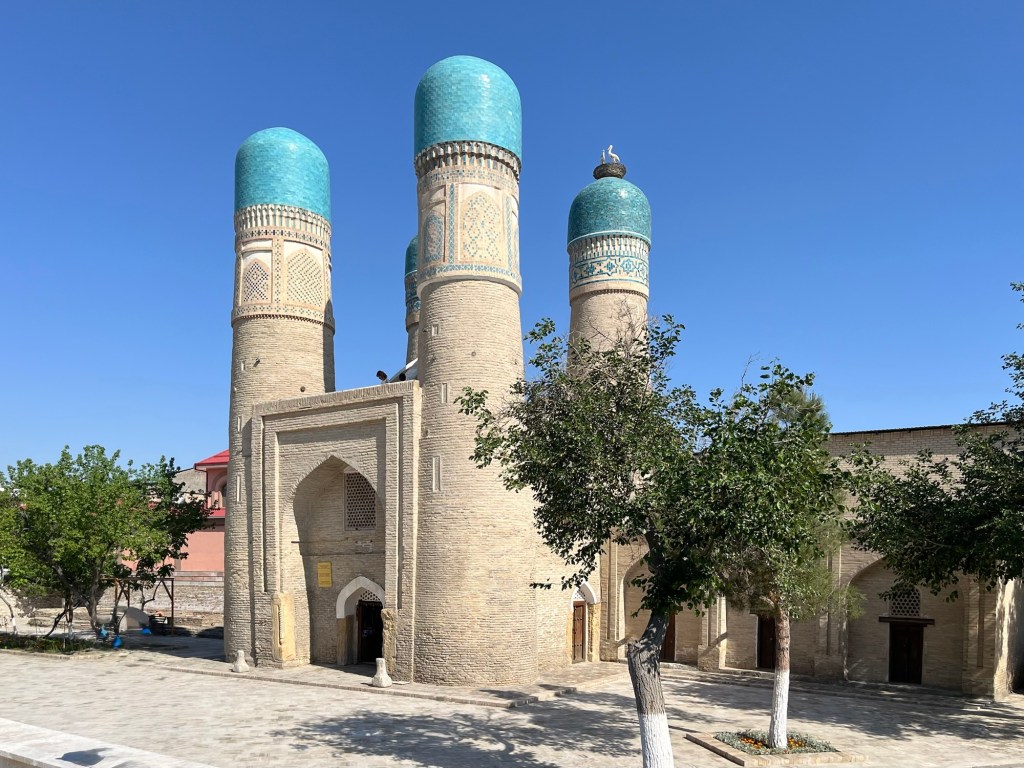
We walked to meet our driver, passing the Chor Minor Madrassa on our way. The four towers of the mosque at its entrance, shown below, are decorated in a different motifs, believed to represent the four main religions that have existed here: Zoroastrianism; Islam; Christianity; and, Buddhism. The stork’s nest on the right tower is a fake, intended to represent the real thing from back when storks were common here.
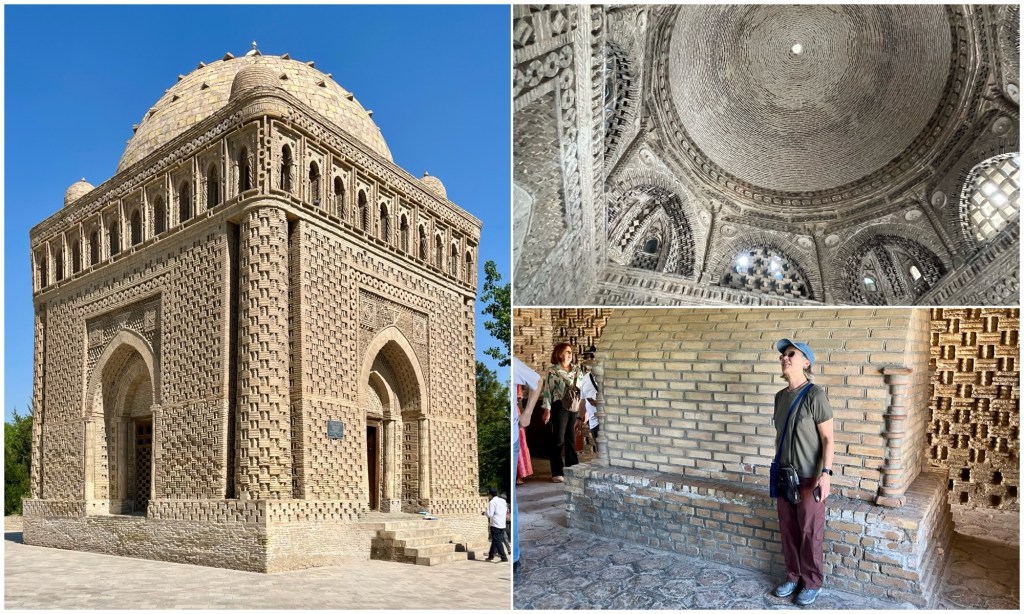
We drove from here to Samoni Park, to visit the Samanid Mausoleum, the burial place of Ismail Samani and the sole surviving structure from the Samanid Empire, constructed sometime prior to 1000 AD. It is also the first building known to this area to have been built of baked bricks.
Inside, Dale admired the interior of the dome while standing in front of Samani’s crypt.
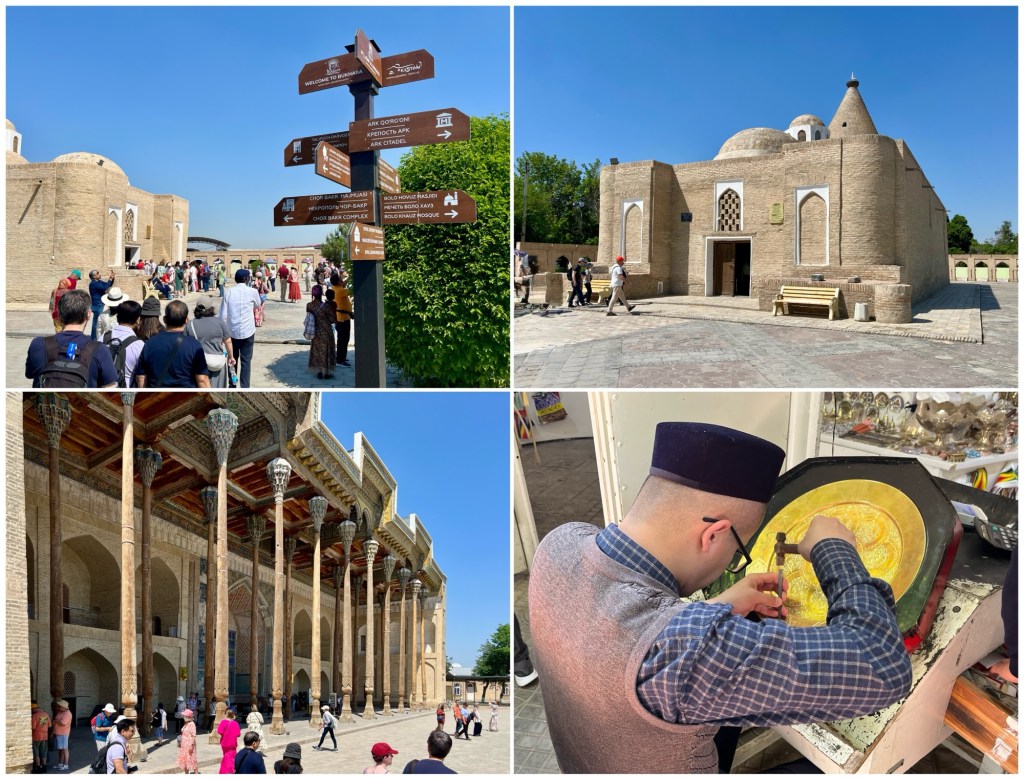
Our next stop was the nearby Chasma Ayub Mausoleum (photo below, top right), constructed during the Timurid Empire, This mausoleum is purported to be the tomb of the Prophet Ayyub, known to Christians and Jews as Job (as in the Old Testament Book of Job).
We then visited the Bolo Haouz Mosque, unique for its wooden construction. There was a artisan out front engraving brass plates, a craft for which Bukhara is known. We bought four.
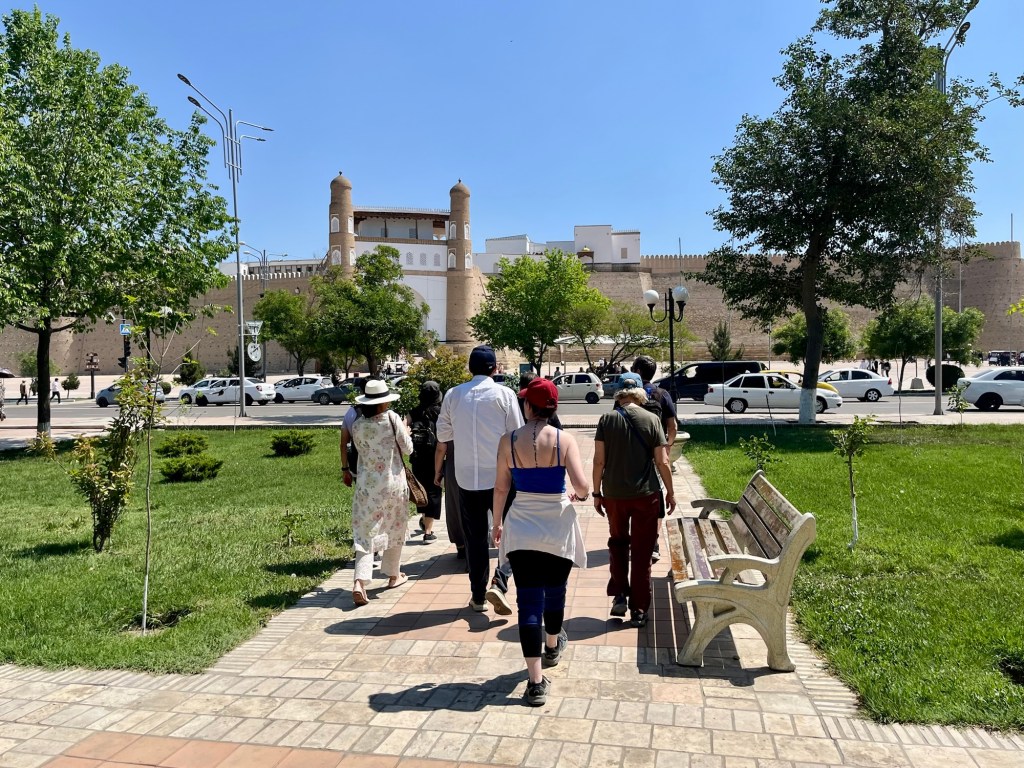
We then proceeded to walk across the old city center to the Ark of Bukhara Fortress.
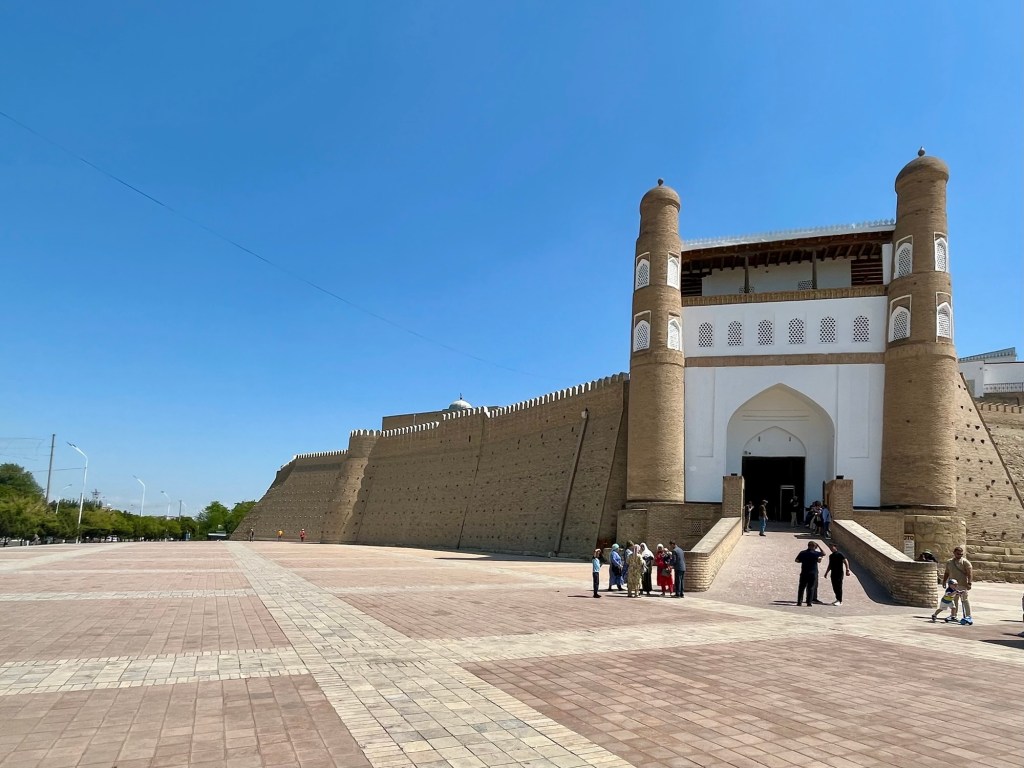
The exact date of construction of the Ark Fortress is unknown, but the essence of what exists today is believed to have been built in the 400s AD. It sits atop the ruins of numerous previously destroyed and buried fortresses.
The defensive wall forms an irregular rectangle measuring nearly a half mile along its perimeter and enclosing a city of 10 acres; it varies from 52 to 66 feet in height.
The photo below is the main gate. The towers were built in the 1700s. Upon entering, there is a ramp that goes straight up to the top of the wall.
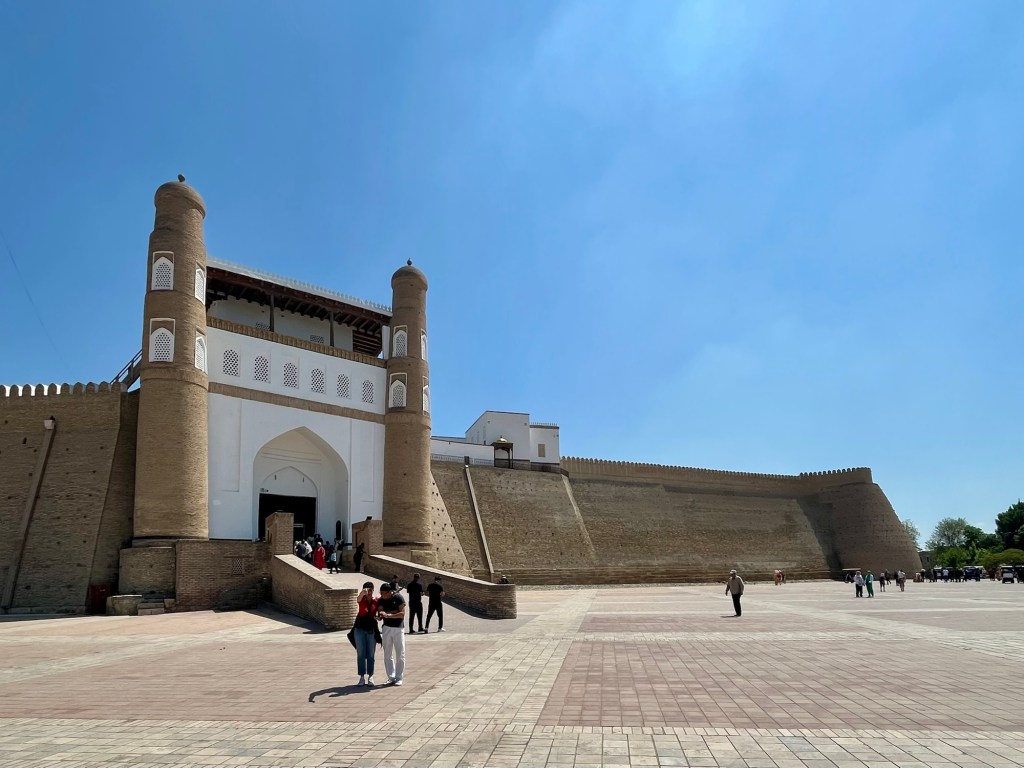
This is the view to the right of the main gate.
Continuing around to the right from the picture above we were able to see what the fortress looked like before it was restored.
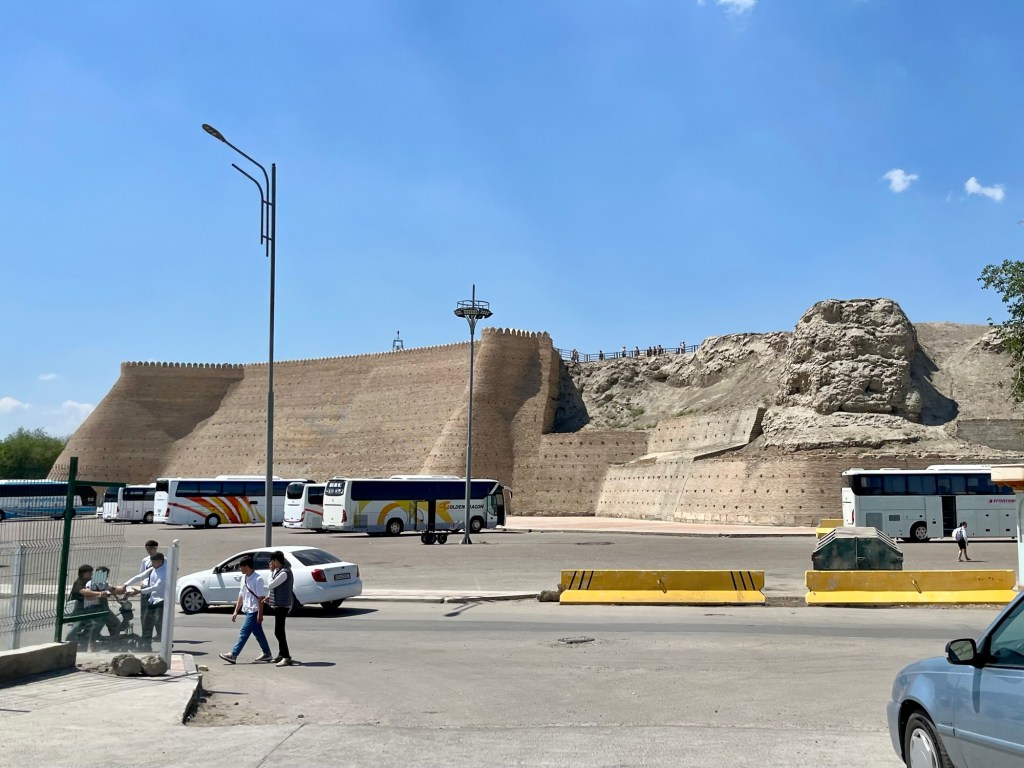
We entered and hiked up to the top, strolled around inside, and then walked across to the lookout point in the photo above (right where the restored and original walls meet), from which I took the photo, below, of our next destination, the religious complex known as the Poi Kalyan.
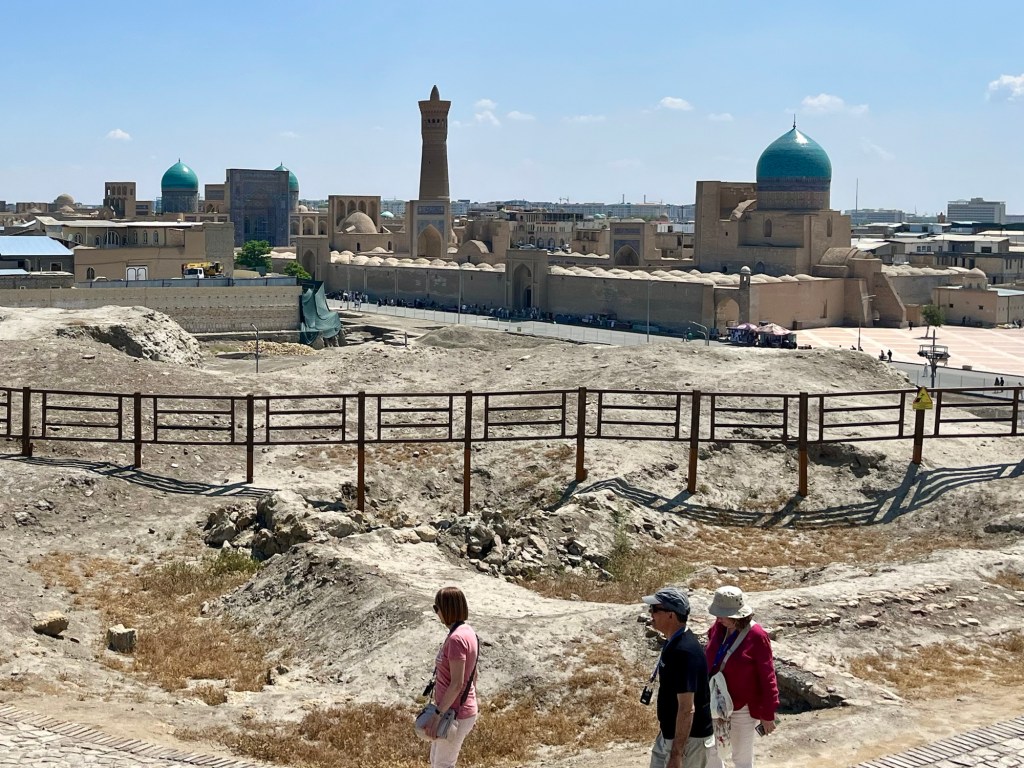
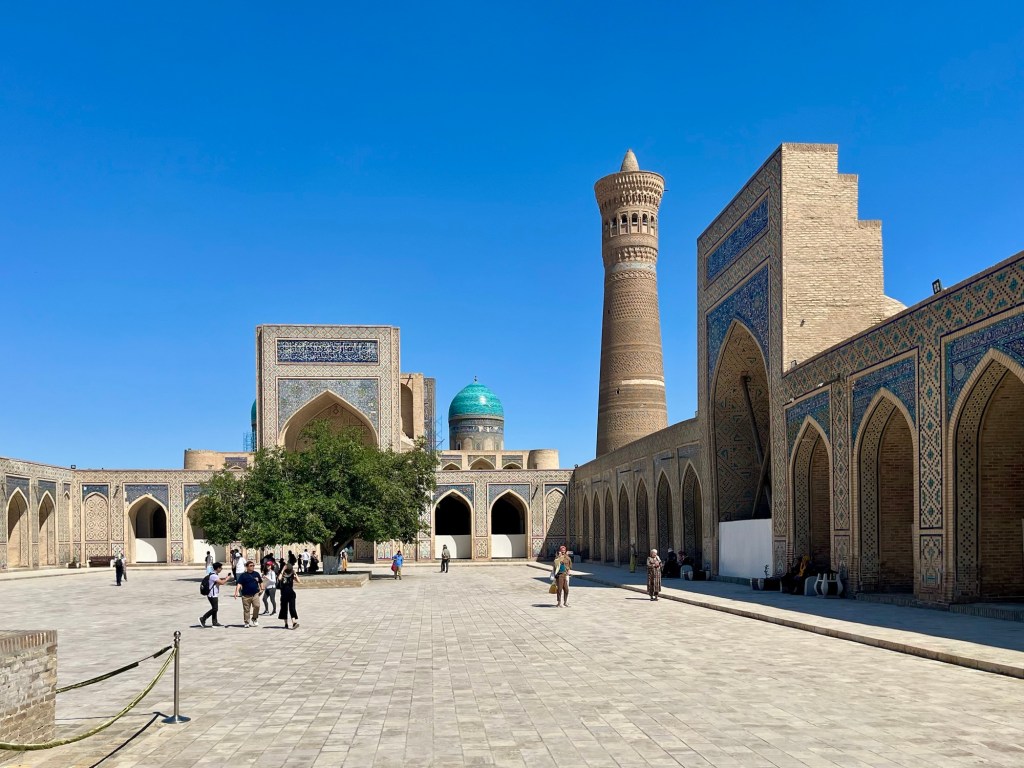
The central feature of the Poi Kalyan is the Kalyan Minaret, believed to have been built in 1127 AD atop the ruins of a previous tower. The Kalyan Minaret is 150 feet tall. Minarets were used as watchtowers, lighthouses, and platforms from which to issue the call to prayer.
A local legend is that, upon his capture of Bukhara, Genghis Khan looked up to admire the height of the minaret and his hat fell off. Bending down to pick it up, he chuckled and remarked that the tower had made him bow, so he would spare it from destruction.
This minaret has also been known as the Tower of Death, owing to the fact that as it was used to free condemned convicts from their earthly existence by letting them fly, momentarily, from its top. The last execution here was purportedly in 1920.
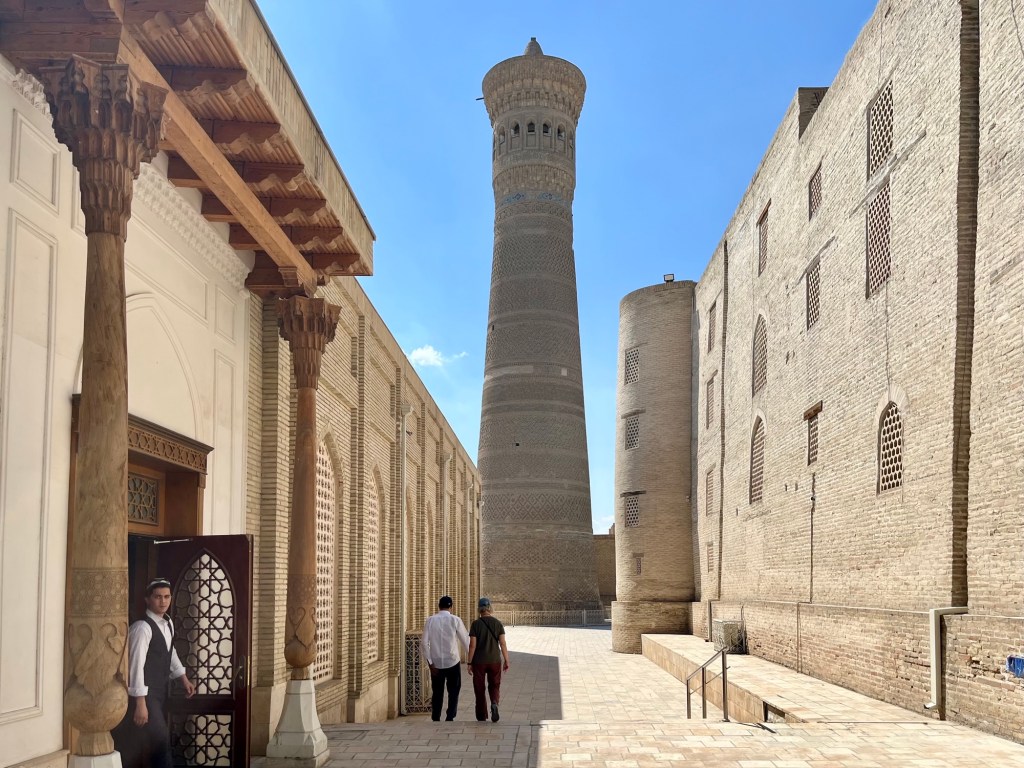
The other components of the Poi Kalyan are the mosque and madrassa surrounding the inner courtyard, built during the Khanate of Bukhara in the 1500s.
Here’s the entrance to the complex:
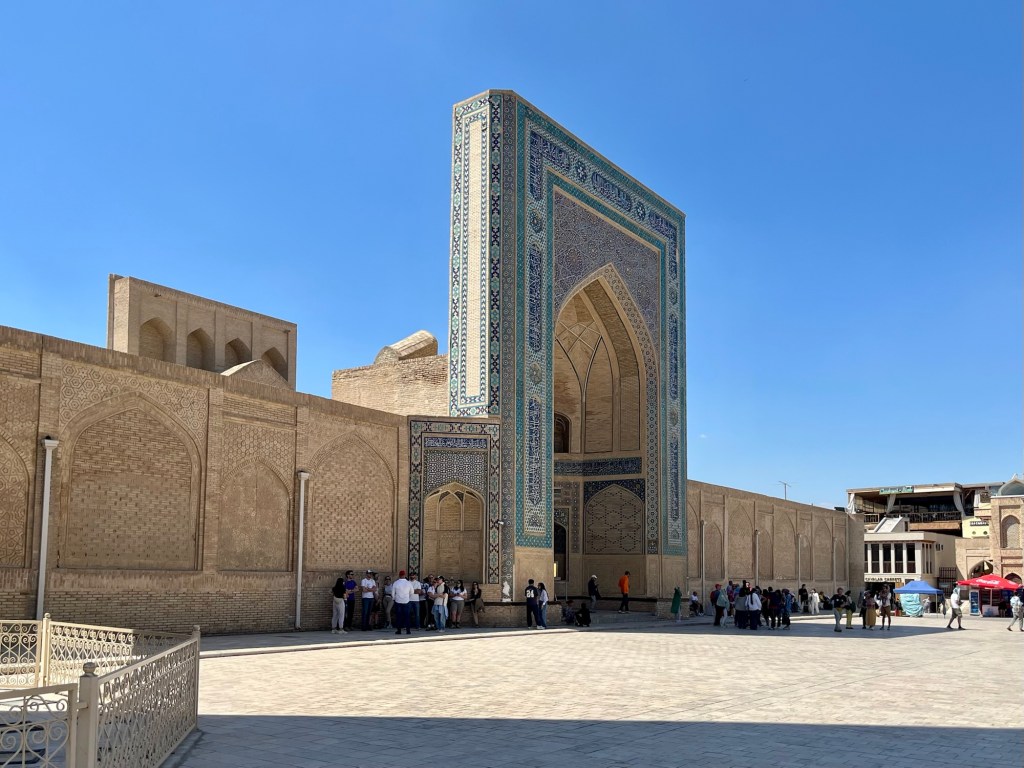
This is the Poi Kalyan Mosque, built in 1515, from the interior courtyard…
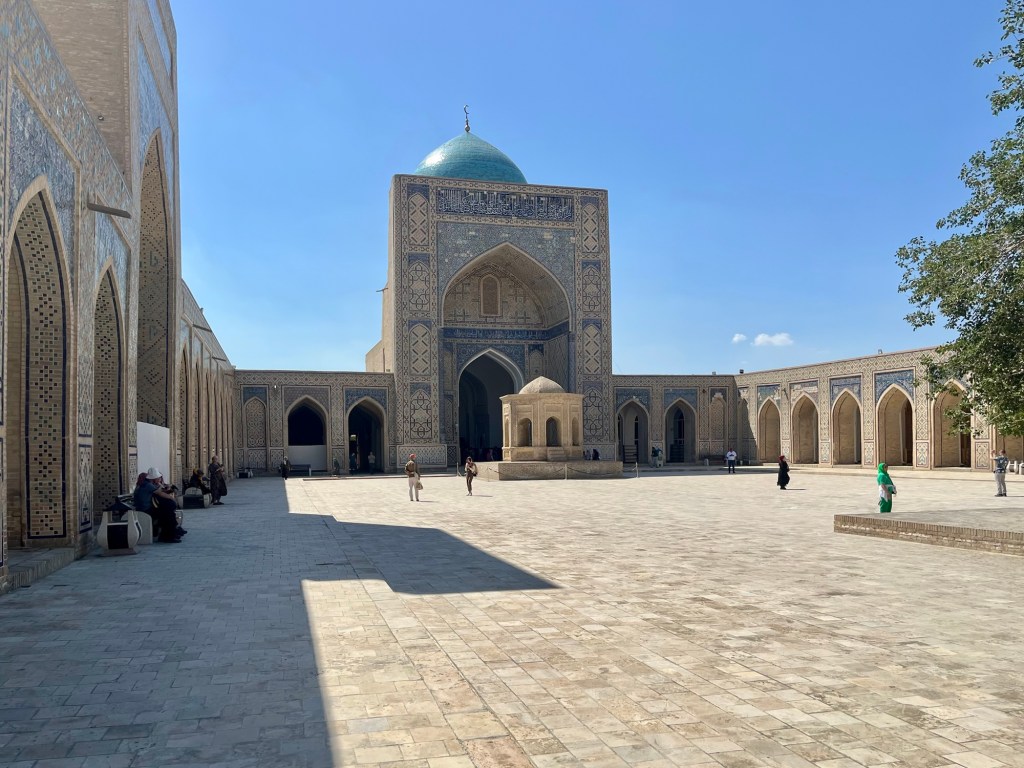
… and this is the Poi Kalyan Madrassa, constructed in 1535, standing next to the minaret. It is still in use as a religious school.
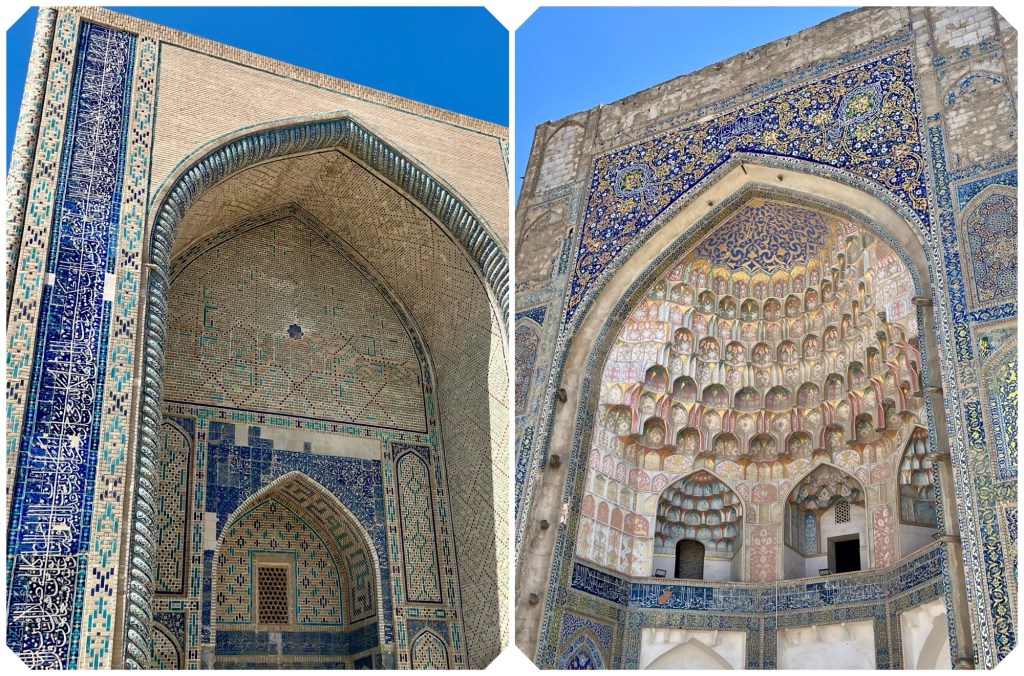
Further on, we admired two madrassas standing opposite one another, the Ulugh Beg Madrassa (left, built 1417 by its namesake) and the Abdulaziz Khan Madrassa (right, built 1652), exhibiting the differences in aesthetics between two dynasties:
Bukhara continued as a khanate until 1868 when it was made a protectorate of the Russian Empire, a story I will tell in a few days when we visit Khiva, another former khanate. Bukhara ultimately became the capital of the Uzbek Soviet Socialist Republic as part of the U.S.S.R. in the 1920s.
As we wandered back to our lodgings, we passed a construction site that uncovered earlier building techniques which you can see in the photo below. But I took this picture mainly to show how utilities are run throughout this part of the world. Those yellow pipes are gas lines. Since they have been added long after the buildings were inhabited, it was more efficient to run the lines above ground than to bury them.

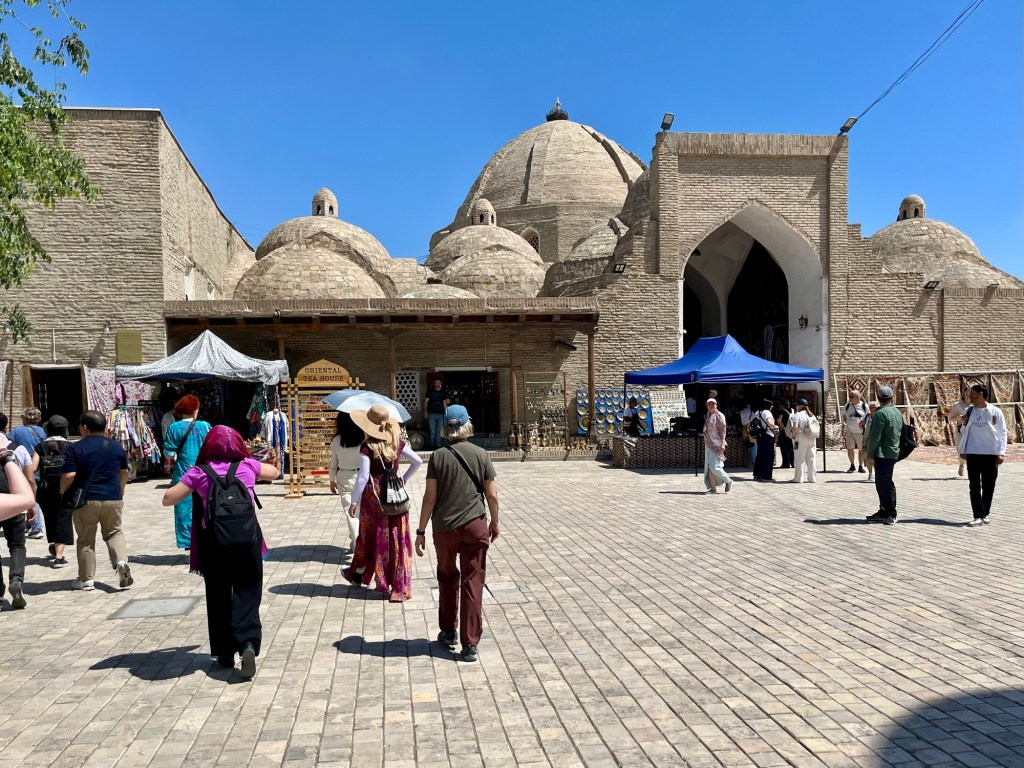
Our last stop for the day was one of the local bazaars.
Tomorrow, we’re off to Turkmenistan.
 The Road Less Traveled