On Thursday morning, we drove to Old Nisa, an ancient Parthian fortress city ten miles to the northwest of our hotel, at the foothills of the Köpet Dag Mountains that separate Turkmenistan from Iran. The complex of Old Nisa, together with nearby New Nisa, was declared a UNESCO World Heritage Site in 2007.
The inhabitants of Old Nisa, the Parthians, were a Persian, that is, Iranian, people. Their Parthian Empire lasted about 500 years, from 247 BC to 224 AD. They were rivals of the Romans, blocking the eastern expansion of the Roman Empire.
We climbed up and over the outer defensive wall.

Old Nisa was founded at the beginning of the Parthian Empire in 247 BC, but was destroyed by an earthquake and abandoned just two centuries later, right before the birth of Christ. It is believed that the survivors moved to nearby New Nisa.
Here’s a view of Old Nisa from atop the outer defensive wall:
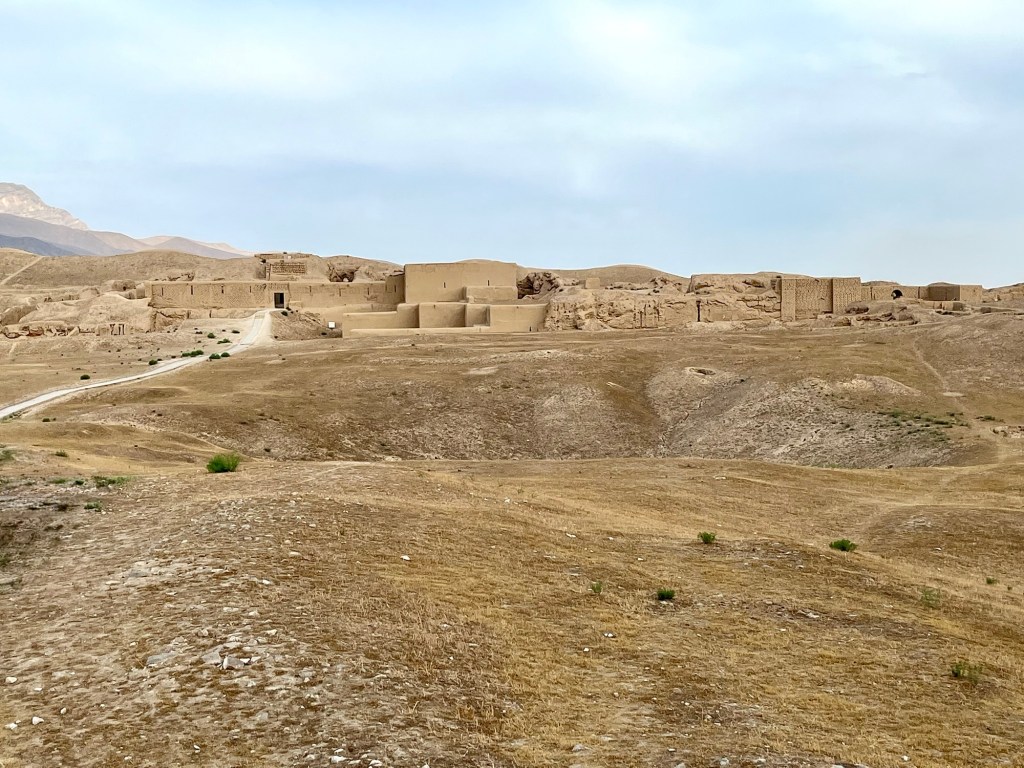
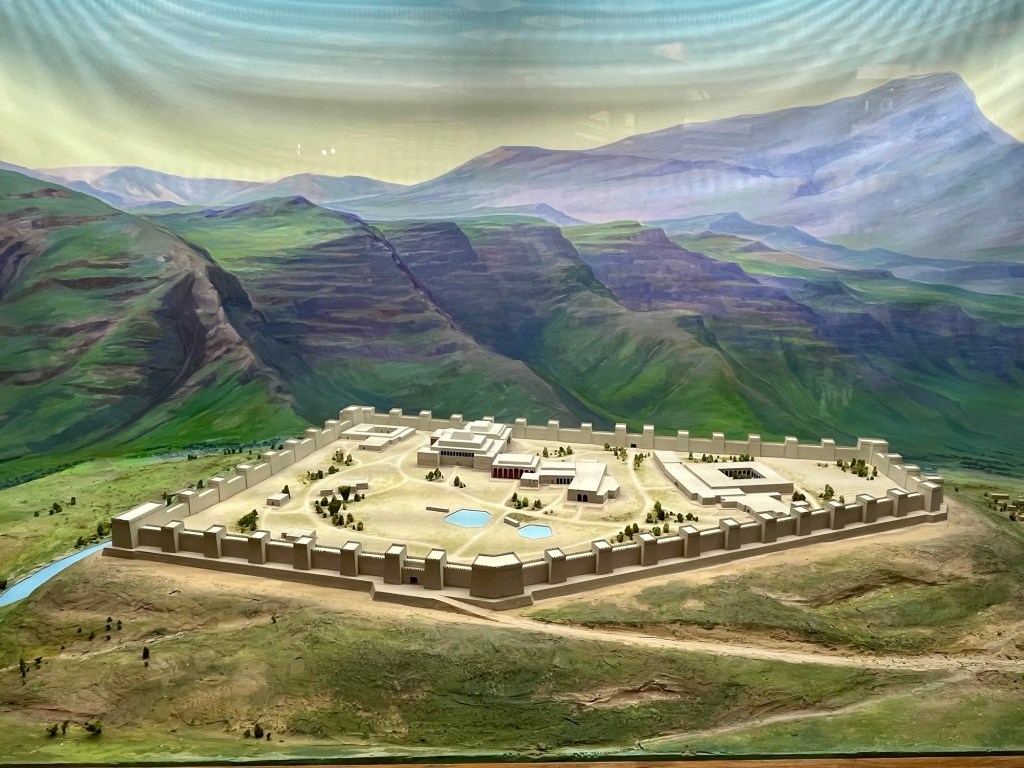
Old Nisa was known by the Parthians as Mithradātkert, the Fortress of King Mithridates I, who ruled from 171-138 BC. It was a major trading hub on the Silk Road and the capital of the Parthian Empire.
This is an artist’s rendering of the city in its heyday:
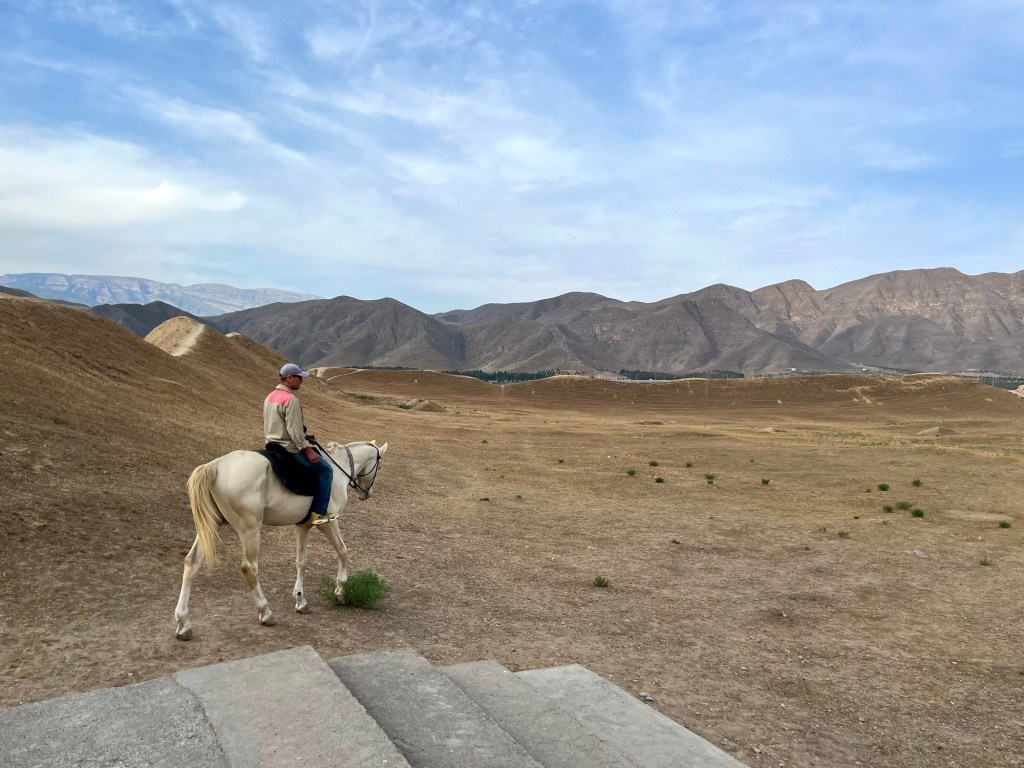
Citing an ancient Greek manuscript, Wikipedia notes that “the region was famous for the beauty, agility and strength of its horses.” They’re still here and still prized by the inhabitants.
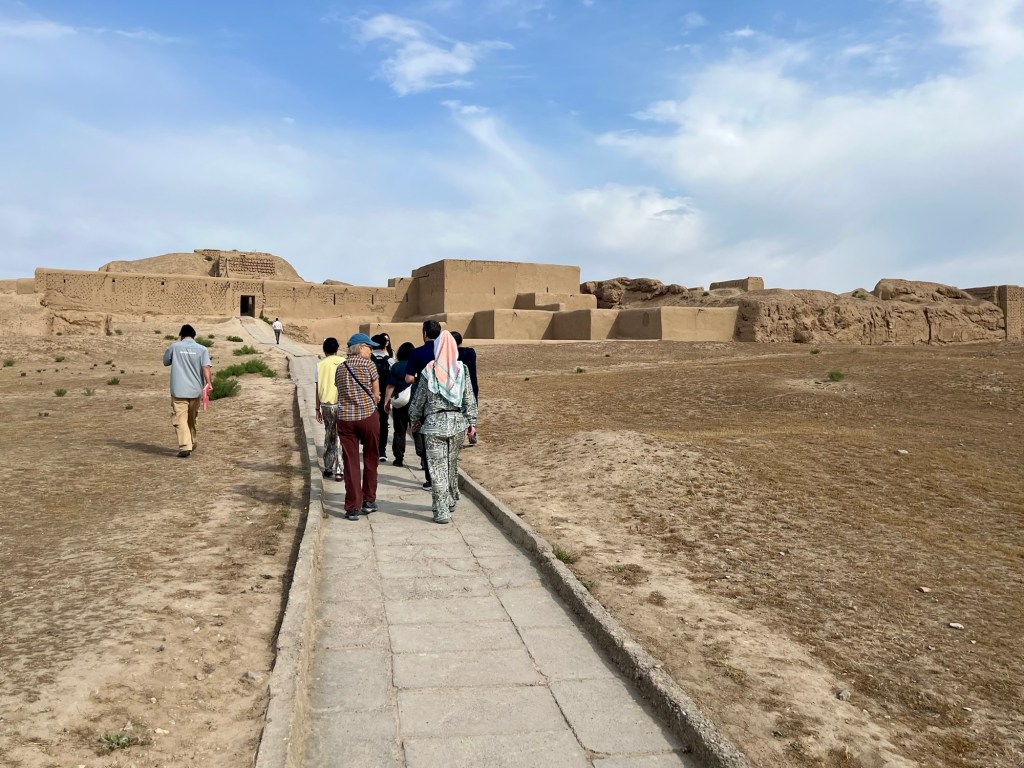
We walked from the outer wall into the palace complex.
Atop the palace, we could see the Walk of Health to the south, winding up into the foothills (photo below). The Köpet Dag Mountains behind them are in Iran, just 20 miles distant.
Former Turkmenistan president Niyazov required his ministers to hike this 5-mile long footpath once a year. Due to his own weak heart, he was afraid to make the trek, so he would fly by helicopter to the end and meet them there.
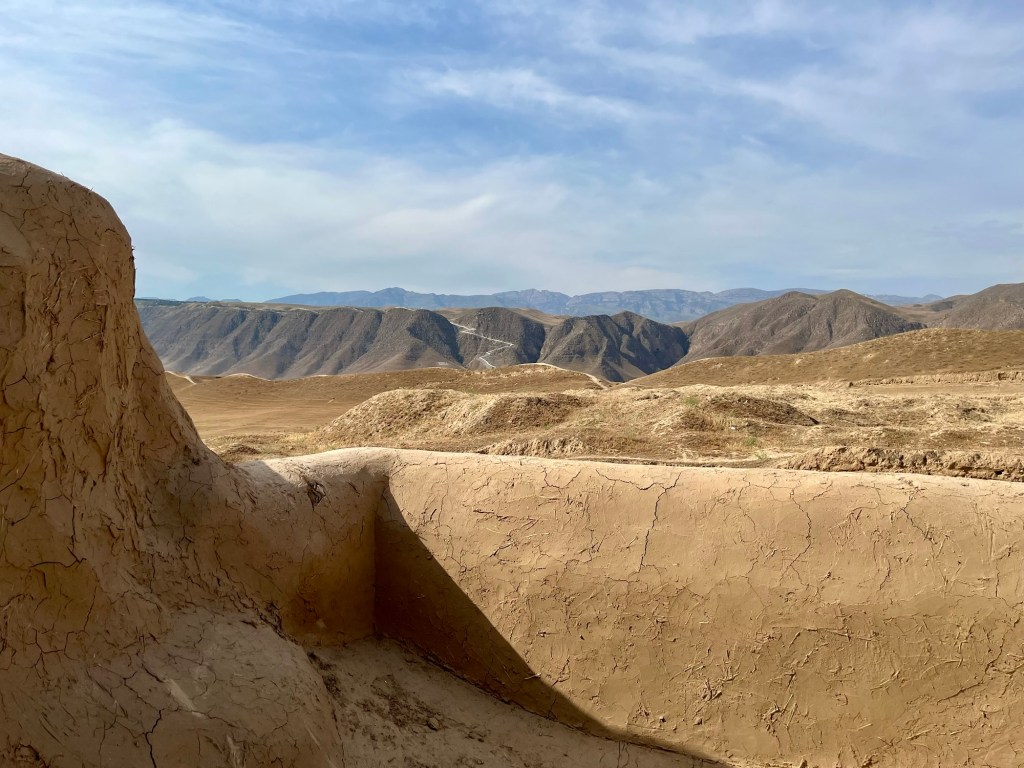
We wandered around the palace complex for about half an hour…
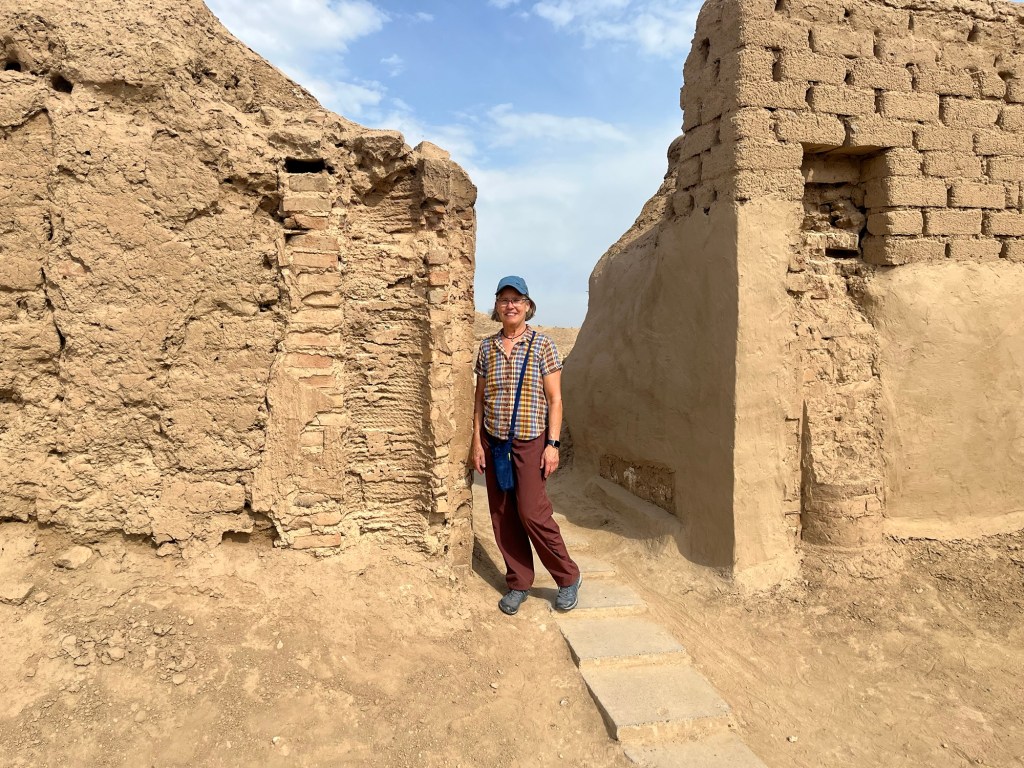
… then drove back into Ashgabat to visit the Museum of History which is where the artifacts found at Old Nisa are on exhibit.
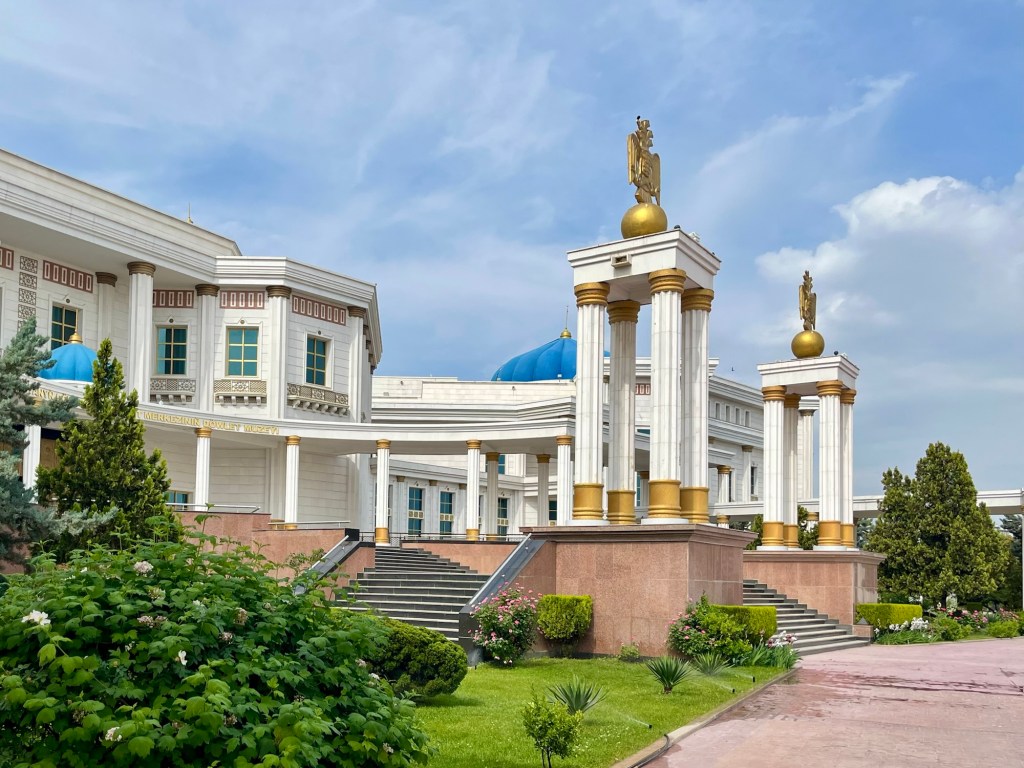
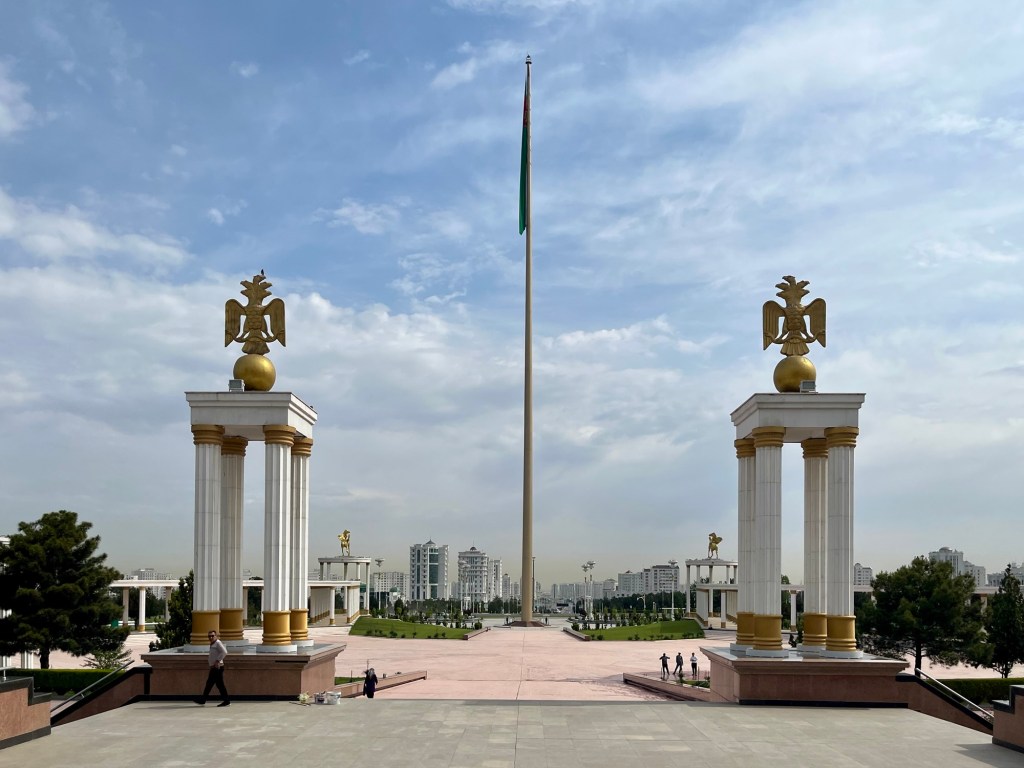
From the entry into the History Museum, above, there’s a great view up Garashsyzlyk Avenue highlighting what was at one time the world’s tallest flagpole (436 feet), now ranked number 9.
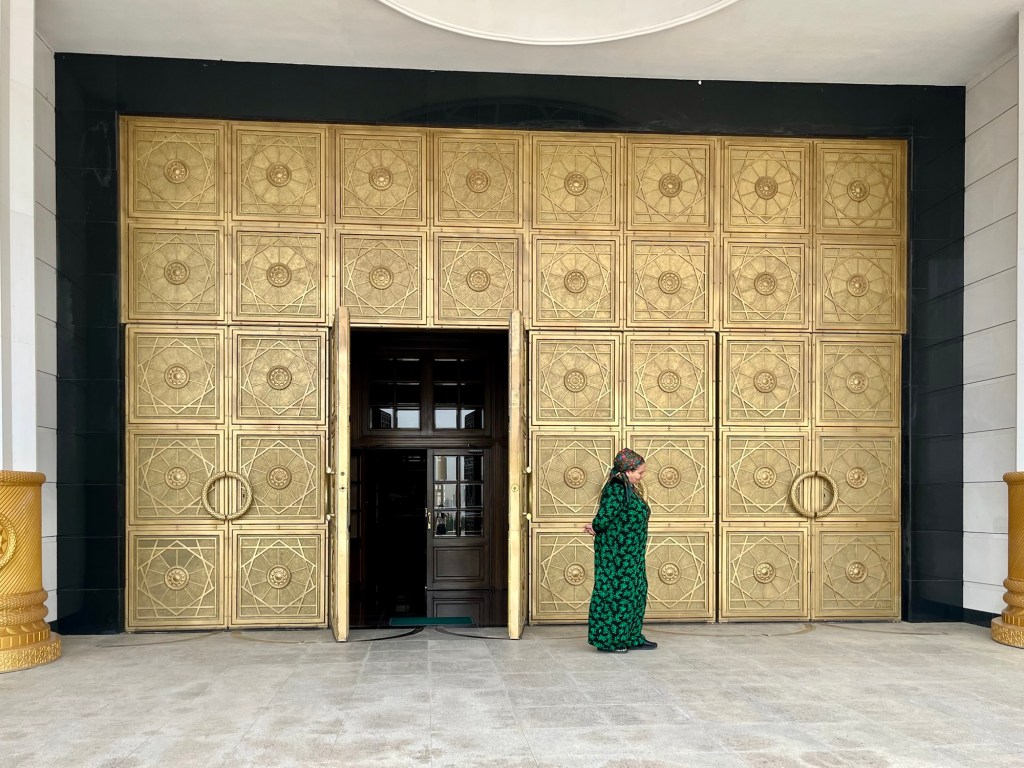
Here’s the entrance to the History Museum. As soon as this museum worker saw me taking a picture, she hustled back inside and closed the door.
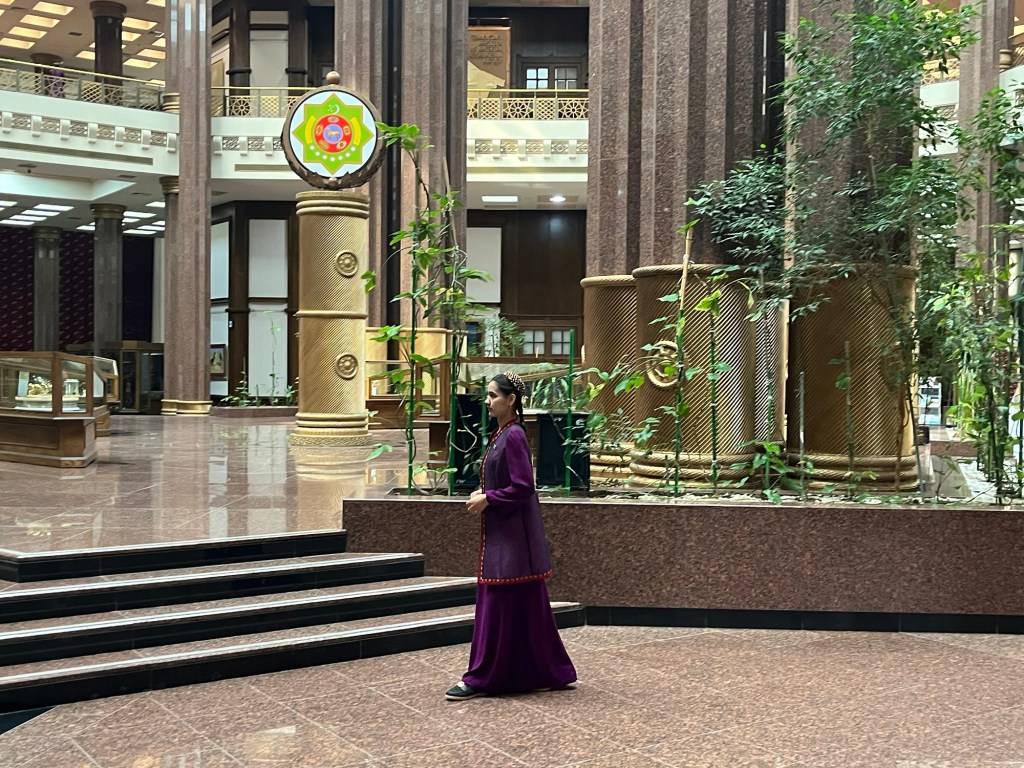
Here’s the main lobby inside the History Museum. Again, as soon as the museum employee saw me taking a picture, she scurried away. But as we went upstairs to the Old Nisa exhibit, she followed, and continued following us throughout the exhibit, directing us to go only counter-clockwise. Strange behavior. Like we were being ushered, or surveilled.
Besides our tour group and the handful of secretive museum workers, the place was empty.
These are all marble building adornments from Old Nisa:

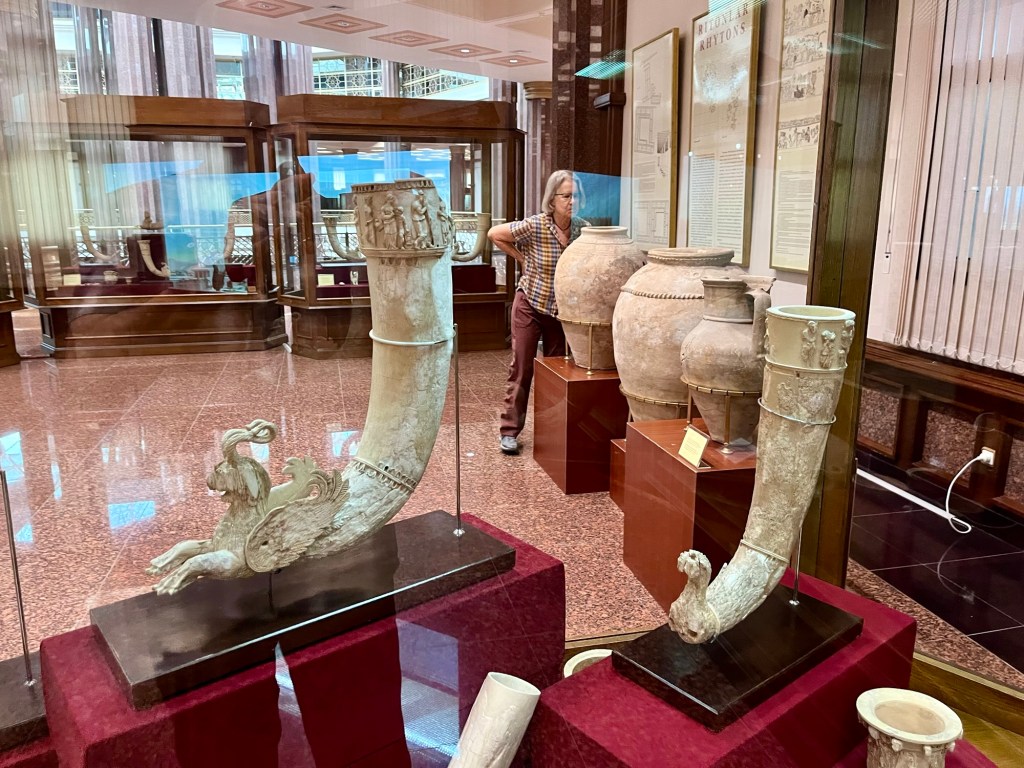
Our favorite artifacts were the ivory ryhtons, essentially intricately carved wine pitchers. Dale, of course, also liked the clay pots.
All of the artifacts below, like those above, were excavated from the ruins at Old Nisa and are dated to somewhere between 200-100 BC.
From the left, clockwise: Dale (not an artifact) standing next to a marble statue of Rodoguna, daughter of Parthian King Mithridates I; the sculpted marble head of a Parthian warrior; and a silver figurine of the goddess Athena. A lot of Hellenistic Greek influence in these things.

After the History Museum, we drove out to a horse farm for lunch and a look at the famous, Akhal-Teke horses.
Wikipedia has this to say:
The Akhal-Teke is a Turkmen horse breed. They have a reputation for speed and endurance, intelligence, thin manes and a distinctive metallic sheen. The shiny coat of the breed led to their nickname, “Golden Horses”. These horses are adapted to severe climatic conditions and are thought to be one of the oldest existing horse breeds.
They were beautiful.

Now, it’s off to the desert.
 The Road Less Traveled