We spent Saturday walking around Khiva’s ancient fortress city known as Itchan Kala, the capital of the Khanate of Khiva, an independent city-state from 1511 until 1747, when it was briefly under the control of Iran.
In the 1800s, the Russian Empire launched several invasions into the khanate and Khiva ultimately became a protectorate of Russia from 1873 until 1920 when it was incorporated into the U.S.S.R., ultimately as the Uzbek Soviet Socialist Republic.
Here’s the outer defensive city wall of Itchan Kala. It was massive and looked impregnable.

For centuries, Khiva was a trading hub on a northern branch of the Silk Road.
Inside the defensive city walls of Itchan Kala is a citadel known as the Konya Ark Palace, the top of which can be seen in the distance in this photo:

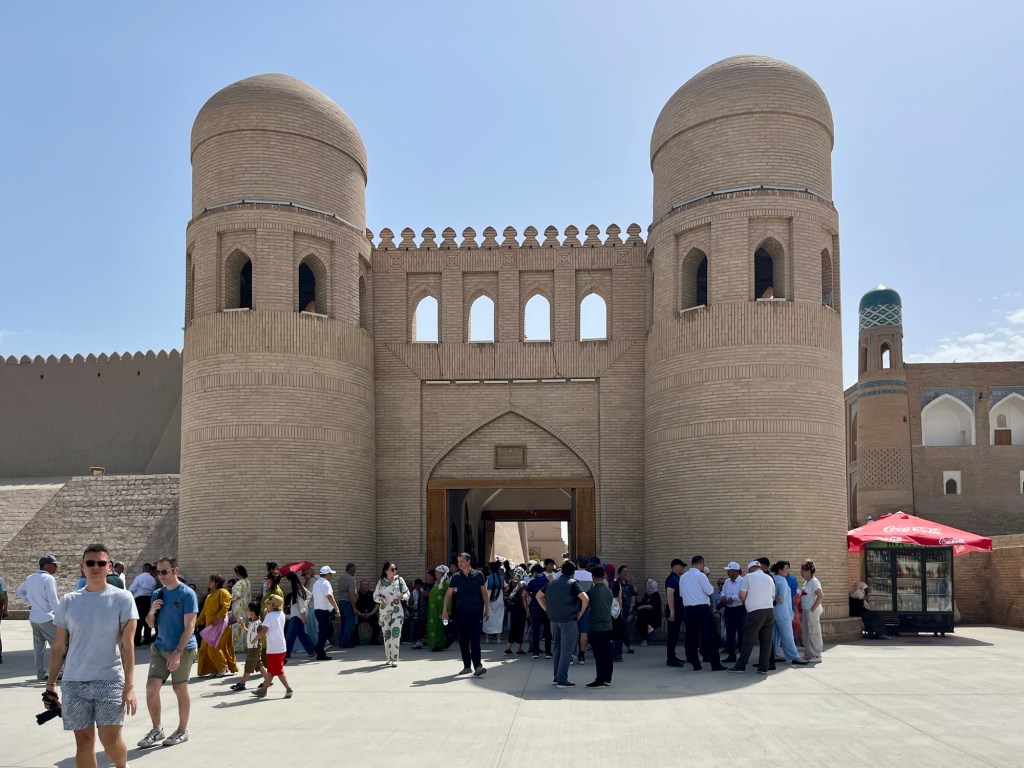
These towers flank the Ota Darvaza, the western gate through the Itchan Khala:
As soon as we passed through the western gate, we found ourselves facing the partially truncated minaret known as the Kalta Minor, originally intended to be the tallest minaret in the Muslim world at around 250 feet.
Construction began in 1852, but stopped abruptly in 1855 when its sponsor, the then khan of Khiva, died in a battle with the Russians. Thus, the minaret was limited to its height at the time, 95 feet.

The 30-foot high walls of Itchan Kala enclose 64 acres within a perimeter of 1.3 miles. Around 300 families still live within the city walls. The entire enclosed city is a UNESCO World Heritage Site, nominated in 1990.
Here’s Ahror pointing out the west gate where we entered and were standing at the time.

While we decided which way to go, I decided to try on some of the local headgear. Beats Rogaine. We decided to head over to the Konya Ark Palace Complex next.

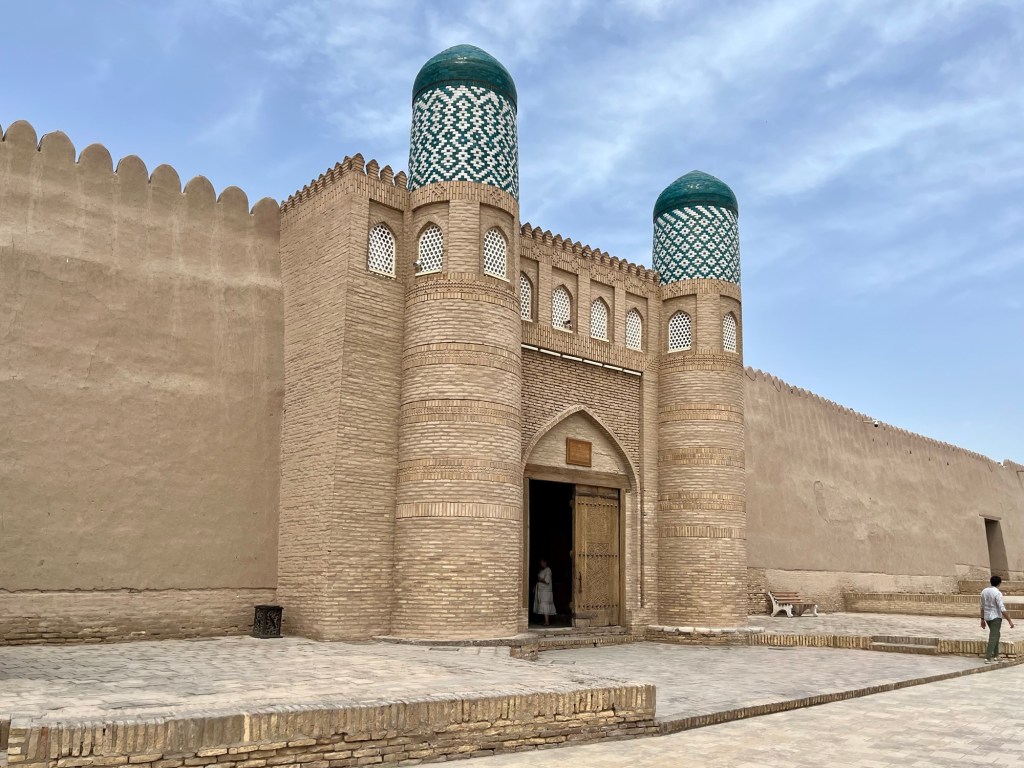
Construction of the Konya Ark Palace began in 1687. By the end of the 1700s this city-inside-a-city included the khan’s residence, mosque, court, powder magazine, arsenal, mint, registry, harem, kitchens, guardhouse, stables and a reception area for greeting visiting dignitaries, called the Kurnysh Khan.
This is the entrance to the Konya Ark Palace:
After wandering around inside, we ended up at the Kurnysh Khan, the original of which was destroyed in the mid-1700s when Iranian troops invaded Khiva. It was rebuilt in 1804-06.

Today, the Kurnysh Khan is an active and colorful bazaar.
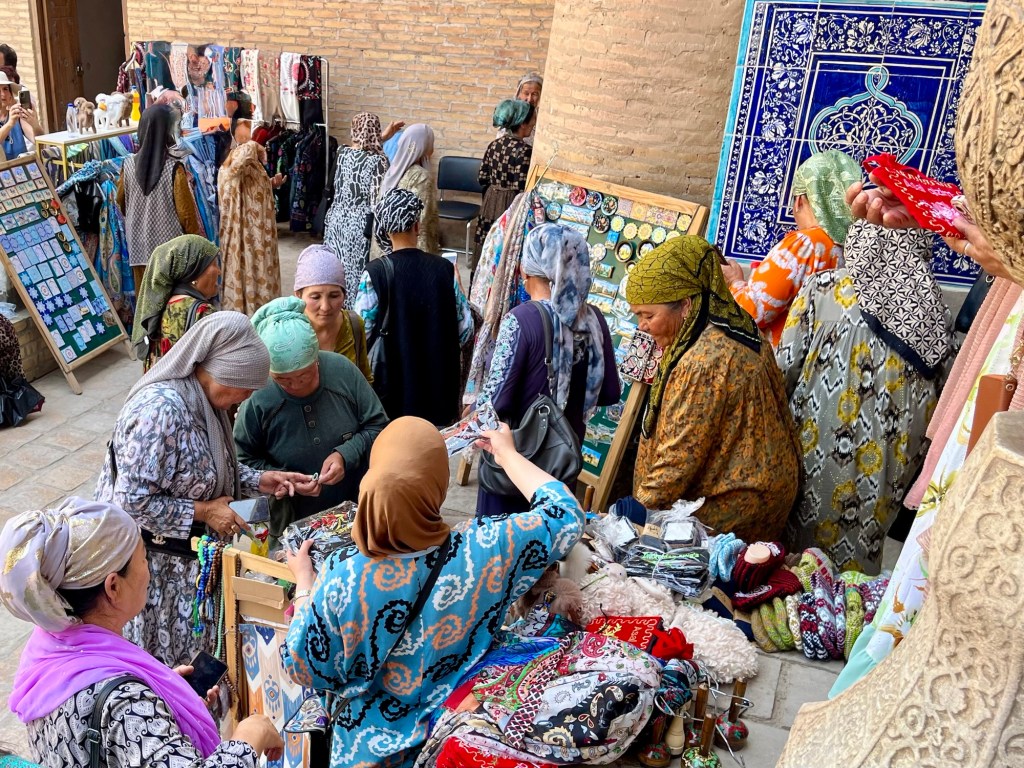
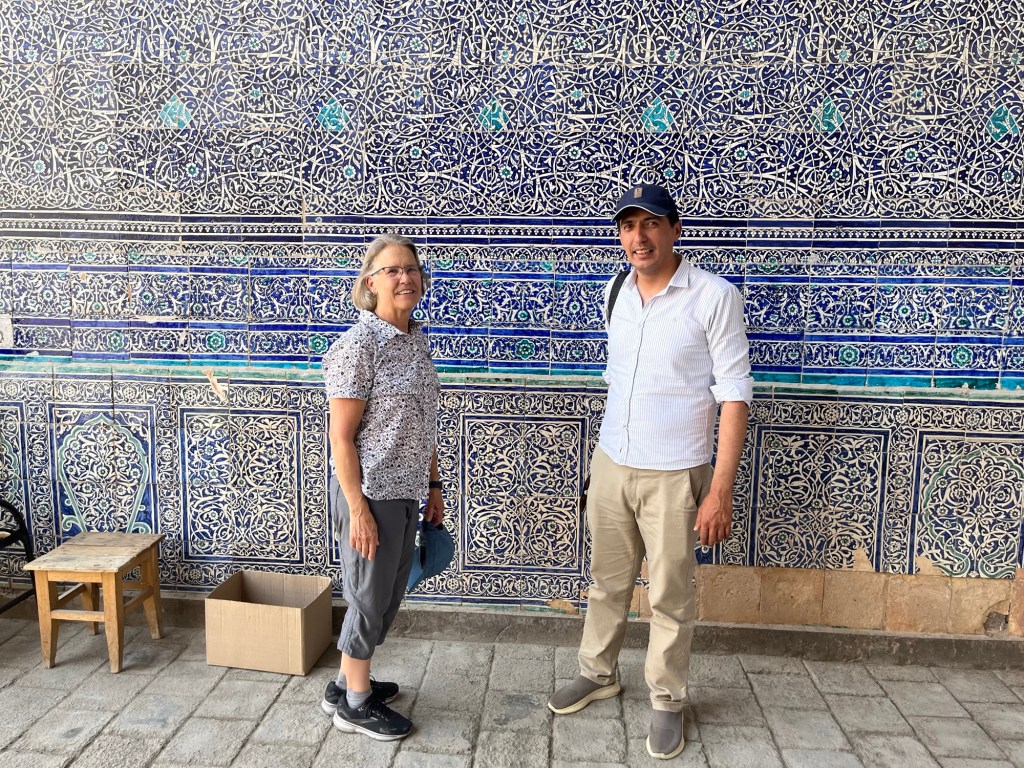
The tile work is fantastic.
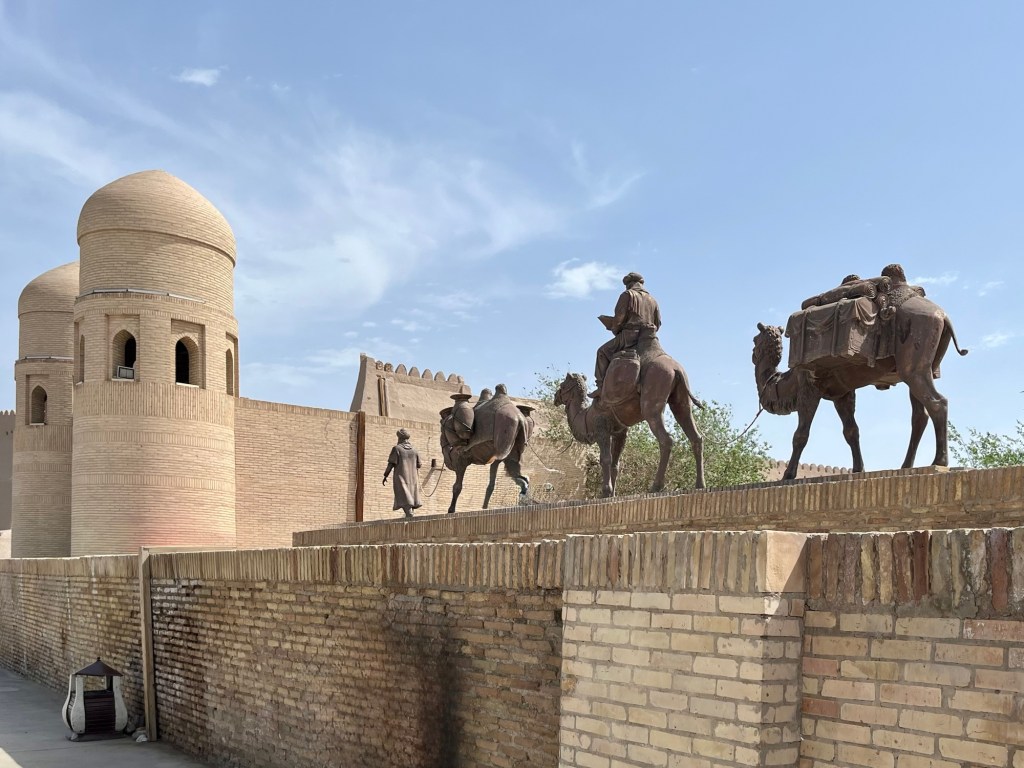
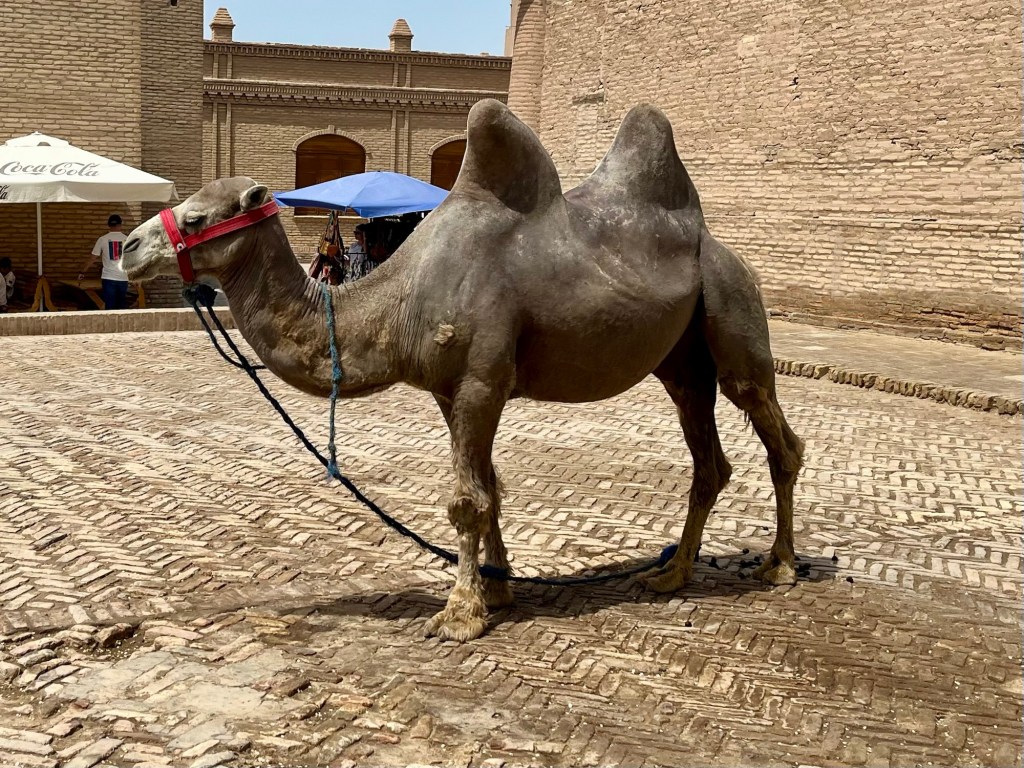
Outside of the Konya Ark, I finally found a Bactrian camel! They’ve apparently been hiding them here in Khiva!
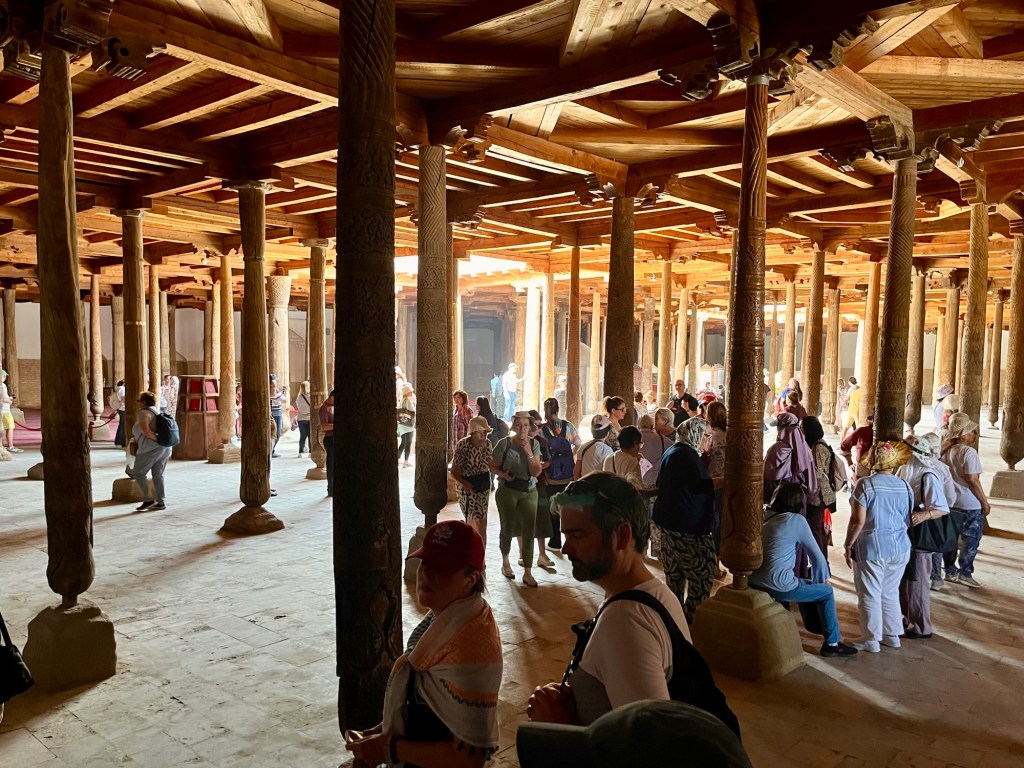
We found our way over to Juma Mosque whose origin dates back to the 900s AD. The mosque was rebuilt in 1788. It’s a single-story brick building with a flat roof supported by 212 unique wooden columns in 17 rows, each column a work of art.
As we made our way from the Juma Mosque to the Pahlavon Mahmud Mausoleum, we passed the Islam Khodja minaret. Just shy of 150 feet, this is the tallest minaret in Khiva. It’s a relatively new addition, built in 1908-1910.

Our next stop was the Pahlavon Mahmud Mausoleum Complex, completed in 1701, built to honor and house the mortal remains of Pahlavon Mahmud (1247-1326), a famous local poet and wrestler. Sounds like inspiration for our own poetic world champion, “float like a butterfly, sting like a bee,” Muhammed Ali.
Again, the tile work was amazing.

Dale realized she was dressed in camouflage.
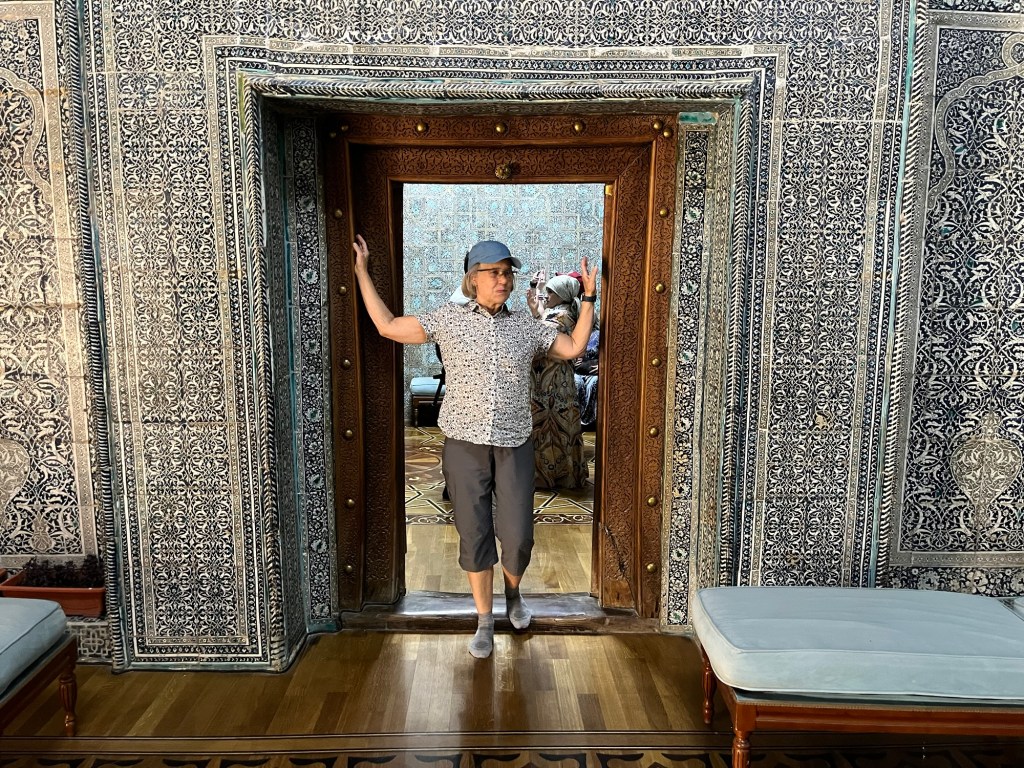
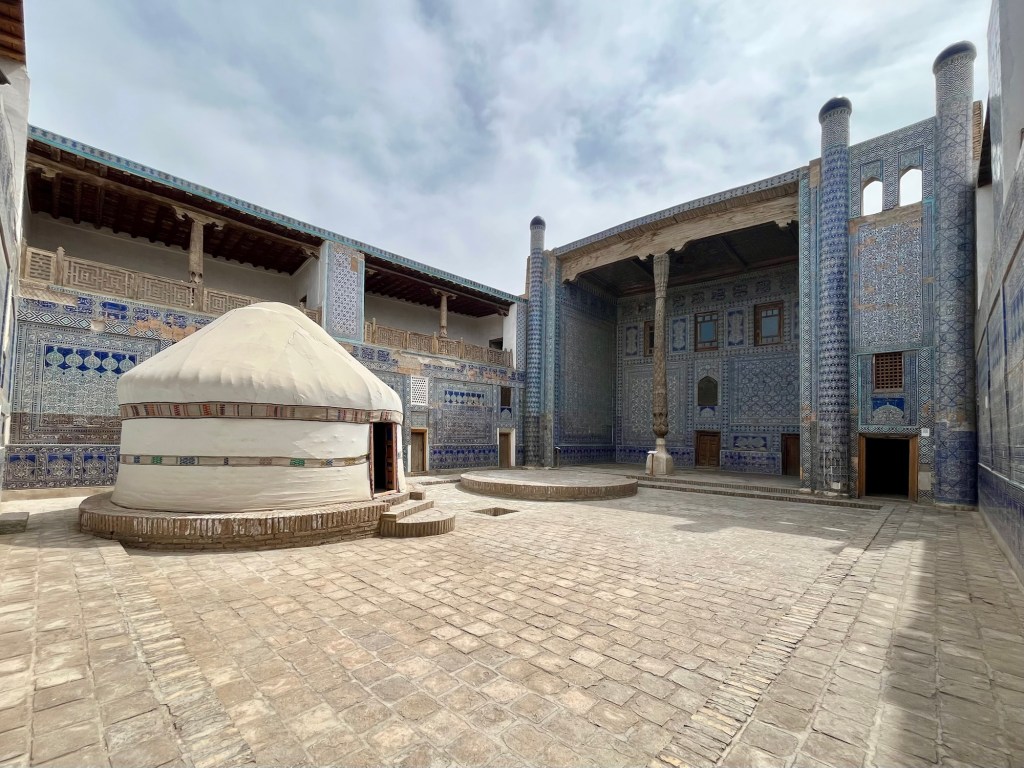
Our final destination was the Tash Khovli Palace, built between 1830-1841 for one of the Khiva khans. The palace has 260 rooms, including a harem.
Sometimes, visiting dignitaries preferred being housed in the traditional yurt, so accommodations were made for them.
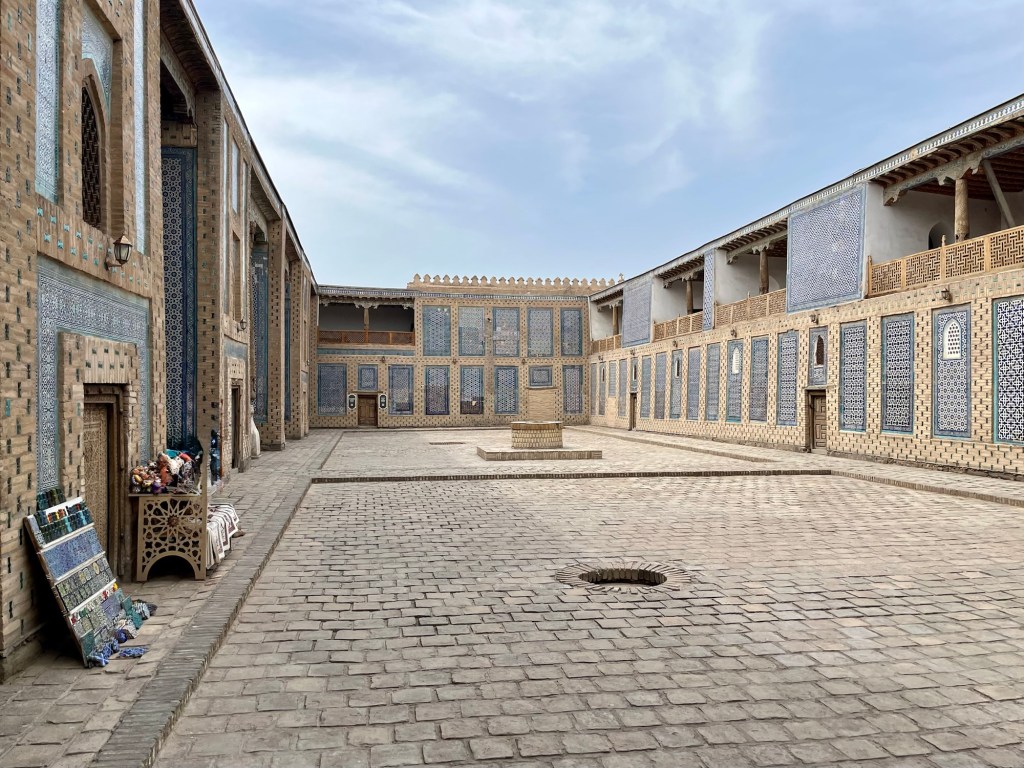
This is another interior section of the Tash Khovli Palace. The khan’s harem faced this courtyard:
After a very full day exploring the mosques, madrassas, minarets and monuments of Khiva and a brief respite back at our hotel, we met up for a farewell dinner before being shuttled to Urgench airport, some 30 miles away, for a late-night flight back to Tashkent. Once there, we’ll all be going our separate ways.
Dale and I will be continuing our travels to the Caucuses for another two weeks, to be joined there by new traveling companions.
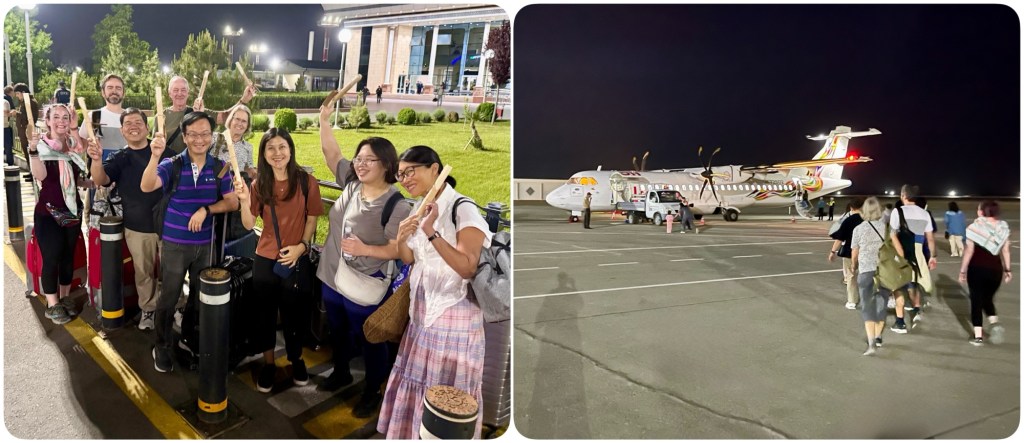
So, for now, it’s goodbye to Central Asia.
 The Road Less Traveled