After a free day in Tbilisi, we said goodbye to our Georgian traveling companions. We will be on our own for the remainder of the trip. The Californians continue elsewhere in Georgia; the others are all homeward bound.
On Thursday morning, May 8, Dale and I left Tbilisi and Georgia to met our new guide, Rima (“Reema”), and driver, Edo, on the Armenian side of the border crossing called Bagratashen-Sadakhlo.
Dale and I have traveled to more than 60 countries so far in this life, so we’re no strangers to transiting borders, but mostly that has occurred at airports, the exception being Europe’s Schengen Area where land borders are mostly non-existent. Getting through immigration and customs has almost always gone without a hitch.
In the Caucasus and Central Asia, on the other hand, each of the land border crossings has been unique and occasionally disconcerting. So we appreciated our Georgian driver taking the time to go with us through No-Mans-Land to the Armenian side to hand us off there to Rima and Edo.
When we had crossed into Georgia from Azerbaijan a few days earlier, we learned that Azeris have been prohibited from leaving their country by land ever since COVID in 2020, which is why we encountered no lines at the border crossing when we left there. The continued closure of land borders to the citizens of Azerbaijan today, however, has nothing to do with coronavirus and everything to do with government control.
In recent years, Azerbaijan has been at war with neighboring Armenia over the sovereignty of Nagorno-Karabakh, a former Autonomous Oblast of the Soviet Union. I’ve outlined Nagorno-Karabakh in red on the map, below. I’ll discuss the conflict in a future post.
[Similar disputed regions in Georgia, the former South Ossetia A.O. and Abkhazia A.S.S.R., which I discussed in my last post, are also shown.]

Upon crossing into Armenia, we learned that Armenia too has closed borders. Armenians cannot travel to Azerbaijan or Turkey. Borders with those countries have been closed since the early 1990s when the conflict over Nagorno-Karabakh first arose, coincident with the breakup of the Soviet Union.
The peculiar and indirect routing of railways and oil and gas pipelines apparent on the map, above, is a direct result of these international disputes.
On our way to Yerevan, the capital of Armenia, we stopped first at the Haghpat Monastery, constructed sometime around 1000 AD on a hillside in the Lesser Caucasus Mountains.
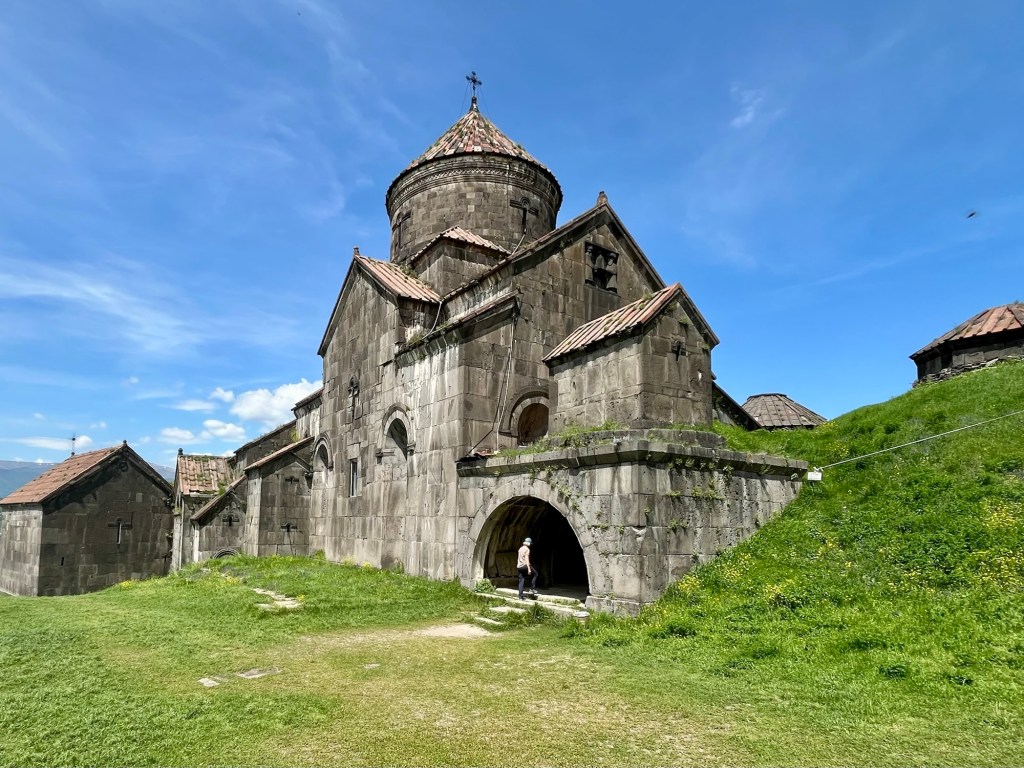
Rima led us through the archway shown in the photo above and into the adjacent part of the monastery complex, past several cross stones, known as Khachkars, leaning against the walls. Khachkars are essentially artistic tombstones, typically depicting an Armenian cross above a rosette or inscription. The tradition continues in Armenia to the present.

Together with the nearby Sanahin Monastery (which we did not visit), the Haghpat Monastery was designated a UNESCO World Heritage site in 1996 because:
The two monasteries represent the highest flowering of Armenian religious architecture between the 10th and 13th centuries. This unique style developed from a blending of elements of Byzantine ecclesiastical architecture and the traditional vernacular architecture of the Caucasus.
Which explains why this monastery looks a lot like what we saw in Georgia.
The main building in the Haghpat Monastery complex is the Cathedral of St. Nshan, shown in the photo below.
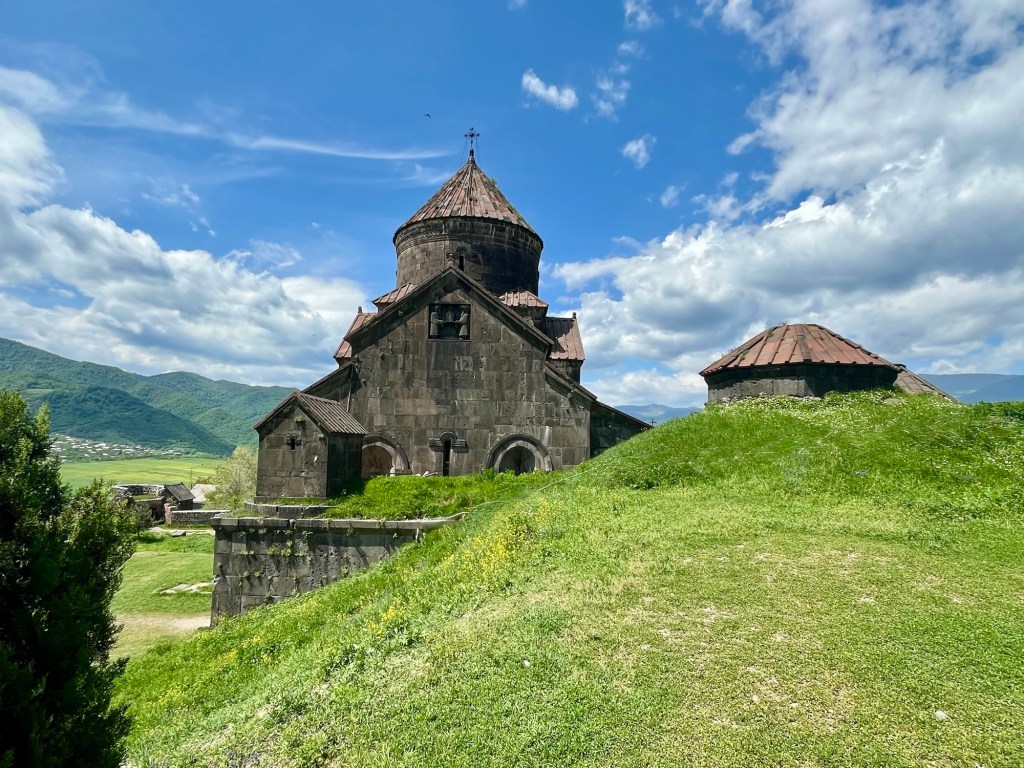
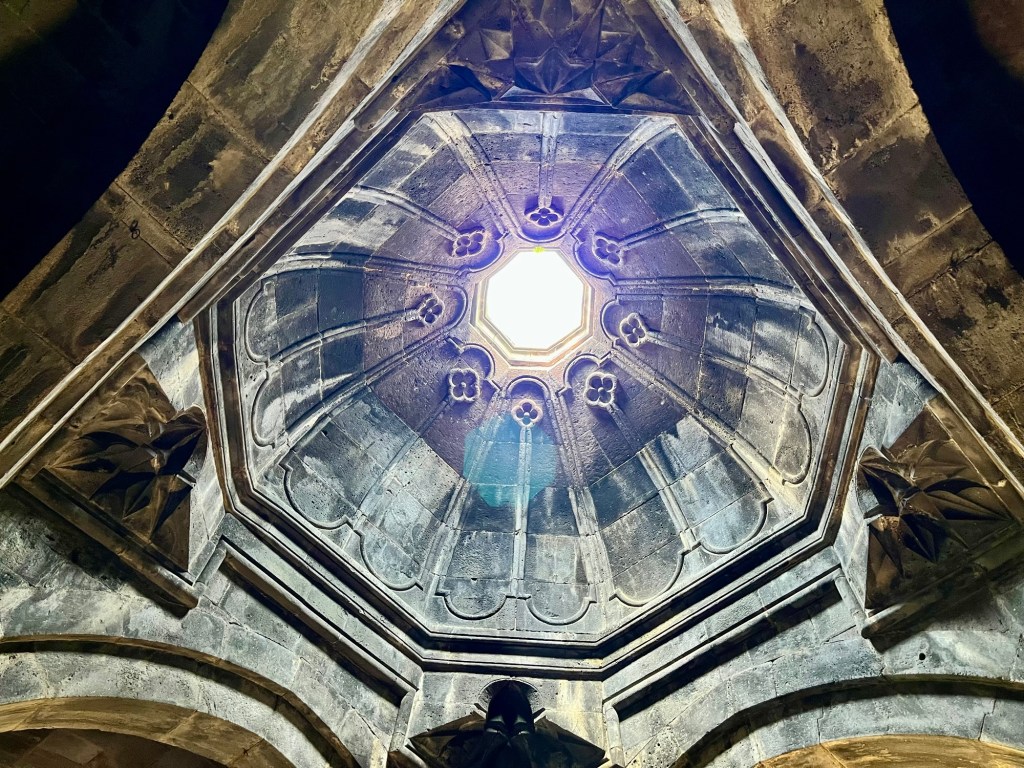
The dome is supported by four huge columns.

And the interior is lit in part by an opening in the dome.
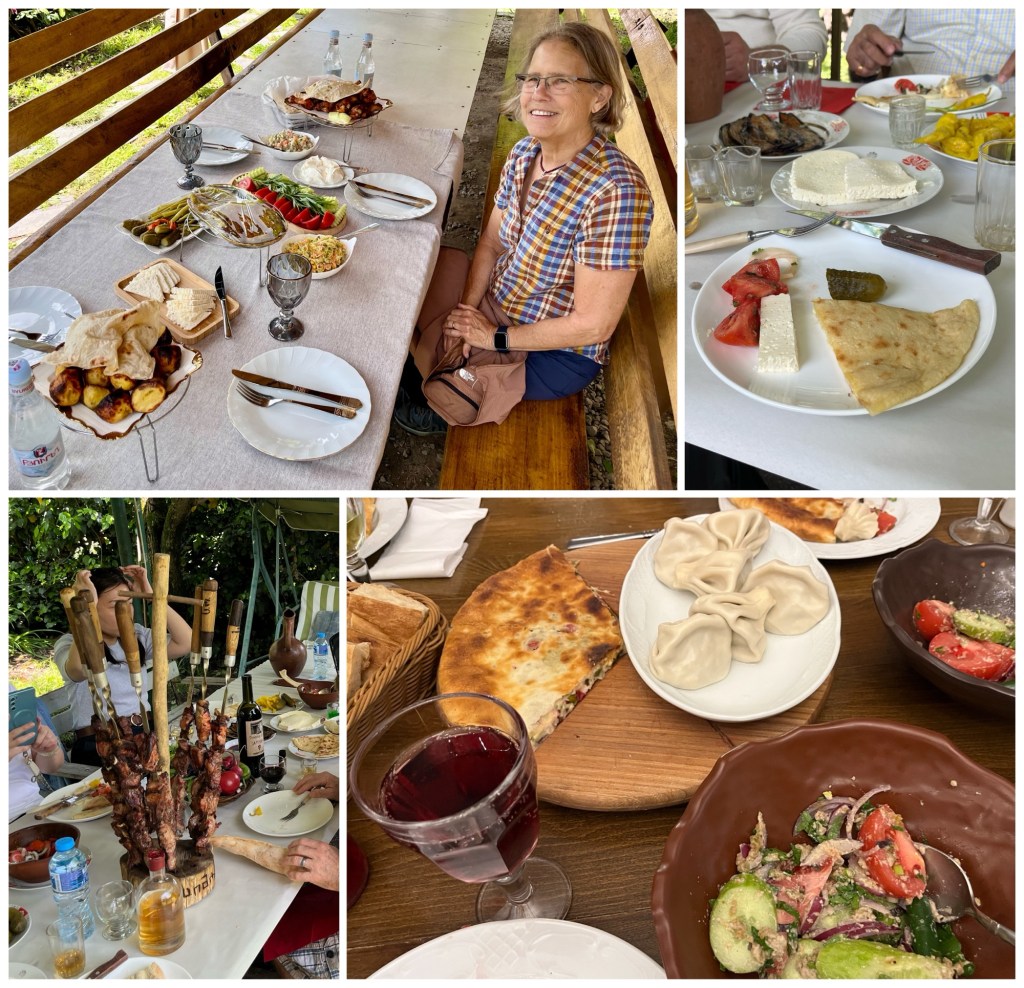
After spending some time wandering around the monastery, we had lunch at a local family’s house just down the hill (photo below, top left). Similar to most of our meals in both the Caucasus and Central Asia, the meal consisted of grilled meat (chicken this time), cucumbers, tomatoes, local cheese (with a consistency and taste of feta) and a flat bread.
My favorite dish on the trip has been Georgian khachapuri, similar to a quesadilla (top right) or a calzone (bottom right), depending on the locale and the chef. Another Georgian favorite is khinkali, a type of dumpling (bottom right). And in every country, we’ve had kebab, grilled skewered meat (bottom left), either beef, lamb or chicken.
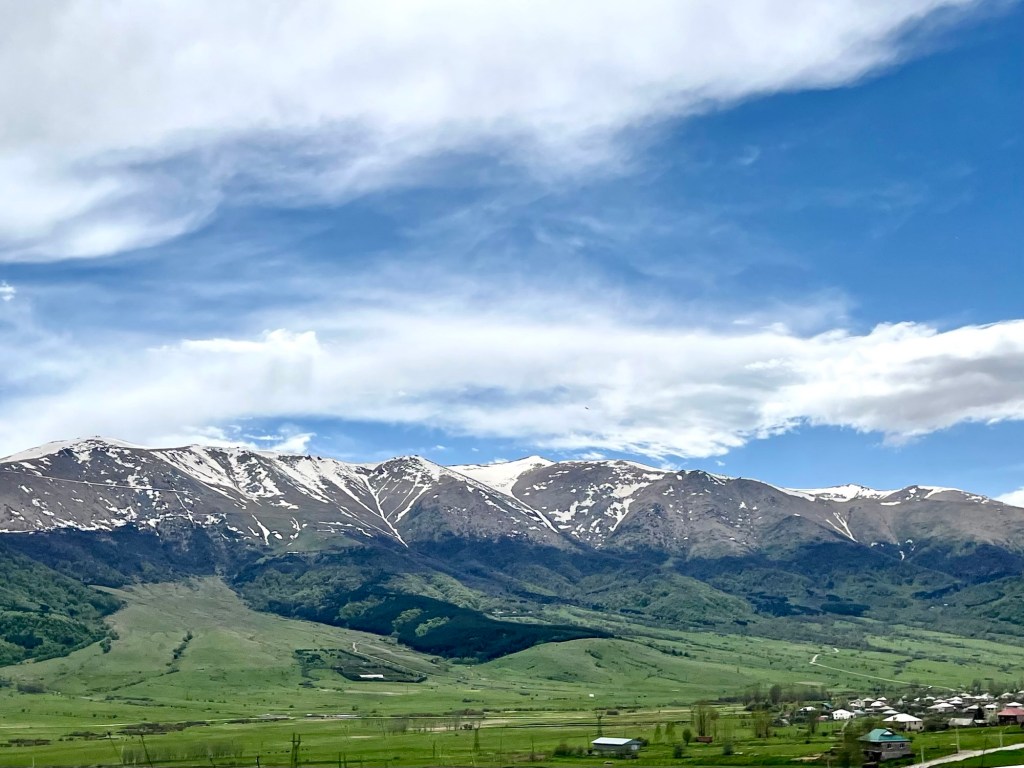
After lunch, we continued our drive through the Lesser Caucasus Mountains to Lake Sevan, east of Yerevan, the largest lake in the Caucasus, visible on the map, above.
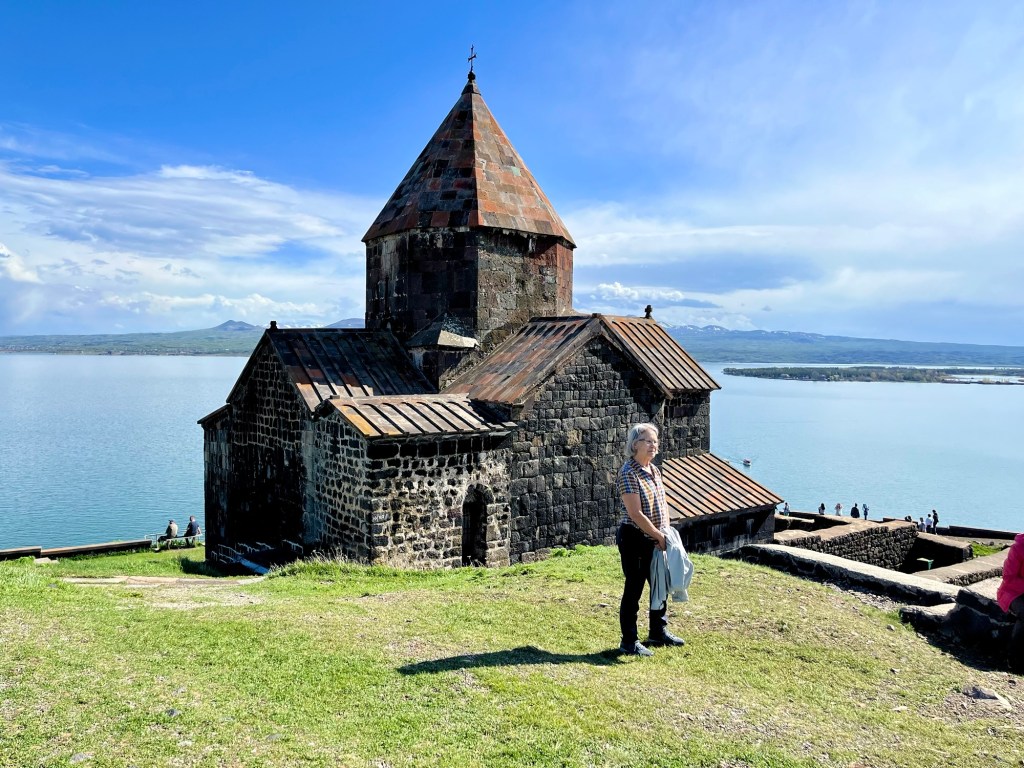
The purpose for our drive to Lake Sevan was to visit Sevanavank, another monastic complex consisting of two main churches: Surp Arakelots (Holy Apostles Church), below, on the left; and Surp Astvatsatsin (Holy Mother of God Church) on the right.

The two churches were built on an island in Lake Sevan around 875 AD, the perfect isolated, meditative location for a monastery.
Many centuries later, when the U.S.S.R. undertook an industrialization program in the 1930s, Soviet engineers looked to Lake Sevan as a source for irrigation for the surrounding agricultural fields and for production of hydro-electric power. Around 1950, water from the lake was diverted for these purposes, lowering the lake about 3 feet per year and turning the island into a peninsula. With the monastery now easily accessible from shore, the churches were reconstructed.
Over the following 20 years, the lake level dropped over 60 feet. Realizing too late the environmental damage being caused, the program was modified in the 1970s to stop the drainage of the lake, leaving it at a level 66 feet below what it was when the monastery was constructed. It has since risen about 8 feet.
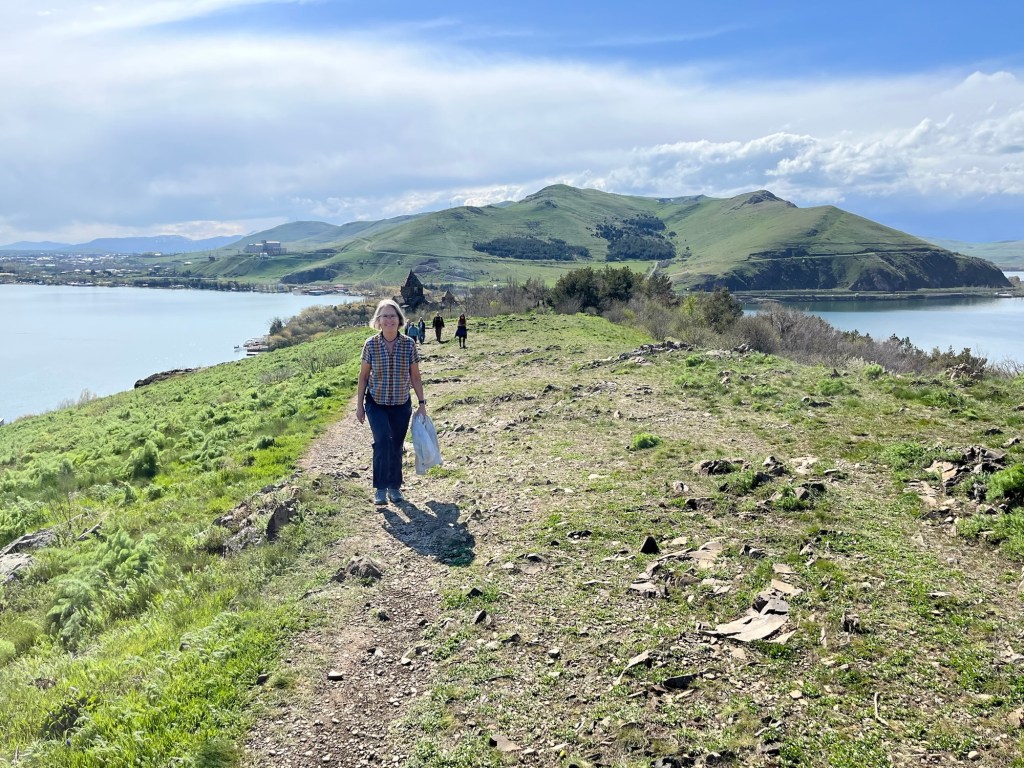
We decided to walk the length of the peninsula to the point. What you see in the photo below was all underwater 70 years ago.
Here’s a better view of the Holy Mother of God Church as we passed it on our way back from the point.
We went inside. It appears that church services are still conducted here.

From Lake Sevan, we continued our drive to Yerevan, checking into the Hilton Double Tree near the city center, our home for the next four nights.
 The Road Less Traveled
ok, several thoughts. One, I’m shocked you are staying at a doubletree in Armenia but you learn something every day.
second, 60 countries!! Truly an accomplishment but I know both of your mentality. It’s just in stride. Jane and I love to travel but I’m pretty certain we are not “keeping up with the Ulmers”
lastly, reading your border crossing comment, if you’ve never crossed the Texas border into Mexico, that likely will merit mention in the Ulmer travel blog. Frankly a bit scary!!
love the education and appreciate it!!
best, Allen
🤣 I will only fly into Mexico. Been to the Brownsville crossing. 😮
wise man …as I already knew!!
bTW, it has to be 3 or 4 in the morning for you there. You are superhuman!!