We began this day with a short drive to the town of Etchmiadzin (also known as Vagharshapat), a little over 10 miles west of Yerevan, to visit another UNESCO World Heritage Site, the Mother See of Holy Etchmiadzin.
Etchmiadzin is the administrative seat of the Armenian Apostolic Church and the residence of its Catholicos, that is, its Patriarch. Echmiadzin and its Catholicos are to the Armenian Orthodox Church what the Vatican and the Pope are to Roman Catholicism.
The Etchmiadzin complex is built around its cathedral and has been known for much of its history as the Monastery of Etchmiadzin. In centuries past, it had the appearance of a fortress, surrounded by 30-foot high walls, anchored by eight towers. This is the eastern gate through which we entered:

According to tradition, the Apostles Bartholomew and Thaddeus brought Christianity to the region just decades after the crucifixion of Christ. This was the genesis of the Armenian Church. In 300 AD, Armenia became the first kingdom in history to adopt Christianity as its official religion.
The Armenian Apostolic Church is an Oriental Orthodox faith. Until the Council of Chalcedon in 451 AD, the Oriental Orthodox Church was united with the Eastern Orthodox Church, but the two split at that time over a disagreement about the nature of the divinity of Christ.
Other than Armenia, the Oriental Orthodox Churches are mostly found in North Africa (Egypt, Eritrea, Ethiopia, Sudan) or in the Middle East (Iraq, the Levant).
Eastern Orthodox Churches, on the other hand, are mostly found today in Slavic (Russia, Ukraine, Belarus, Moldova), Serbian (Serbia, Bosnia, Kosovo, Bulgaria, Albania) and Baltic (Estonia, Latvia) countries. But Georgia, Greece and Romania are all Eastern Orthodox, too.
All the Orthodox Churches separated from the Roman Catholic Church in 1054 AD in what historians call The Great Schism when the Orthodox Patriarchs refused to recognize the Catholic Pope as their superior.
The Echmiadzin Cathedral is the mother church of the Armenian Apostolic Church. It was the first cathedral built in ancient Armenia and is thought to be the oldest cathedral in the world. The original church is believed to have been built in 301-303 AD on top of a pagan temple, thus physically and symbolically supplanting the old religion. The original church was partially destroyed by the Persians, but was rebuilt in 483 AD. Here it is:
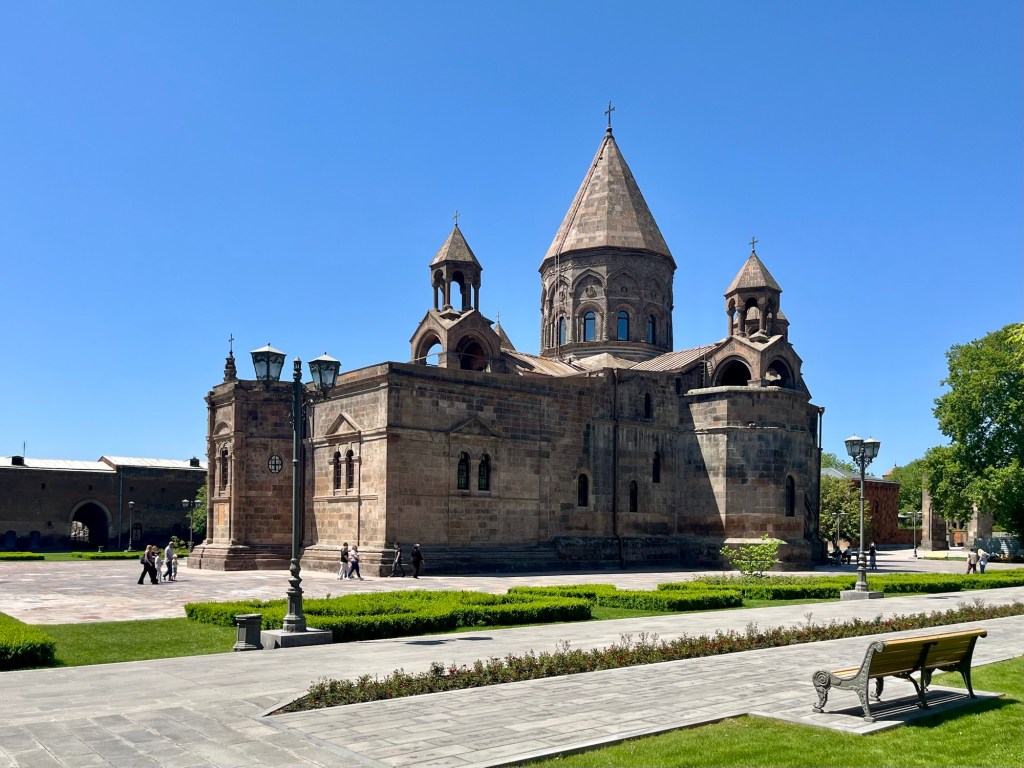
And here’s a view from the other side:
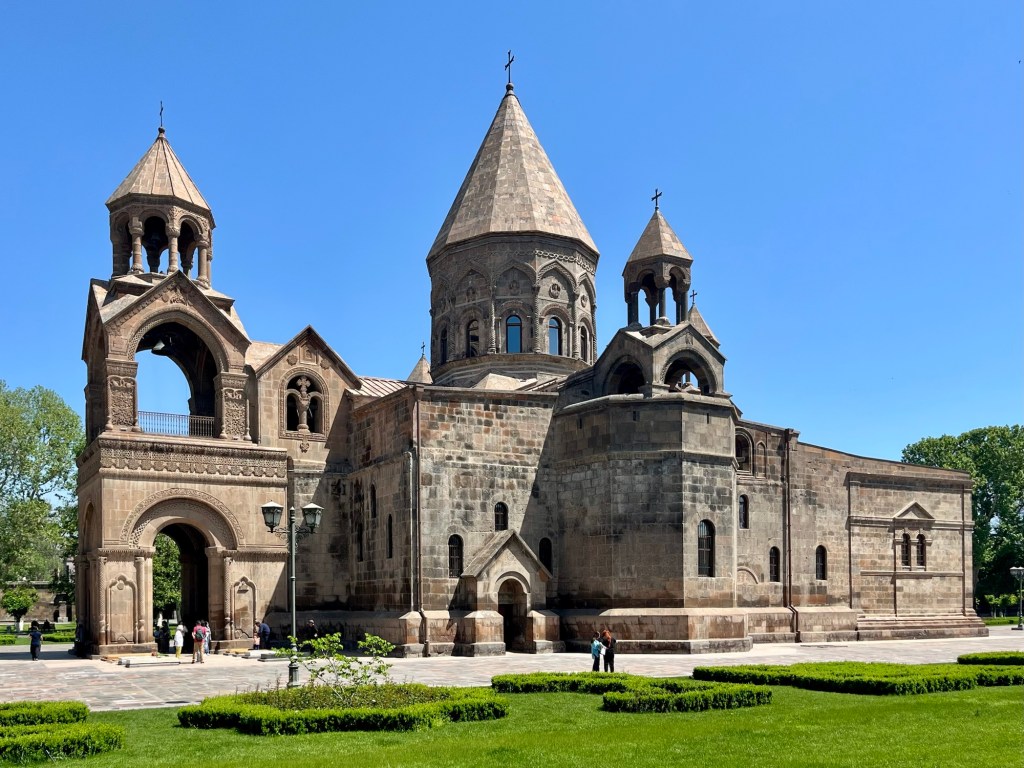
And the altar:

Besides the cathedral, the Etchmiadzin complex also has a seminary, the Catholicos’ residence, various administrative buildings and a museum where the Church exhibits its icons and relics.
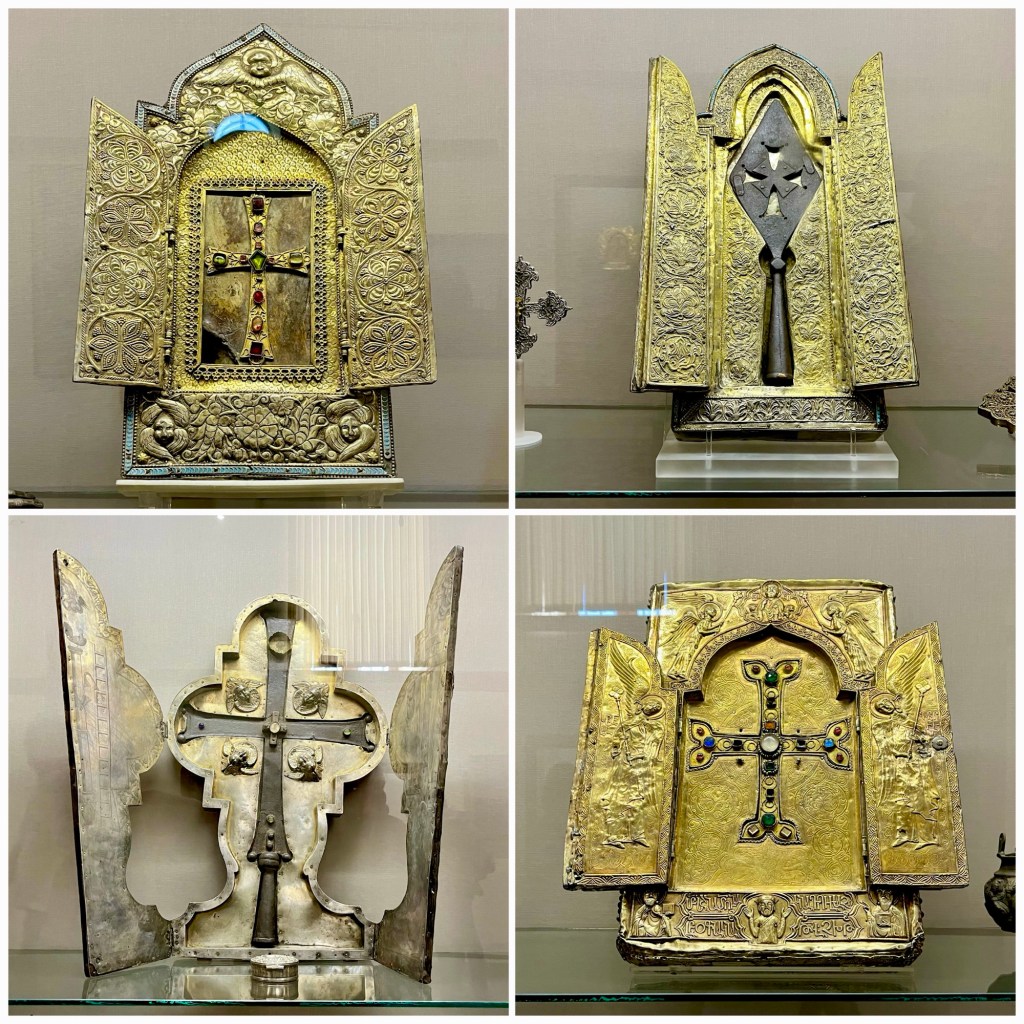
The photo below shows the most important relics in the collection, at least so far as I’m concerned. At the top left, behind the cross, is part of a plank from Noah’s Ark (more on that in my next post); at the top right is the Holy Lance, that is, the spear point that pierced Jesus’s side during the crucifixion; and, the bottom two photos are purported to contain fragments of the crucifixion cross, both about the size of your thumbnail.
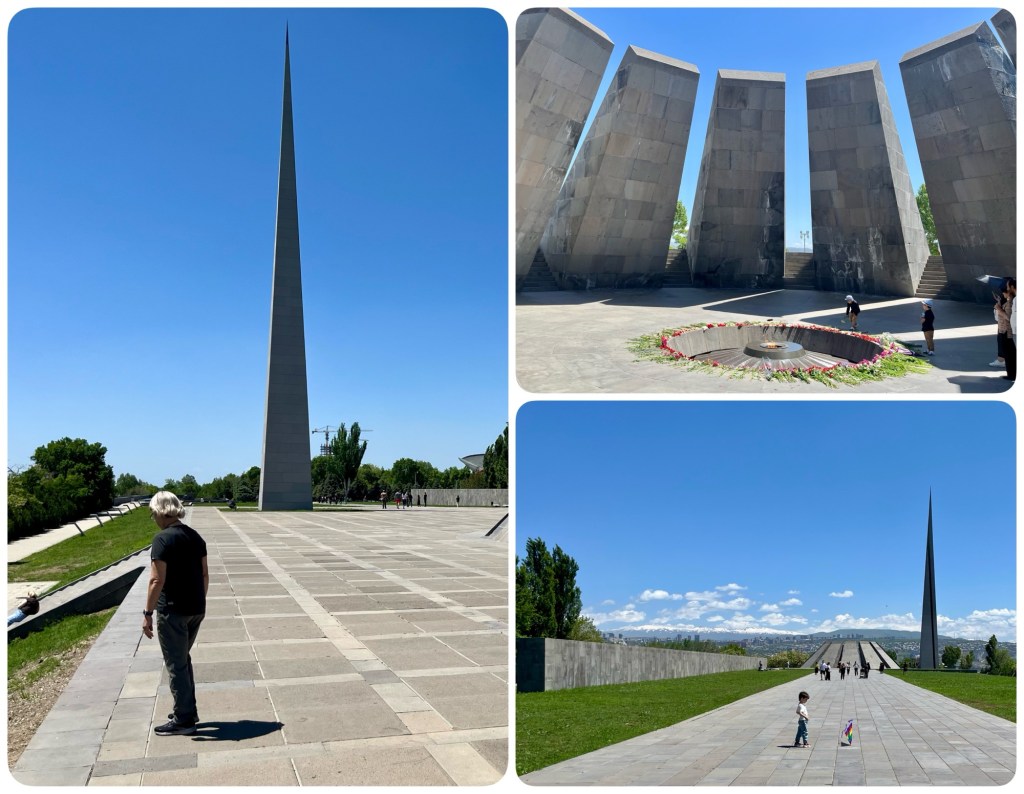
After leaving the Mother See of Holy Etchmiadzin, we drove to the Armenian Genocide Memorial, known to Armenians as the Tsitsernakaberd.
According to Encyclopedia Brittanica,
The Armenian Genocide was a campaign of deportation and mass killing conducted against the Armenian subjects of the Ottoman Empire by the Young Turk government during World War I (1914–18). Armenians charge that the campaign was a deliberate attempt to destroy the Armenian people and, thus, an act of genocide. The Turkish government has resisted calls to recognize it as such, contending that, although atrocities took place, there was no official policy of extermination implemented against the Armenian people as a group. (emphasis added)
Read that last sentence again. What kind of excuse is that?
The United States formally recognized the Armenian Genocide in 2019 by passage of resolutions in both the House and Senate affirming that the mass killings of Armenians by the Ottoman Empire constituted genocide.
Something similar to the Armenian Genocide happened to the Greeks living in Turkey in the 1920s. The Young Turks were not good people.
The memorial, constructed in 1966 during Soviet times, contains an eternal flame. The twelve slabs erected around its perimeter represent the 12 lost Armenian provinces that are now part of Turkey.
Although Armenia has its own historical timeline, a fair amount of what I discussed in my posts about the history of Georgia also applies to Armenia.
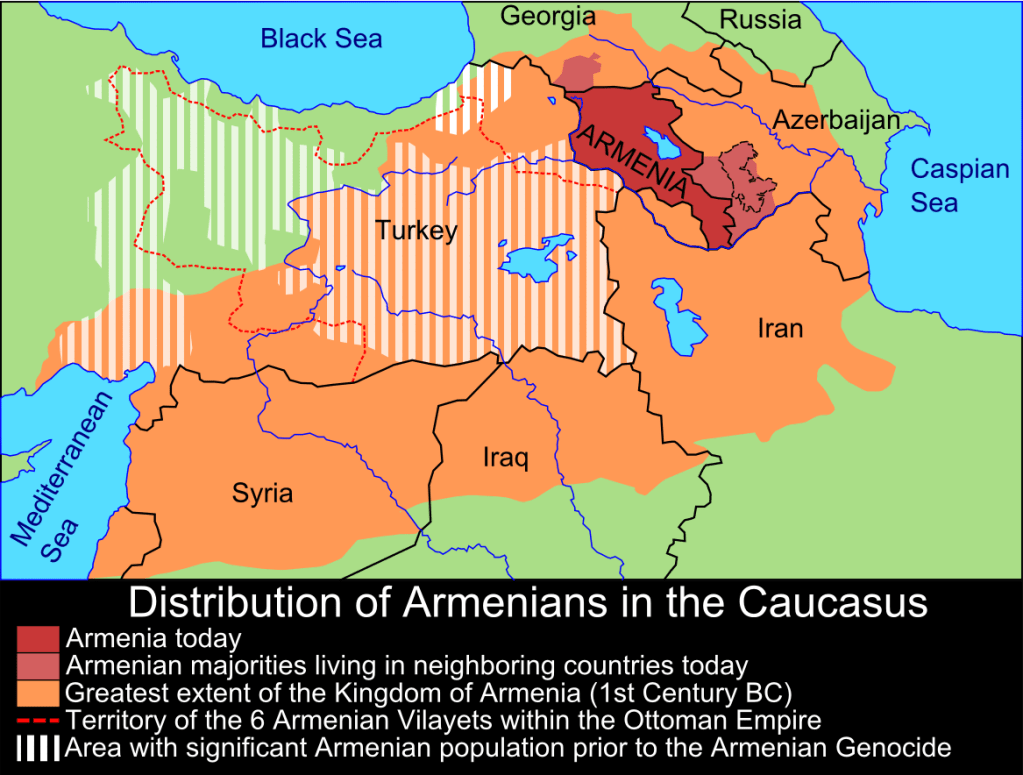
In ancient times, however – and specifically in the century preceding the birth of Christ – Armenia was a much greater empire than Georgia ever was (see map, below, orange region). Azerbaijan was never even a close third place, until modern times.
For centuries, Eastern Anatolia, that is, present-day eastern Turkey, was inhabited primarily by Christian Armenians who shared the area with Muslim Kurds (map below, striped region).
Over time, various Armenian kingdoms rose and fell. Armenians were made vassals to Rome and conquered by Persians, Arabs, Mongols, Timurids, and Persians again. Yet, as a nation of people, the Armenians endured.
Then came the Turks. In 1453 the Ottoman Turks conquered Byzantium and occupied Constantinople, today’s Istanbul, Turkey. The Turkish conquest of Armenia soon followed with Armenia partially being incorporated into the Ottoman Empire.
The result of losing so much territory to Turkey is that Armenia today has, unfortunately, been reduced to relative insignificance from a geopolitical standpoint (map below, red region).
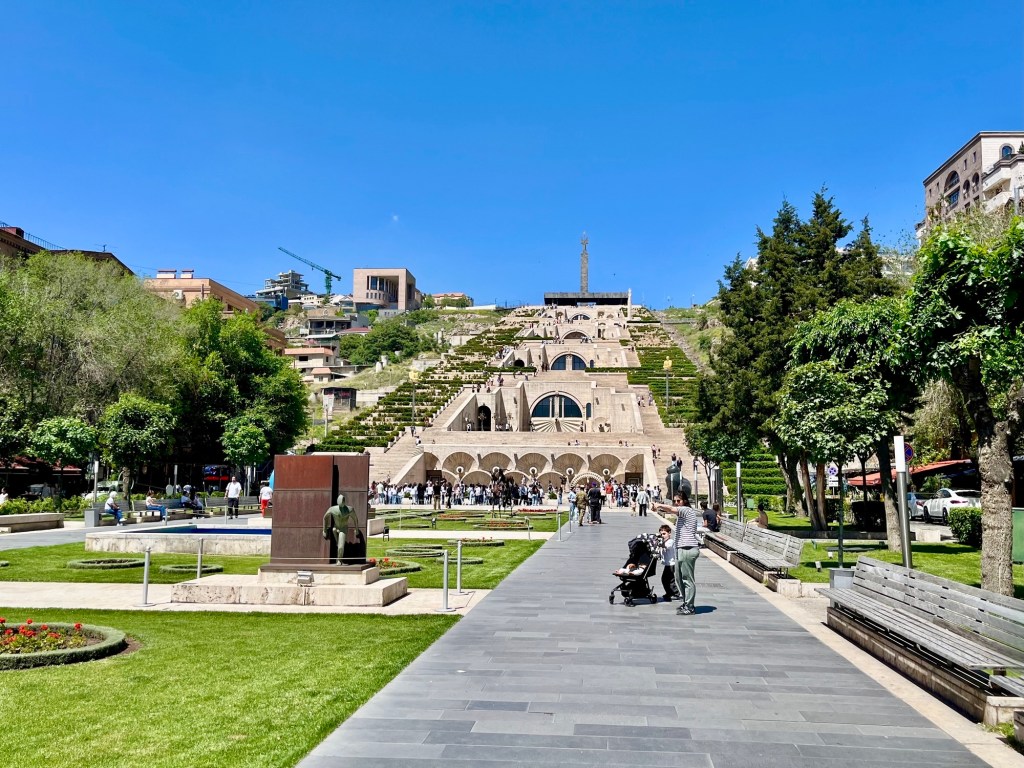
Edo drove us from the Armenian Genocide Memorial to the Yerevan Cascade in downtown Yerevan.
The Cascade consists of five hillside terraces connected by 572 steps. The 160-foot wide staircase is nearly 1,000 feet from bottom to top. We opted not to walk all the way up, stopping at the first plaza.
Below the Yerevan Cascade is an open-air museum of modern art, surrounded by shops and cafes. We stopped to have lunch…
… then finished the day by walking back to the hotel, past the Opera Theater and through Republic Square (photo below), the center of Yerevan.
During Soviet times, Republic Square was called Lenin Square. In the fall of 1990, a year before Armenia declared independence from the Soviet Union, the square was renamed – a sign of what was to come. Following a referendum, Armenia became an independent nation on September 21, 1991, and Lenin’s statue was removed from the square.
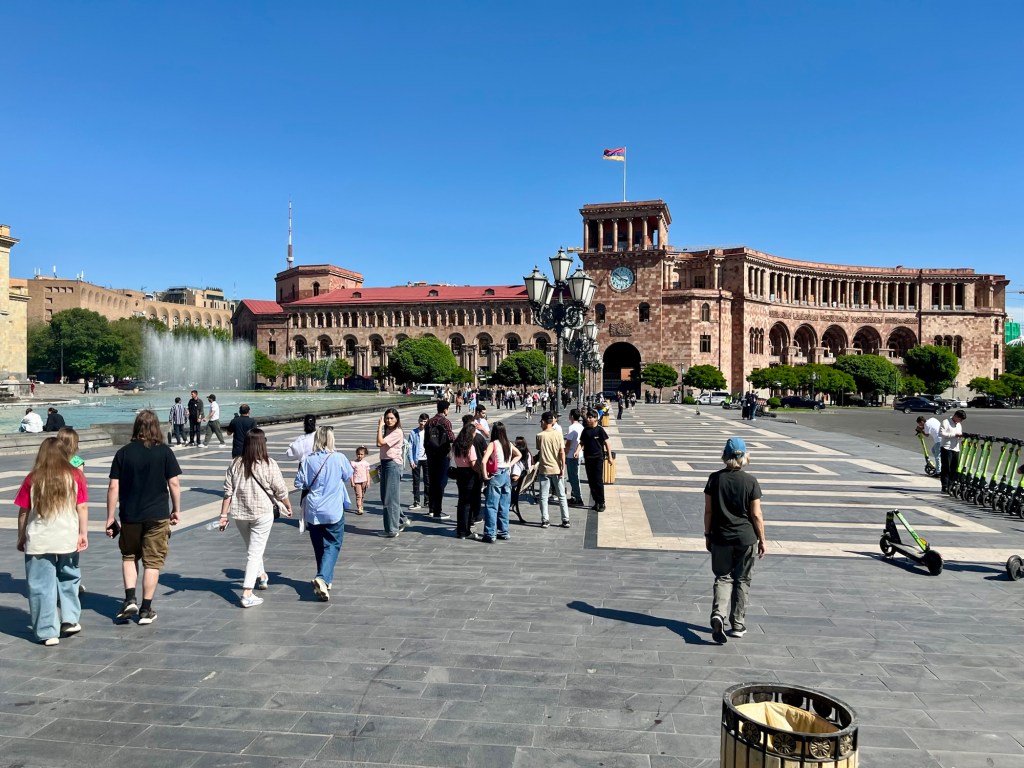
When we walked across it on this bright, sunny day, Republic Square was filled with young people. We continued another mile through Shahumyan and Vardanyans’ Parks, past the Italian and French embassies to our hotel.
Our time in the Caucasus is coming to an end.
 The Road Less Traveled