In my last post, I related the history of Thailand’s first 400 years, ending in 1767 with the Burmese invasion and siege of Ayutthaya. Once Ayutthaya fell, the kingdom disintegrated.
The story continues by way of a local noble named Taksin who managed to make his way out of the city during the attack at the head of 500 followers. Several other lords also escaped, establishing themselves as local rulers and dividing the kingdom into six regions. For the next four years, Taksin continued the fight with the Burmese while also launching a campaign against his local rivals.
Ultimately victorious, Taksin established himself as the new Siamese ruler and set up his capital across the river from Bangkok, naming his kingdom and capital city Thonburi and naming himself King Taksin the Great, which in Thai is: สมเด็จพระเจ้าตากสินมหาราช. [Textual Thai is as odd looking as the scripts of Armenia and Georgia that we visited in May.]
Taksin the Great ended up being the one and only monarch of the Kingdom of Thonburi, ruling over Thailand from 1767 to 1782. He lost power in a coup d’état, was executed and succeeded by his supposed friend, Thongduang, who installed himself as ruler, founding the Chakri dynasty which has ruled Thailand ever since.
Thongduang, known as King Rama I, promptly moved the Siamese capital across the Chao Phrya River from Thonburi to Bangkok and began building a walled city similar to what had existed in Ayutthaya, enclosing a royal palace and temple complex, known today as the Grand Palace. For extra points, King Rama I moved a famous and sacred Emerald Buddha into his new temple, calling it Wat Phra Kaew, the Temple of the Emerald Buddha. The perimeter wall enclosing the complex runs a length of nearly 1.2 miles.
The Grand Palace served as the Siamese and Thai kings’ official residence from 1782 until 1946, although the last king to actually live there was King Rama V. And while a handful of the buildings within the walls are still in governmental use, the importance of the Grand Palace today is mainly tourism. It is the most popular tourist destination in all of Thailand, attracting 8 million visitors annually, ranking it 40th globally and 8th in Asia in popularity! Thank Vishnu we’re here during the shoulder season.
By the way, for perspective, modern-day Thailand is about 20% larger than the State of California, but has almost double its population.
On our first full day as tourists, we took the public express boat from Sathorn Pier to Tai Chang Pier, then walked down Na Phralan Road along the northern wall of Wat Phra Kaew,
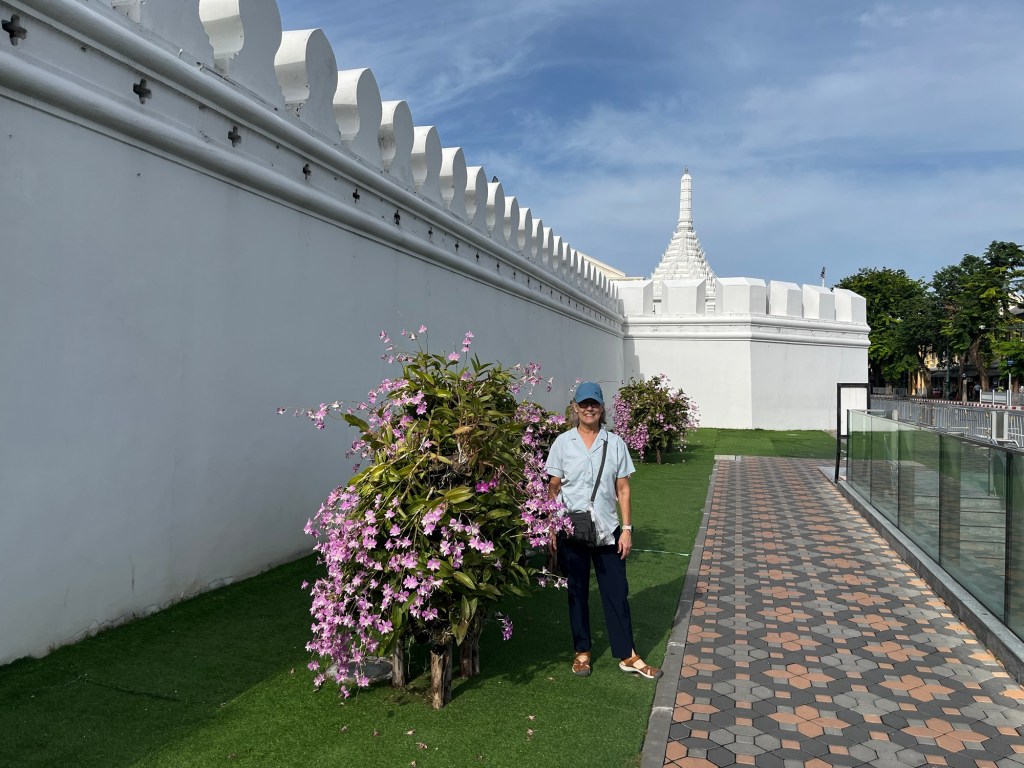
… entering Manee Noparat Gate, then walking around the exterior of Wat Phra Kaew past the guards at the entrance. This wat is Thailand’s holiest temple, although there are no resident monks here.
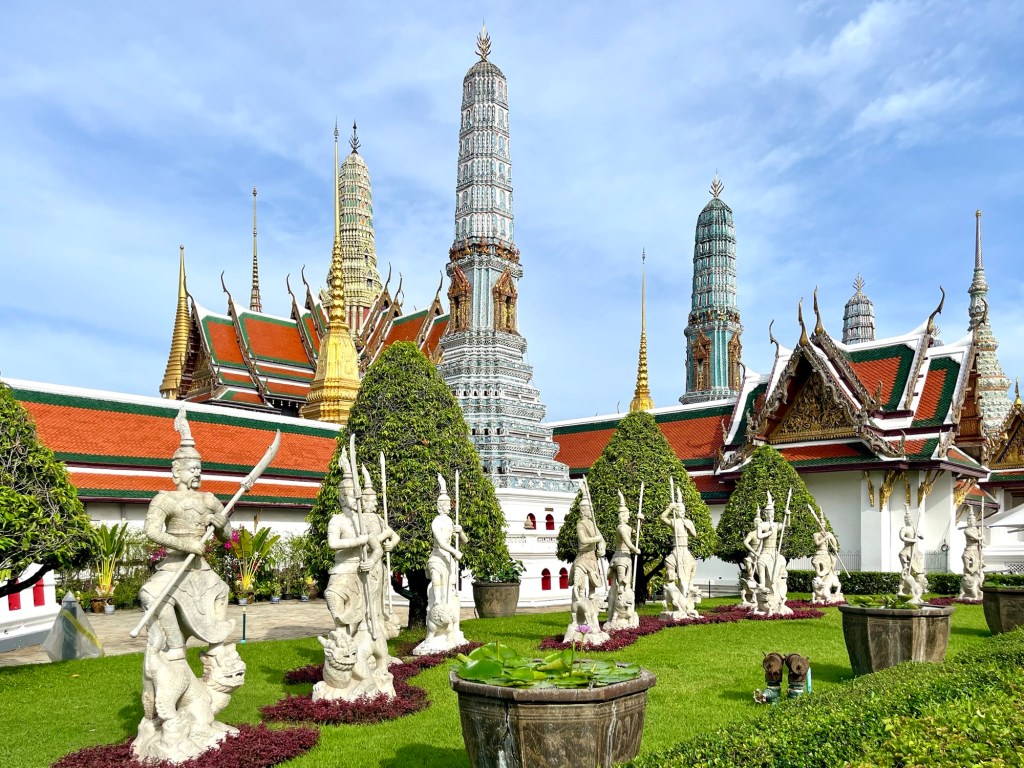
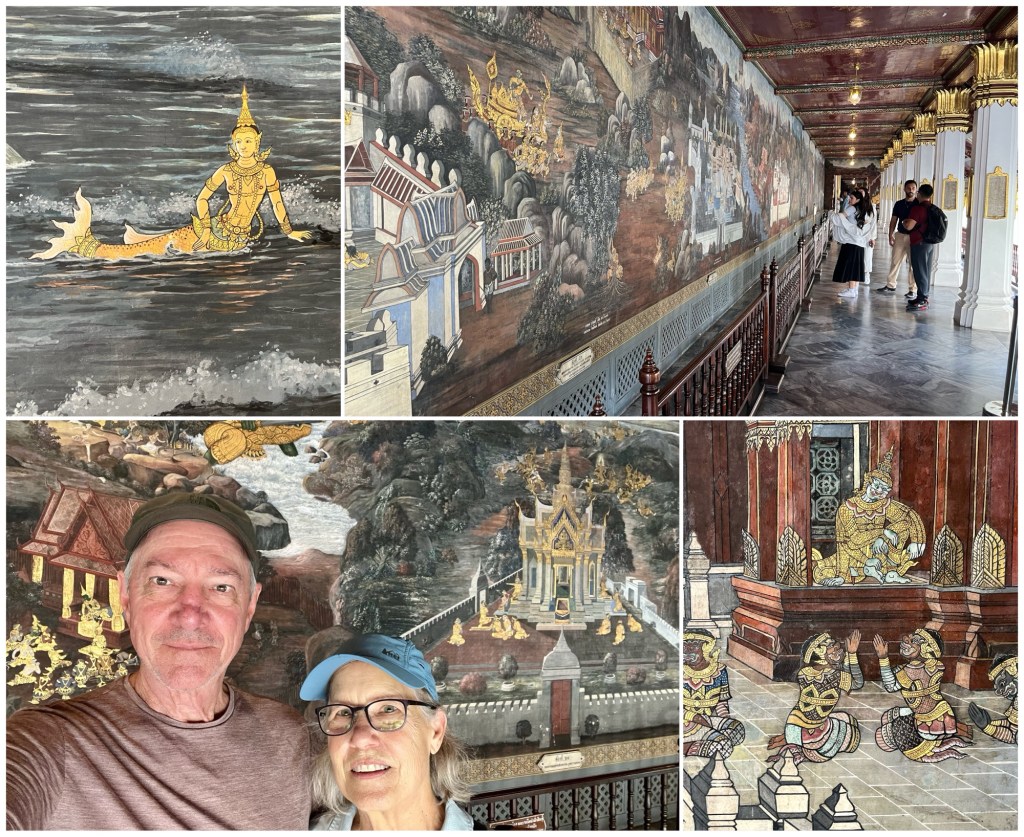
At the entrance, there is an option to either head straight into the temple or to visit the galleries surrounding it that exhibit the Ramakien mural which depicts the Hindu legend of Rama, the “Ideal Man” (Rama, as mentioned, also happens to be the name adopted by the Chakri dynasty kings). We opted for the mural. It runs along for what seemed the length of a football field.
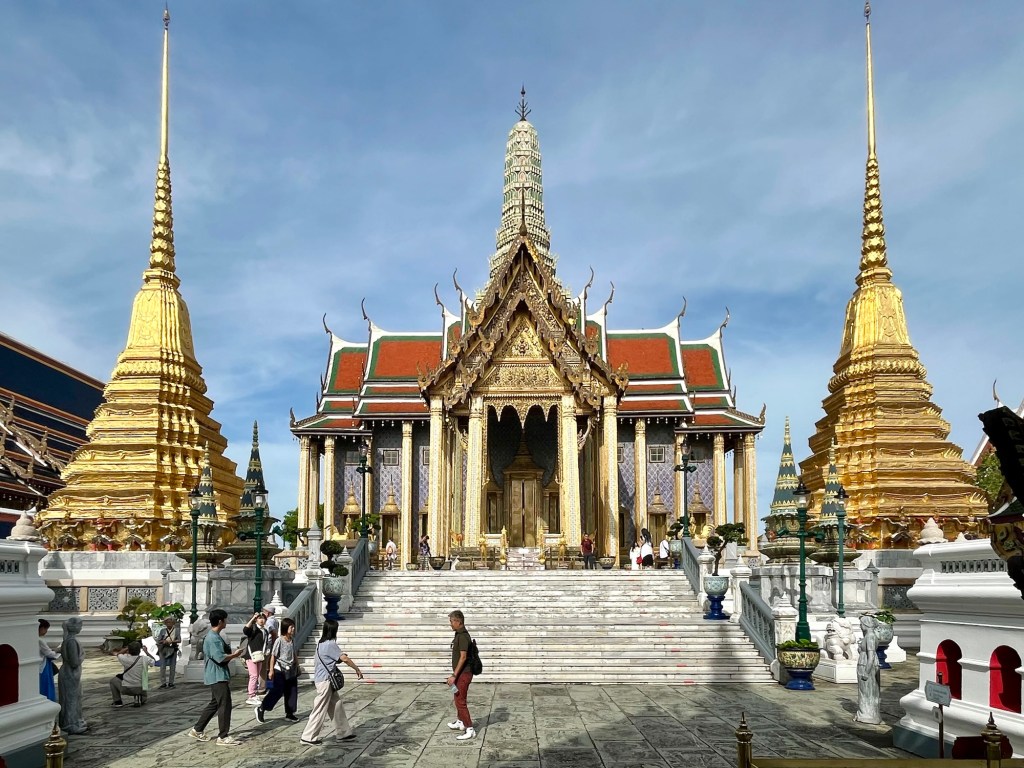
Here’s the Temple of the Emerald Buddha:
In front of the temple stands one of several statutes of Garuda, the bird-human “king of birds” and combination pilot/airplane of the Hindu god, Vishnu.
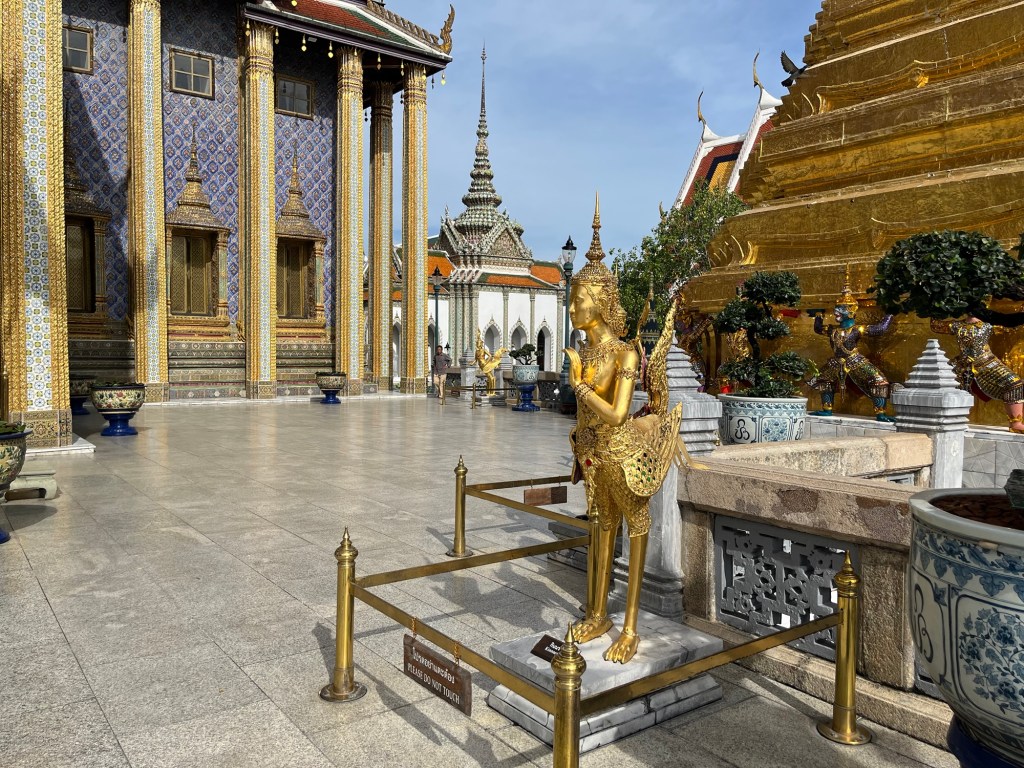
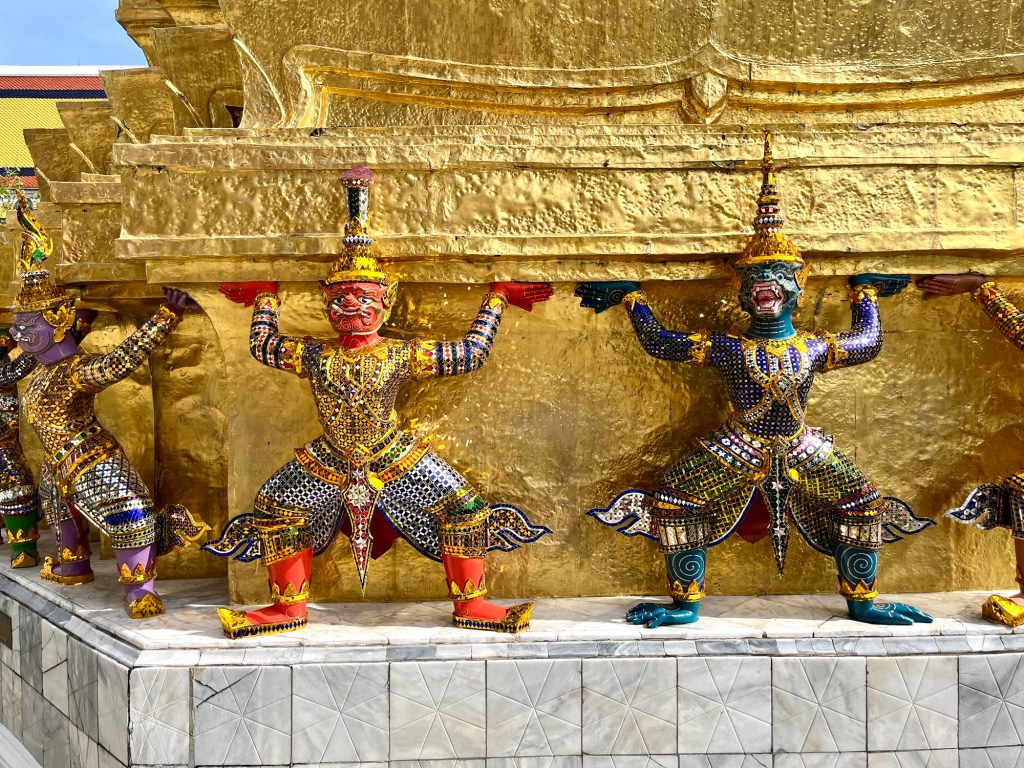
Behind Garuda were these guys, called yaksha (“giants”), holding up the golden stupas built by King Rama I to commemorate his parents.
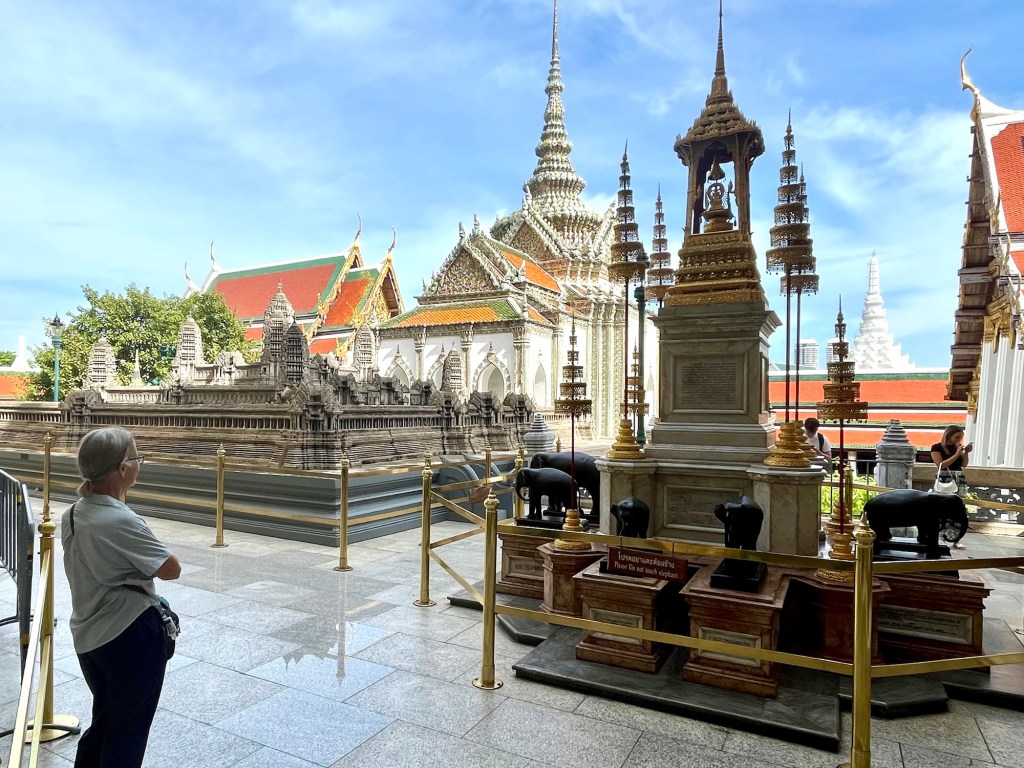
On the north side of the temple is a model of Angkor Wat and an elephant monument. Elephants are considered sacred in Thailand.
We took off our shoes and went into the Temple of the Emerald Buddha (photography not allowed), then continued to the Royal Palace.
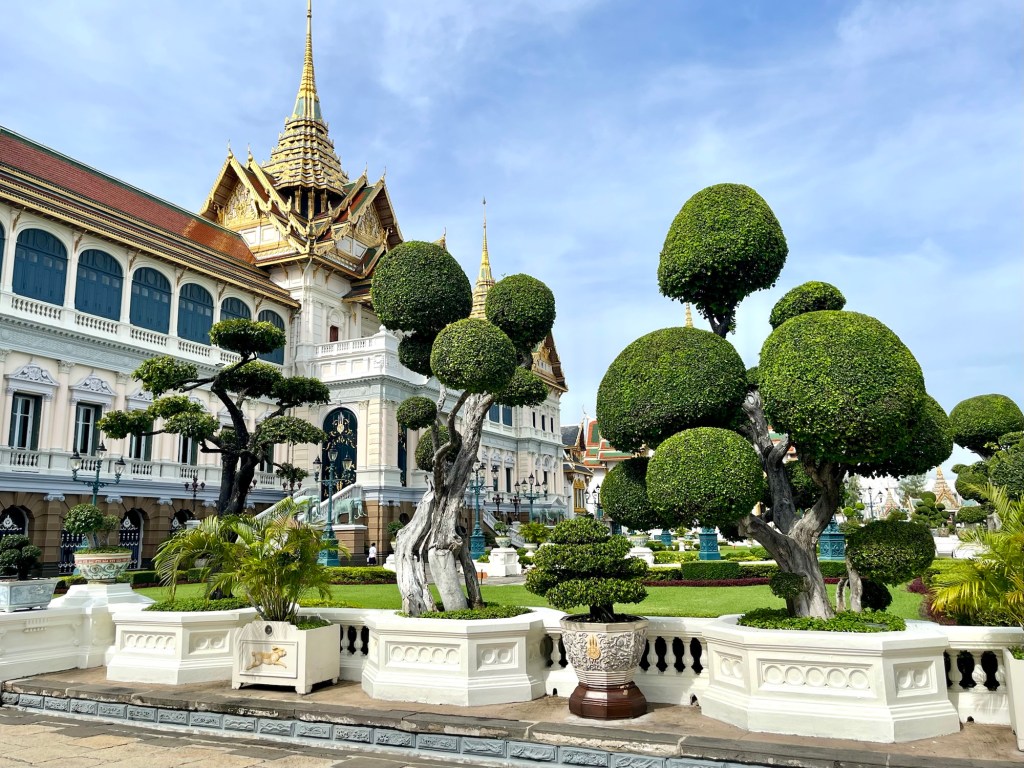
The photo, below, is of Chakri Maha Prasat, the Chakri Dynasty Throne Hall. It was built in 1882 by King Rama V to mark the centennial of the Chakri dynasty. On the top floor are ashes of the deceased royal monarchs. The king welcomes live foreign dignitaries on the ground floor.
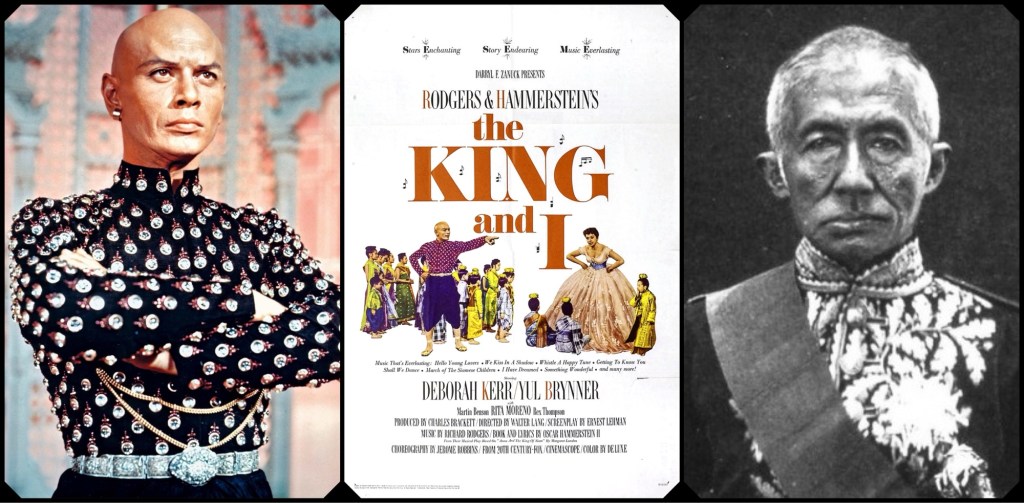
I have early memories of watching a movie called The King and I, a 1956 musical (Part 1 and Part 2) starring Yul Brynner and Deborah Kerr that won five Academy Awards and two Golden Globes. My parents used to play several of the songs from the movie on their hi-fi; you might know them too: I whistle a Happy Tune; Hello, Young Lovers; Getting to Know You; and, Shall we Dance.”
The plot of The King and I was based on the memoir of a widowed school teacher who became tutor to the 15 children of King Mongut of Siam, Rama IV of the Chakri dynasty, in the 1860s. That’s him on the right, below; Yul Brynner, portaying him on the left:
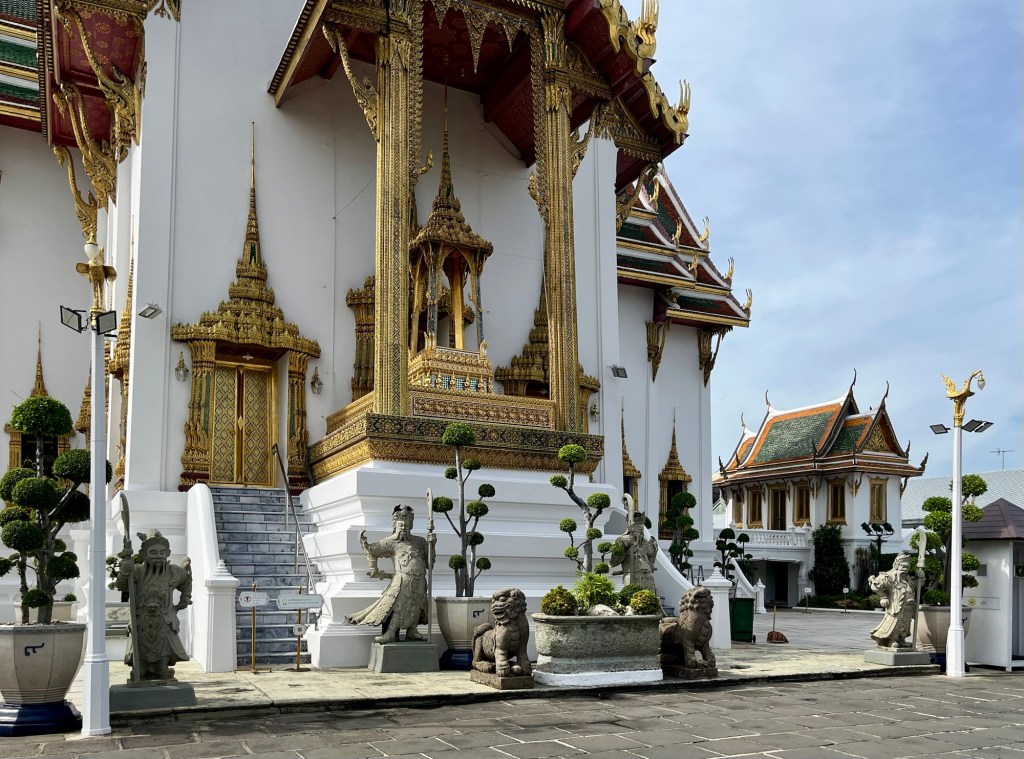
Just beyond the Chakri Dynasty Throne Hall is the Dusit Throne Hall, built in 1784 and shown in the photo, below. This is the throne hall in which Yul Brynner King Mongut was crowned. The royal residence is behind this building, the locus of the movie.
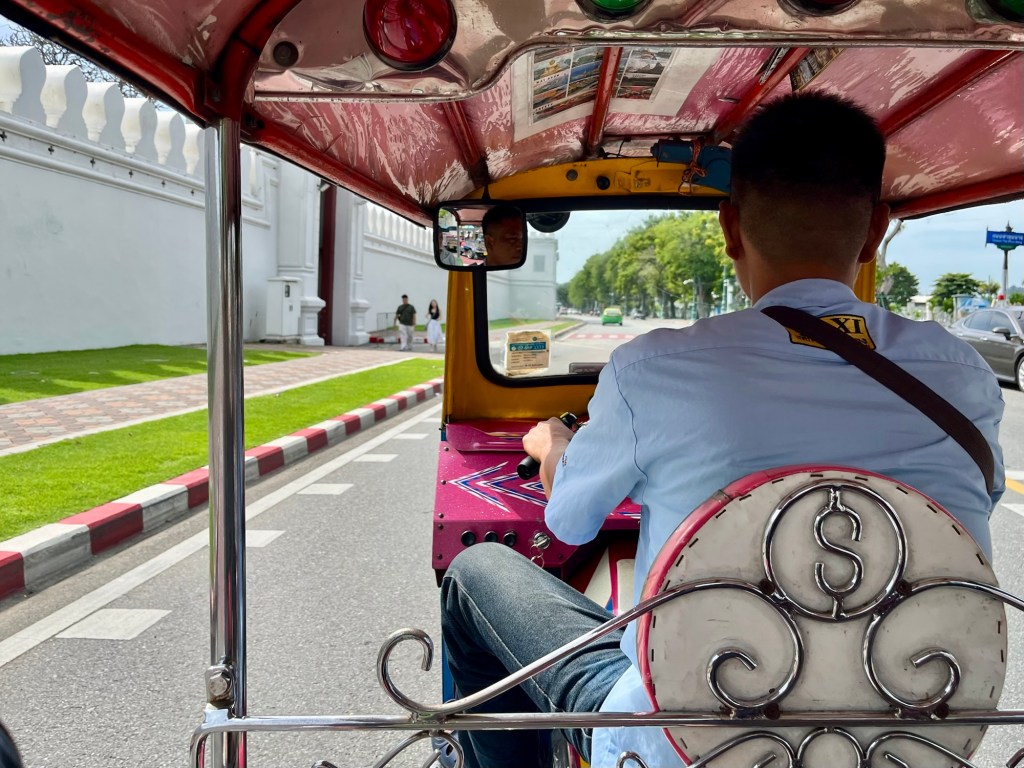
Having seen what we wanted to see at the Grand Palace, we exited through the Thewaphirom Gate onto Maha Rat Road and flagged down a tuk-tuk to take us around the crenelated walls surrounding the Grand Palace complex to Wat Pho to the south.
Wat Pho, is known as the Temple of the Reclining Buddha. The temple complex houses the largest collection of Buddha statues and images in Thailand, including a reclining Buddha measuring 151 feet long and 50 feet high.
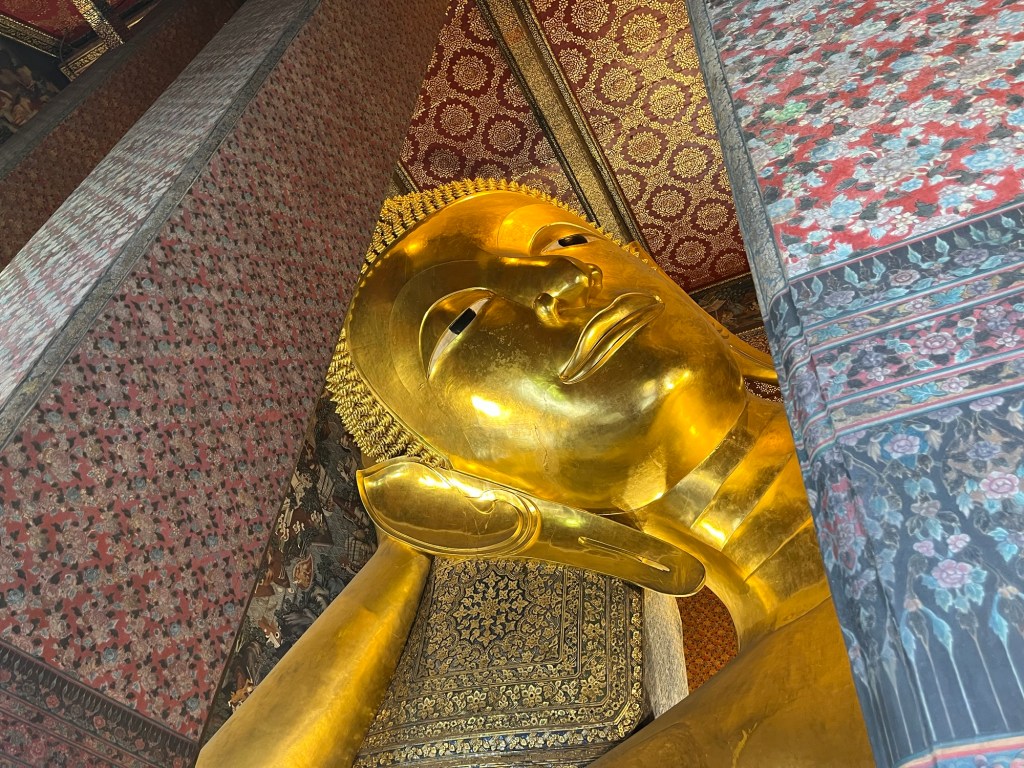
The figure is made of brick, covered with plaster, and gilded.
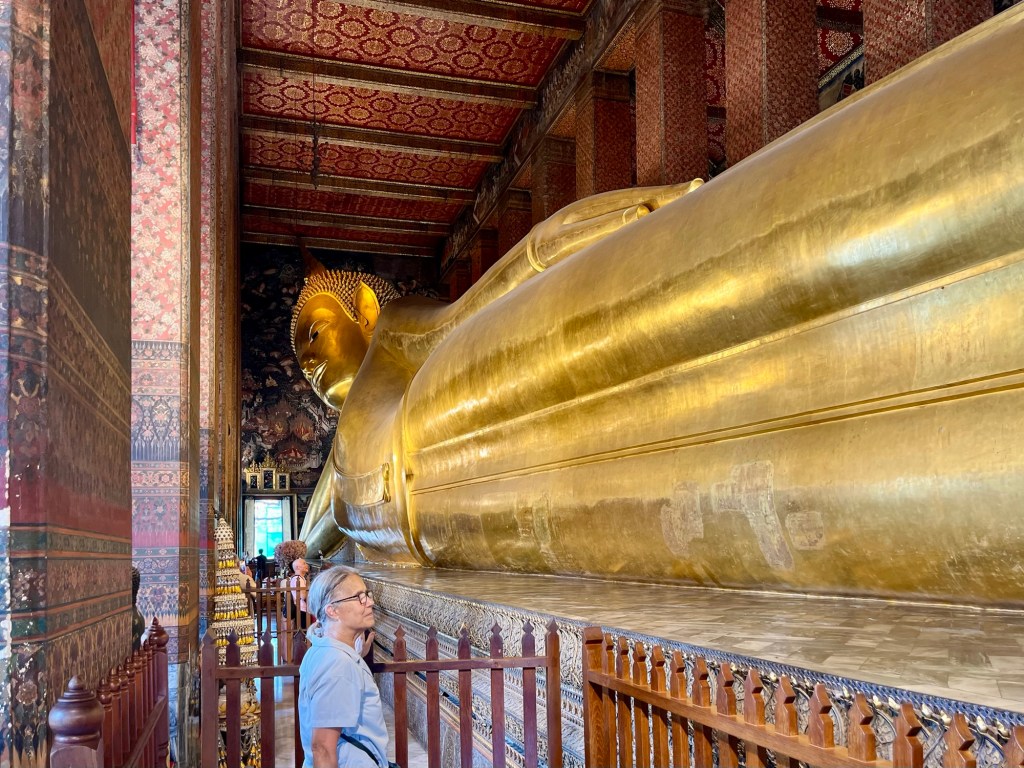
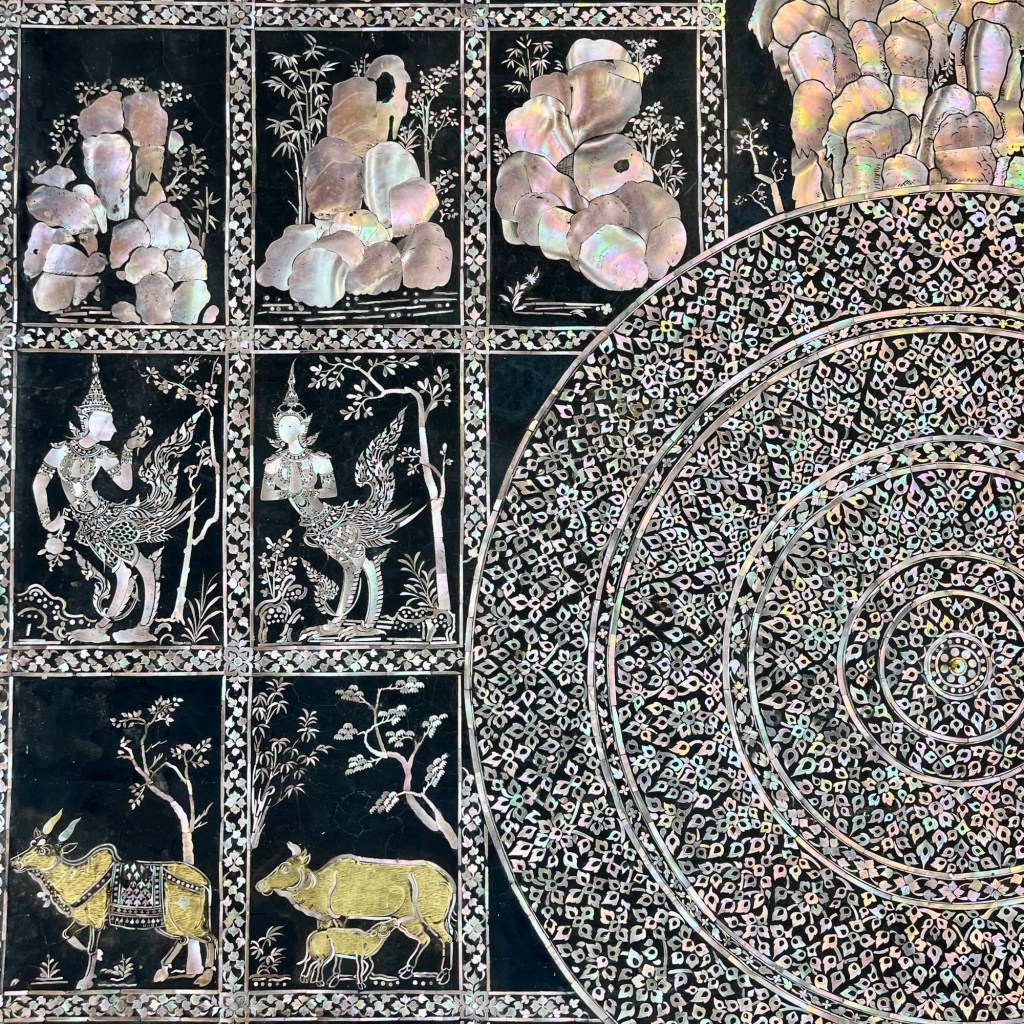
We walked the length of the Buddha to see the most impressive feature: the soles of the Buddha’s feet. They are each 15 feet long by 5 feet wide, about the same dimensions as my first car, a Honda 600 sedan. They’re covered in mother of pearl inlays.

Here’s a close-up, rotated 90° (notice the two Garuda on the center left).
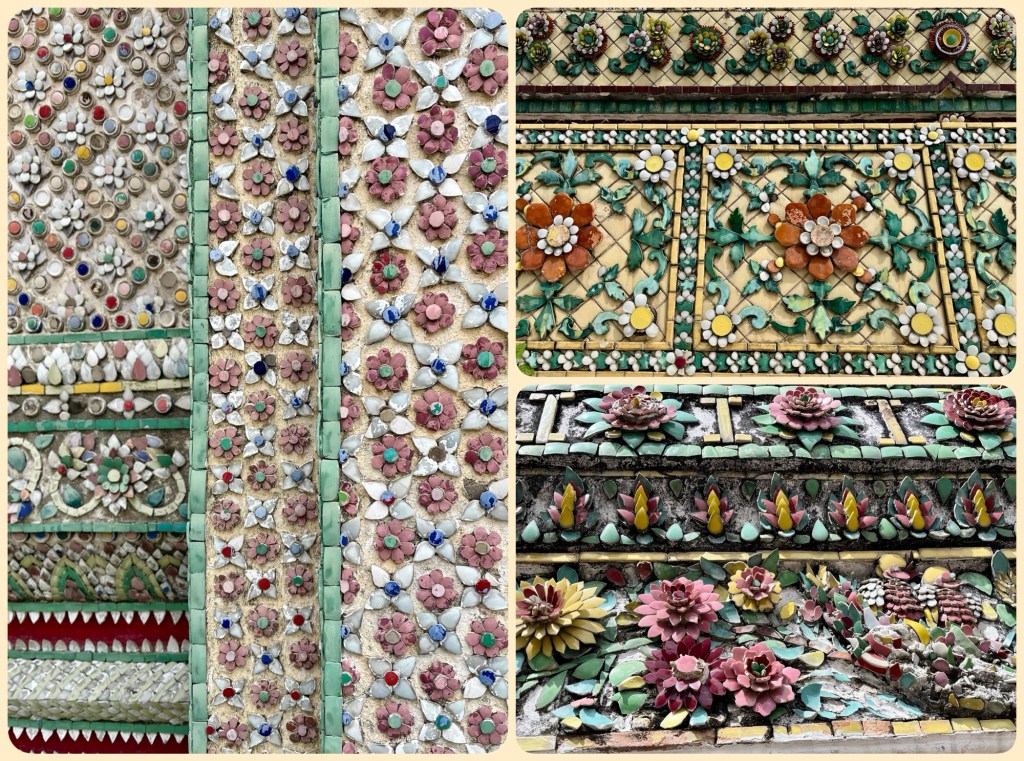
There are four great and 91 small chedis at Wat Pho. Here are a few of them:

Dale really enjoyed the ceramic tiles we saw throughout Wat Phra Kaew and Wat Pho:
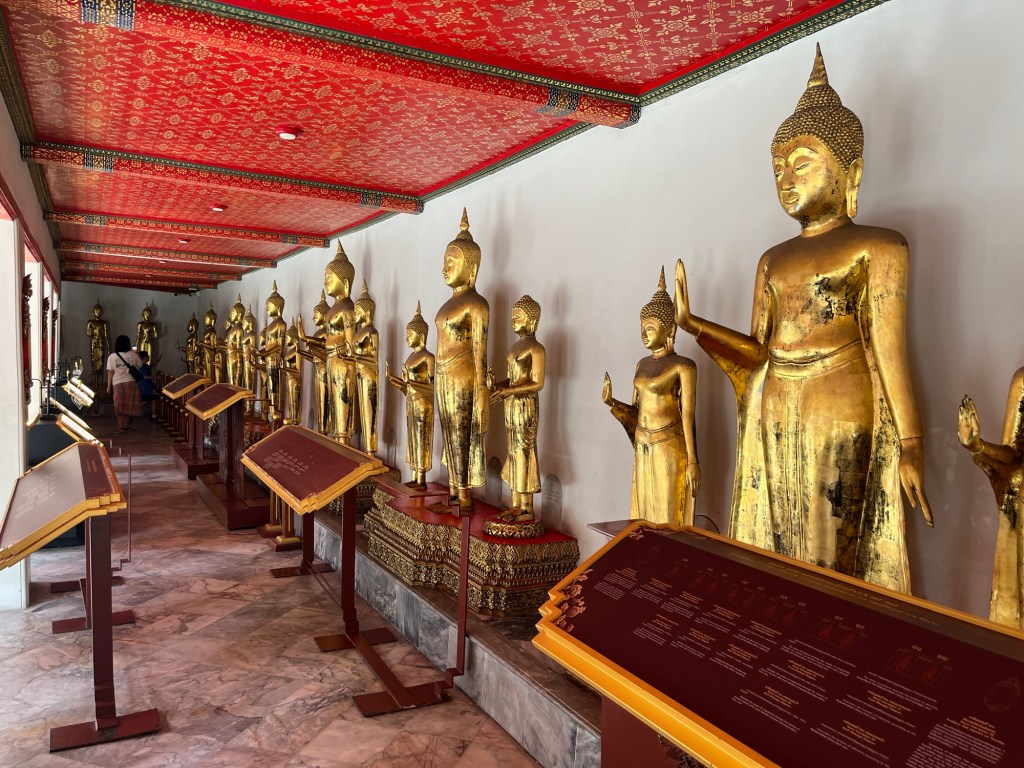
Wat Pho is home to more than 1,000 Buddha images and statues. The Buddha figures below, mostly standing, are mounted on matching pedestals throughout the monks’ cloisters. They are from different periods in Siamese history, but were all covered with stucco and gold leaf during the reign of Rama I to make them appear related.
The photo, below, is of Phra Mondop, the Scripture Hall at Wat Pho, which contains a small library of Buddhist texts inscribed on palm leaves. It is not open to the public.

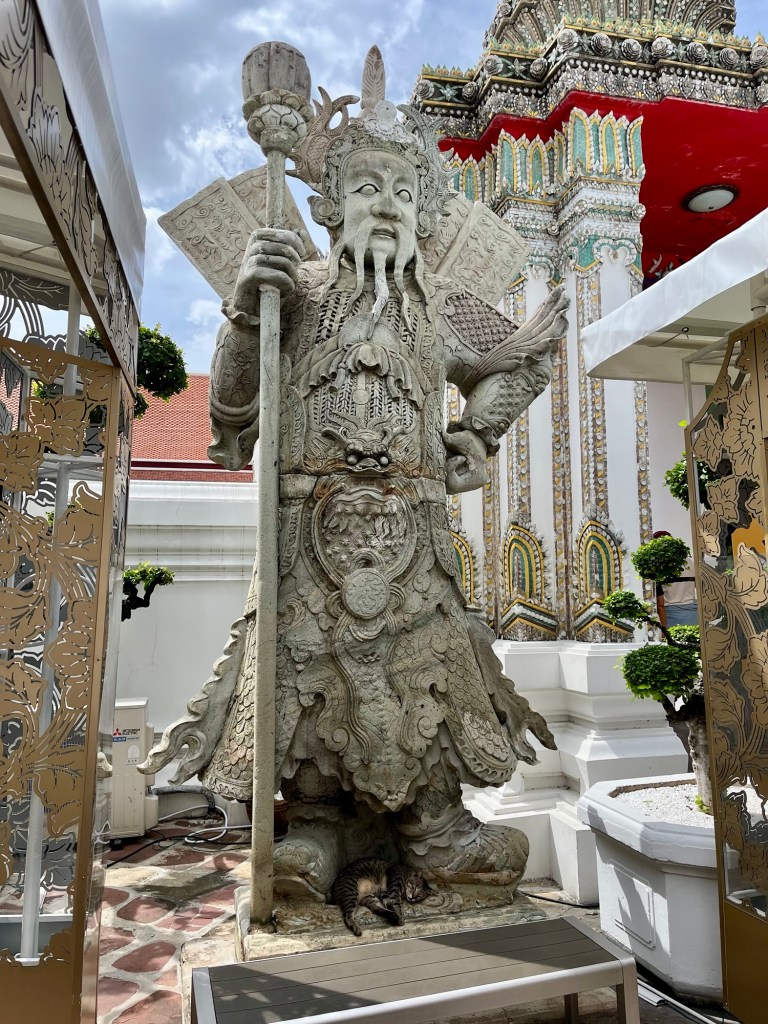
At the exit, I looked back to see this Chinese statue guarding the gate. He supposedly found his way to Wat Pho as ballast aboard a Chinese sailing ship.
Although we’ll be returning to Bangkok, we’re now off on an adventure to the countryside around Kanchanaburi near the Myanmar border.
 The Road Less Traveled