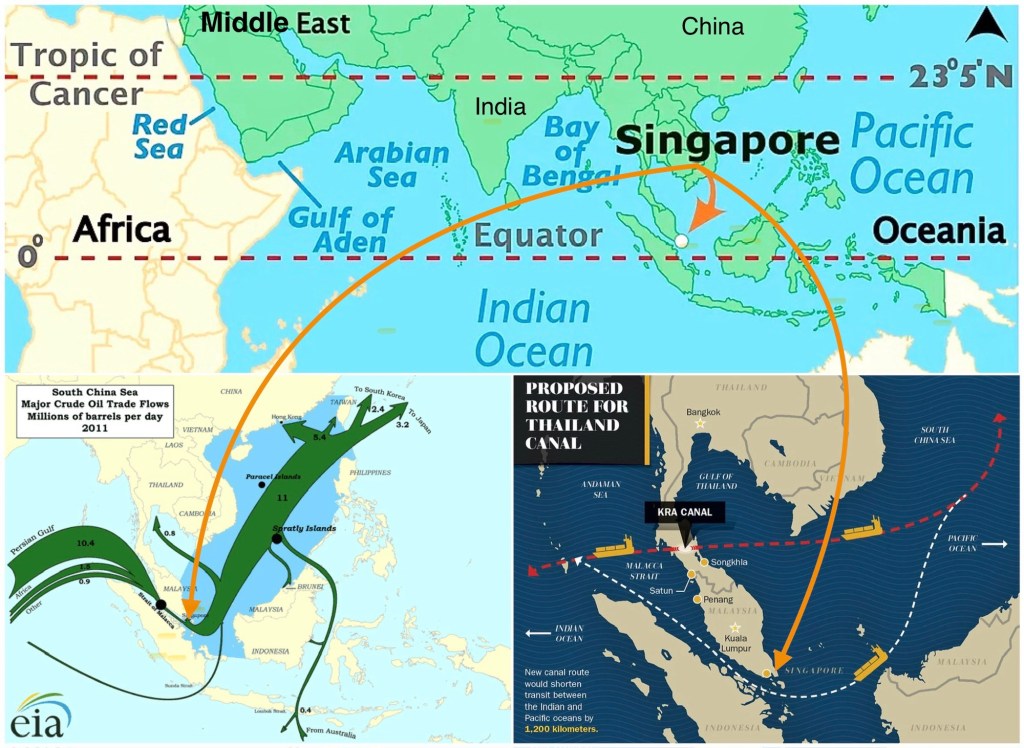
The island city-state of Singapore is 876 miles nearly due south of Bangkok, just 85 miles north of the equator. It sits at the southern tip of the Strait of Malacca, connecting the Indian Ocean with the South China Sea at a pinch point between Malaysia and Indonesia.
Although it is not the only way for ships to travel between the oil rich kingdoms of the Middle East and the industrial powerhouses of China, Japan and Korea, it is the most direct, safest and least expensive. Consequently, nearly all tankers and cargo vessels transiting this part of the world must pass by Singapore.
And while there have been visionaries promoting an alternative route via a canal across Thailand, the Kra Canal, at present there are no plans to make that a reality.
The upshot of all this is that Singapore is a very strategic place from a geopolitical perspective, able to benefit from the enormous amount of trade and capital flowing through the Strait.
The known history of Singapore does not go back much farther than 1400 A.D. when, as Encyclopedia Brittanica puts it, “Singapore Island originally was inhabited by fishermen and pirates,…” Sounds like the Florida Keys, where we lived for awhile.
Its modern history begins in 1819 when Sir Stamford Raffles essentially bought the island for the East India Company to serve as the hub of British trade with the Orient. By 1867, with the demise of the East India Company, Singapore had become a British crown colony, which it remained until February 1942 when the Japanese invaded and occupied it during World War II.
Although Singapore remained in British hands after Japan surrendered in 1945, the protective umbrella of Great Britain had shown itself to be illusory. The United Kingdom was no longer the great power it had been in years past, so British colonies began to demand their independence, beginning with India in 1947.
By 1959, Singapore, too, had gained its independence, although like Canada, Australia and a number of other former British colonies, it still remains part of the British Commonwealth.
We arrived in Singapore on Sunday, September 28, to discover that our timing could have been better. Our hotel, Dao by Dorsett, was packed with “Tech Bros” here for the Singapore Week of Innovation and Technology.
And the Singapore Grand Prix, a race on the Formula One Championship circuit, was set for the weekend with preparation nearing completion and the first practice laps scheduled for Friday, the day of our departure.
One of the Formula One cars was on display in a local shopping mall and bleachers had been set up along the course.
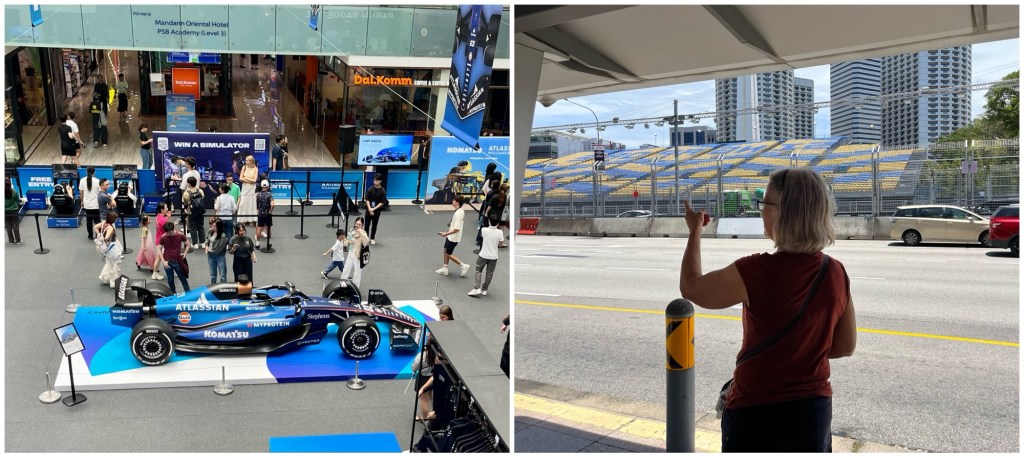
The track for the race is a 3-mile loop through downtown, resulting in numerous road closures and detours. Consequently, we became expert on the use of Singapore’s public transit system, which, by the way, is amazingly high-tech. Just flash your VISA card at the turnstiles when you enter and leave a bus or the subway; no need to buy a ticket.

In the photo above, far right, you can see three high-rise towers in the distance. That’s the iconic Marina Bay Sands, a hotel, casino, convention center and upscale shopping mall complex that opened in 2010. More on that later.
The Marina Bay Sands is located at the edge of the most famous tourist attraction in Singapore, Gardens by the Bay. We spent two days wandering around there.
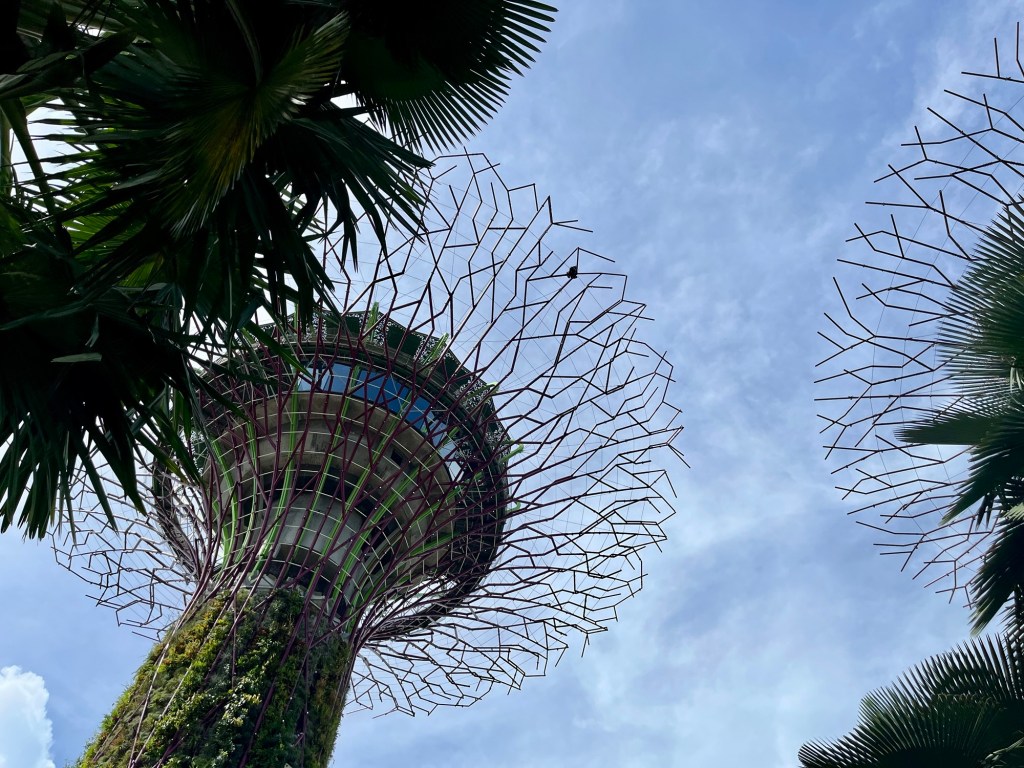
The photos below are of the “Supertree Grove” at the Gardens: 18 tree-like structures imitating life. Wikipedia says:
They are fitted with environmental technologies that mimic the ecological function of trees: photovoltaic cells that harness solar energy which can be used for some of the functions of the Supertrees (such as lighting), similar to how trees photosynthesize, and collection of rainwater for use in irrigation and fountain displays, similar to how trees absorb rainwater for growth. The Supertrees also serve air intake and exhaust functions as part of the conservatories’ cooling systems.
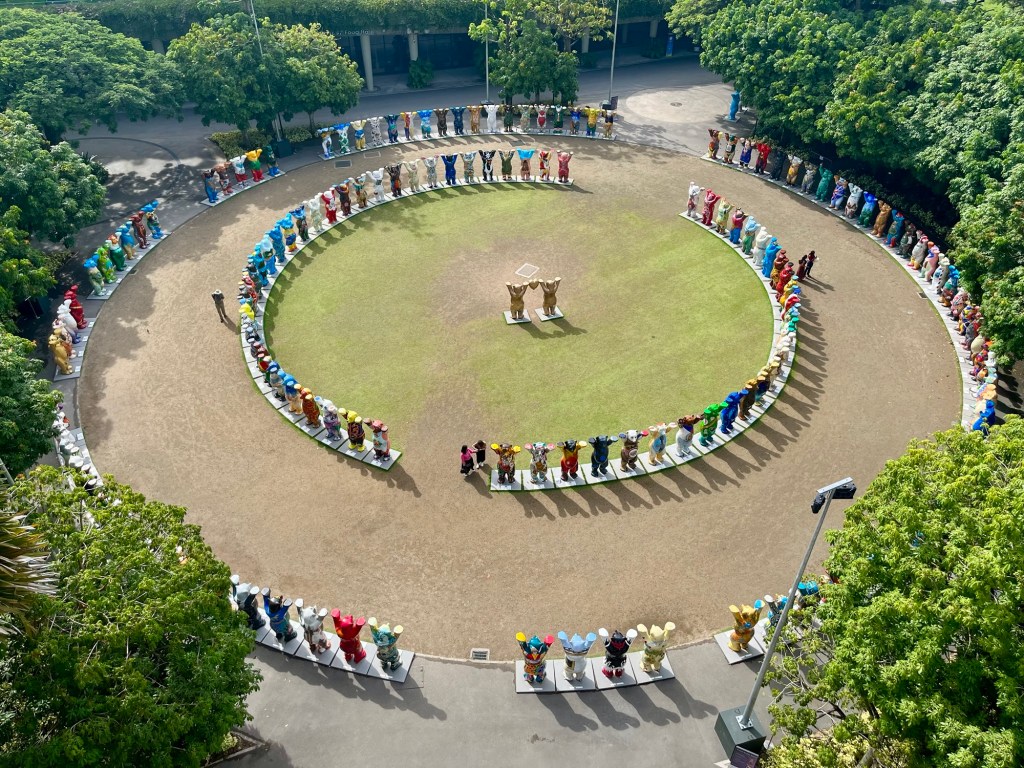
Standing in front of the Supertrees are the “United Buddy Bears:”
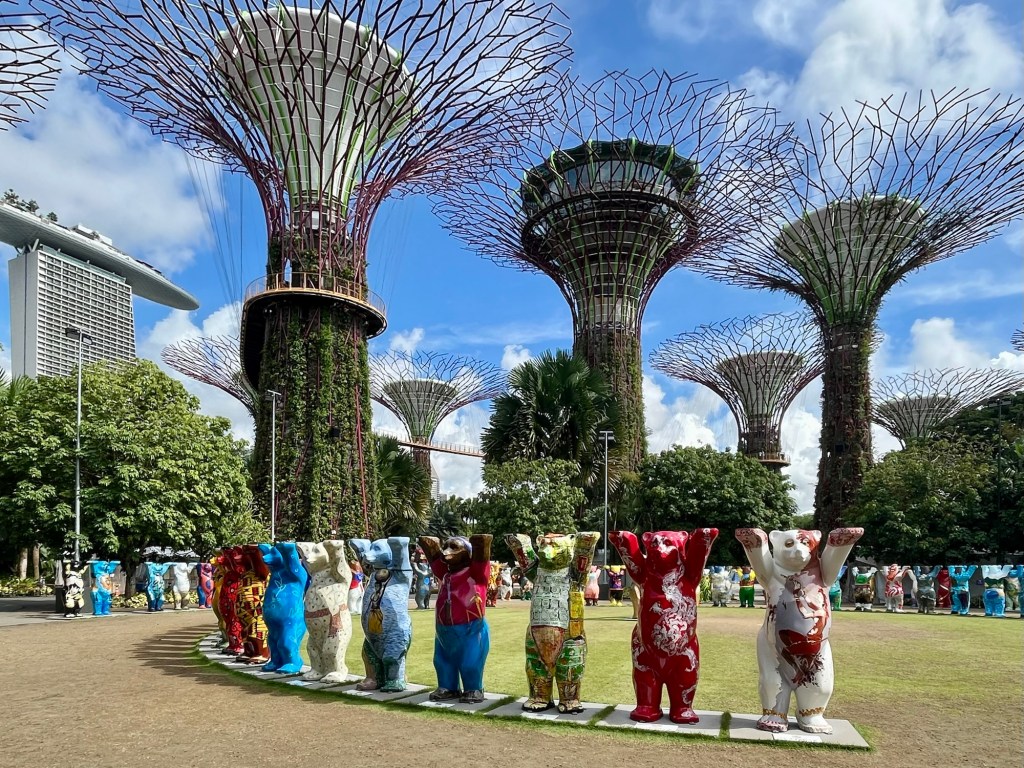
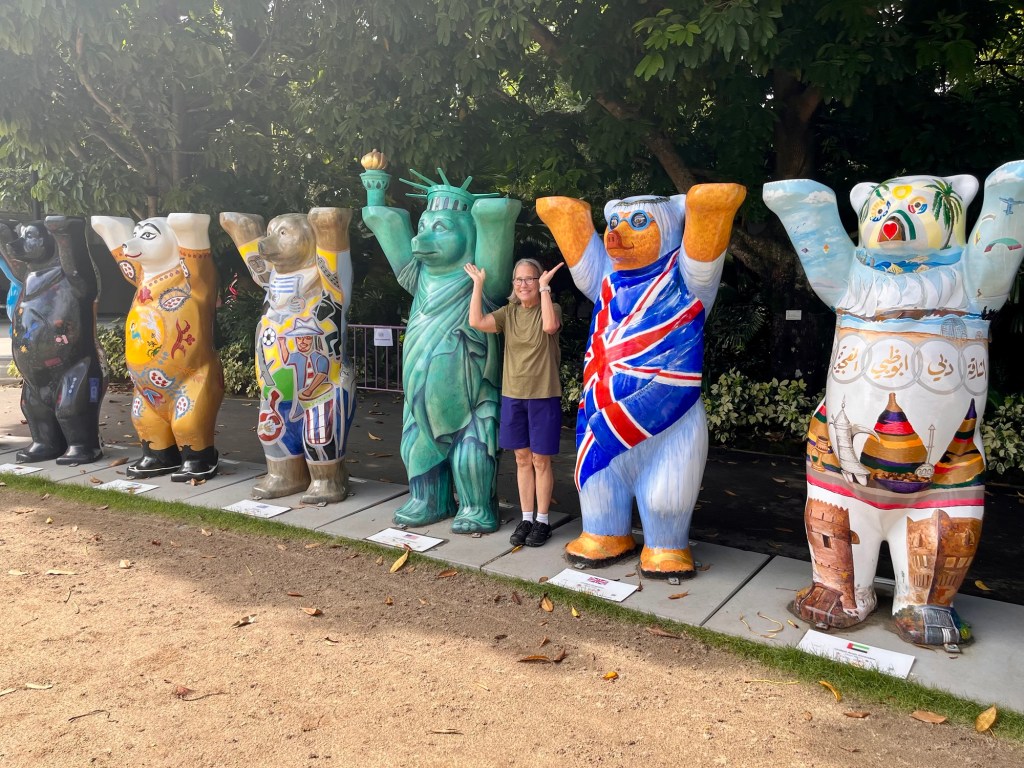
The Buddy Bears are a German exhibition, a collection of 145 countries’ representative bears that, since 2002, have been on a 35-stop tour across 5 continents fostering peace and harmony. Dale is filling in the gap between the USA and the UK.
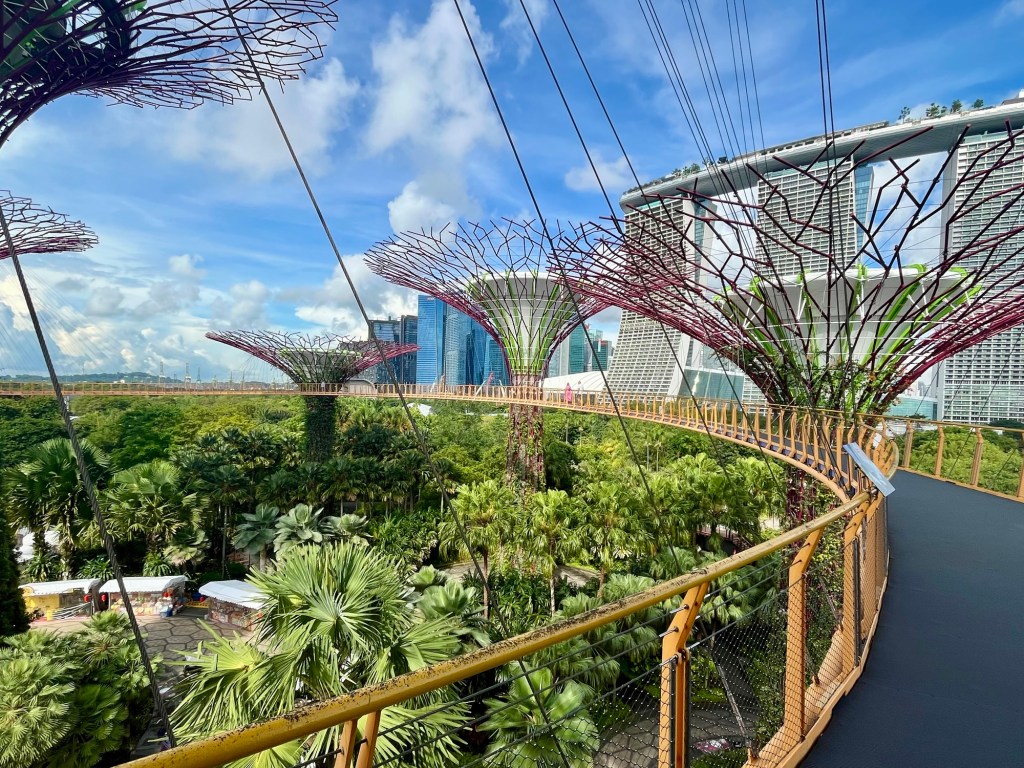
We took the elevator up to the top of one of the Supertrees and walked the length of what they call the OCBC Skyway. You can see Marina Bay Sands in the background.
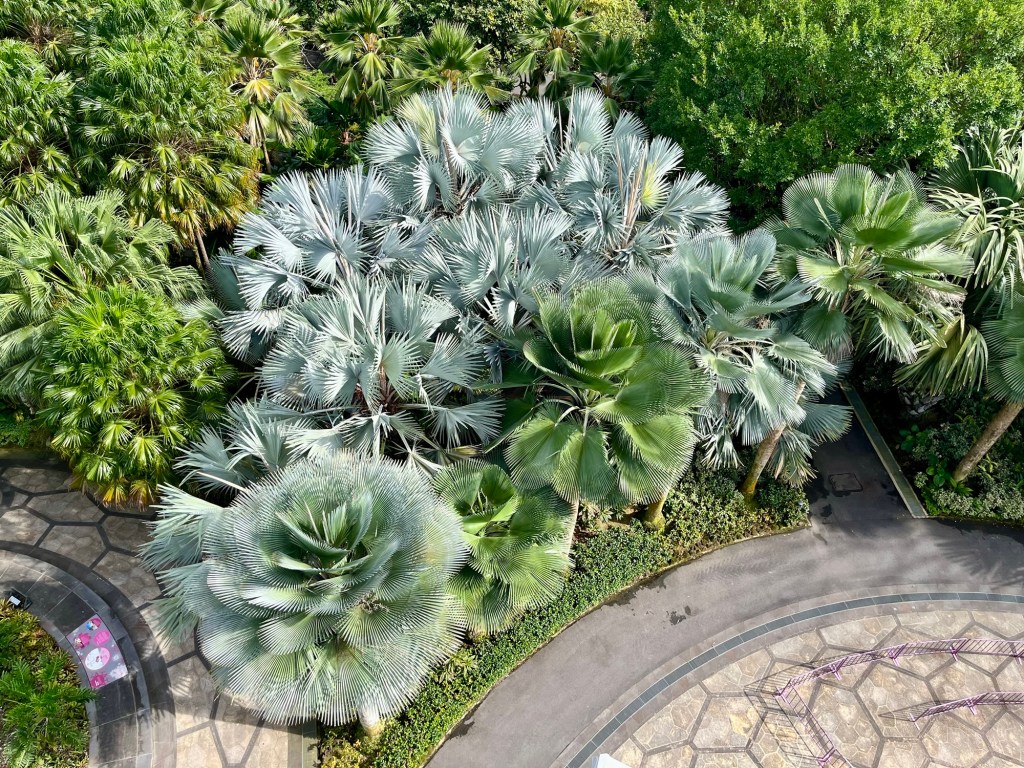
The palms below, probably 20 to 30 feet tall, looked like cabbages from up here.
That’s the core of the downtown in the background.

We had a good view of the United Buddy Bears from up here, too. Kinda like a modern-day Stonehenge from this vantage point.
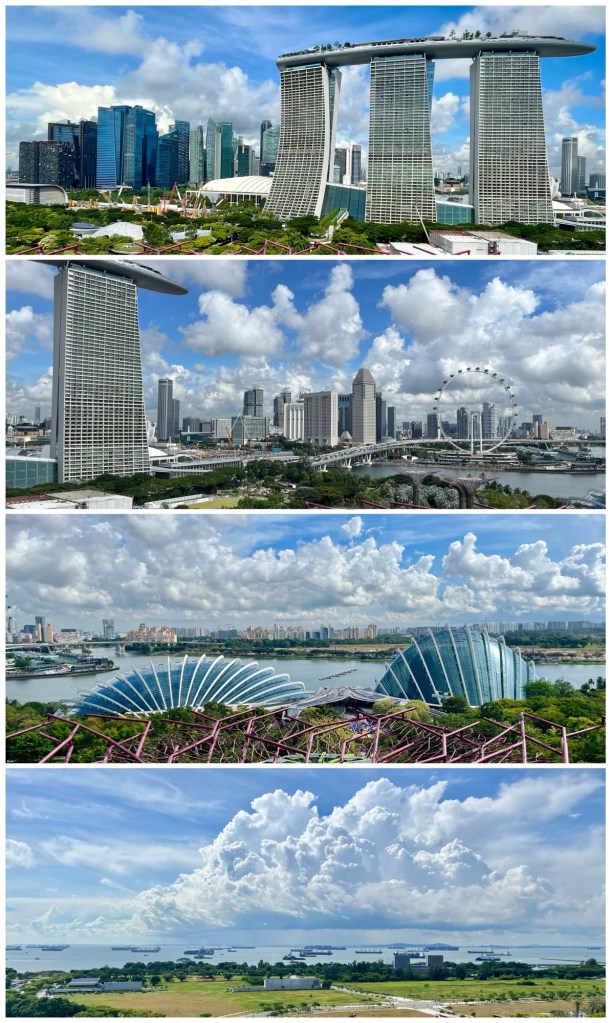
The tallest Supertree is called the Observatory. Here’s the view from there:

And here’s the view of Singapore from the top of the Supertree Observatory, looking west (top photo), north (next two), then south (bottom), out over the Singapore Strait which connects to the Strait of Malacca:
Back on the ground, we looked up at the Supertree Observatory to see an electrician out on the branches fixing the lighting. We saw him while we were up there, tethered to the structure by a rope and carabiner. They couldn’t possibly pay this guy enough.
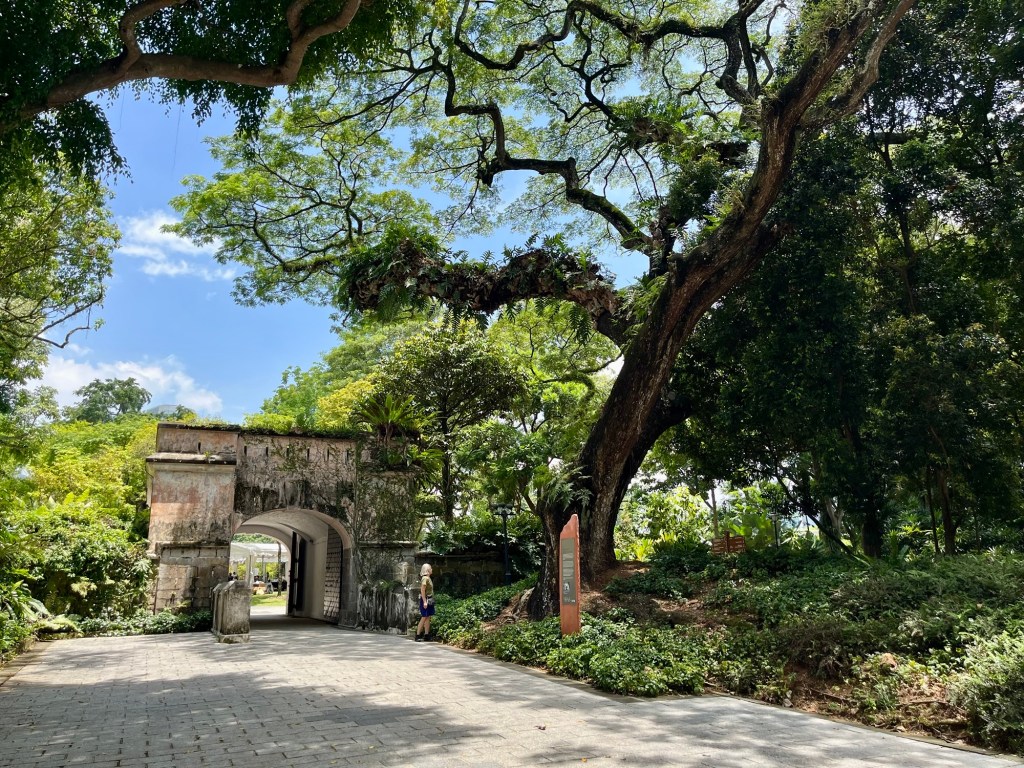
On another day, we wandered around the downtown area, stopping to see Fort Canning, built in 1861 by the British to protect Singapore from seaborne attacks. This photo is of the Fort Gate, the main entrance to the fort.
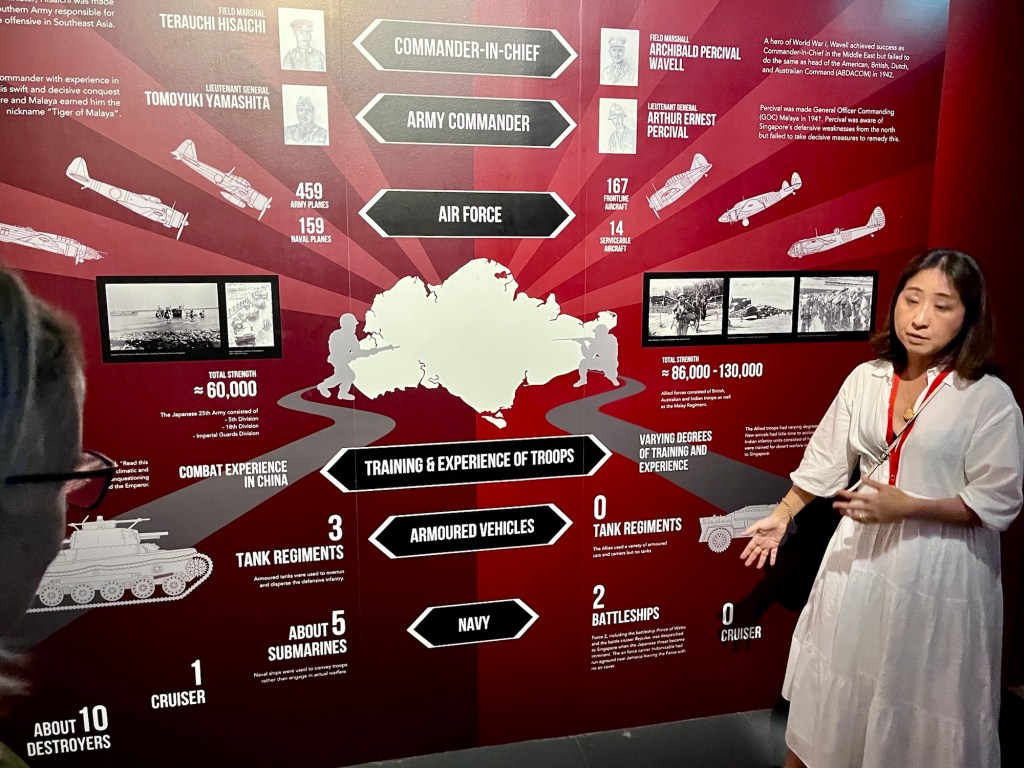
We also visited the adjacent National Museum of Singapore for an explanation of Singapore’s history from a well-informed docent. Below, she is describing the Japanese attack in 1942.
Singapore’s population of a little over 6 million people is a mixture of ethnicities, Chinese, Malay, Indian and European, and all religions seem to be represented here.
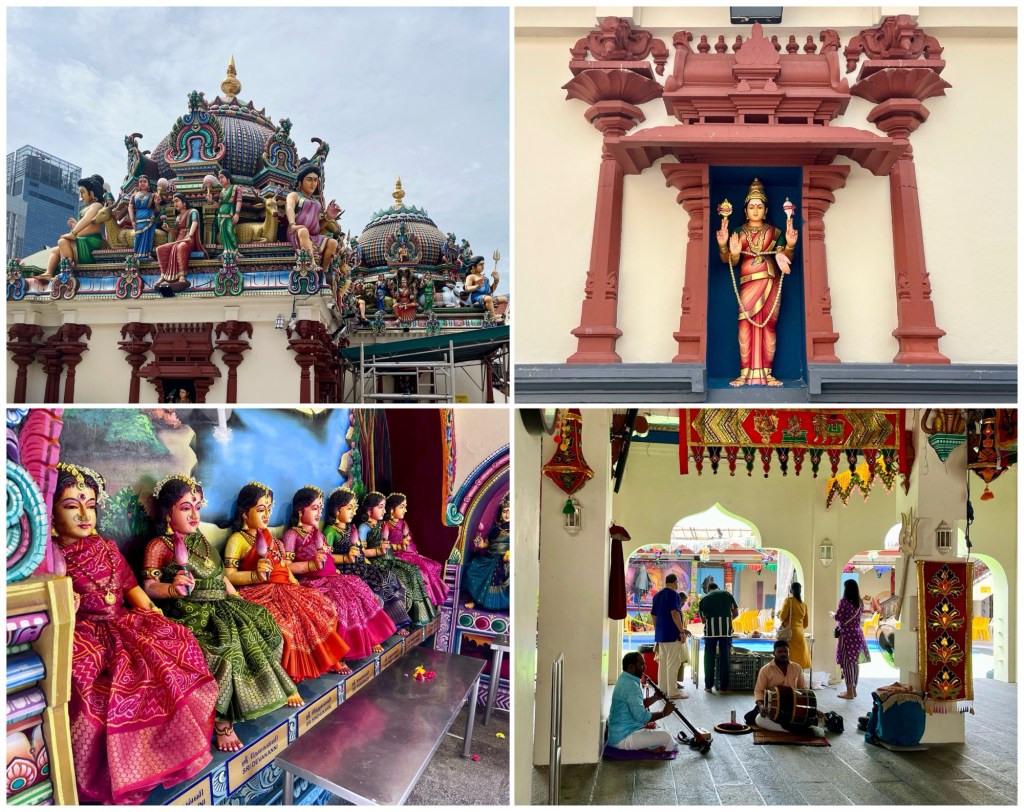
Walking to visit Chinatown, we stumbled upon the Sri Mariamman Temple, the oldest Hindu temple in Singapore, built in 1827.
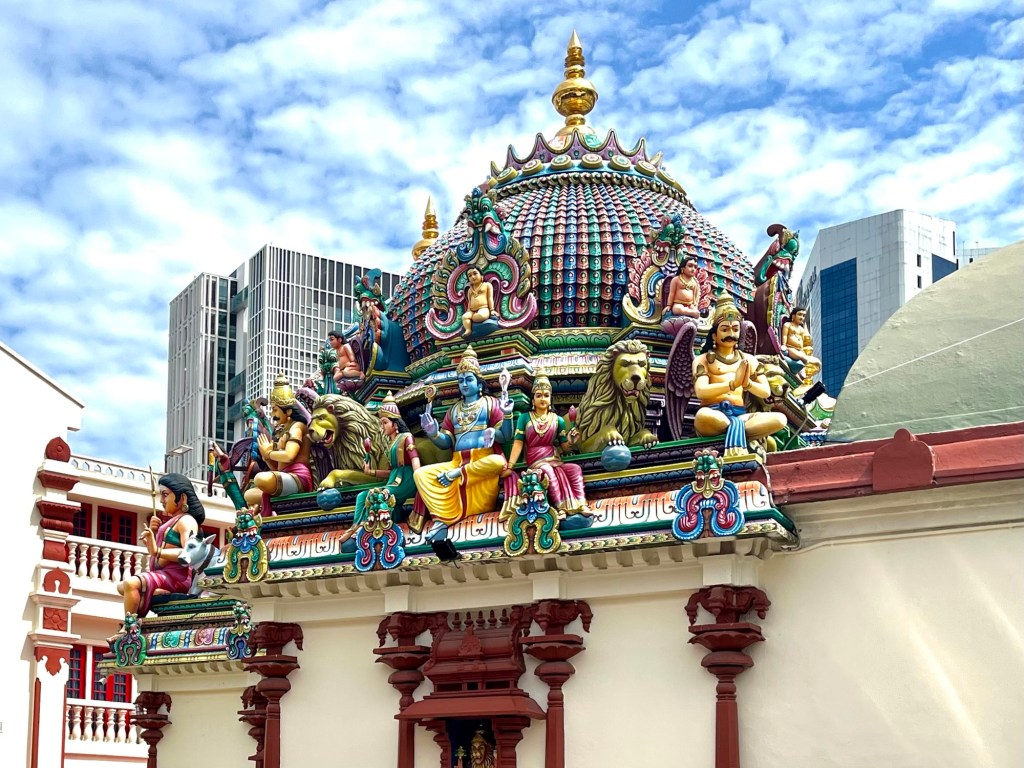
In the early years, this was the only temple in Singapore whose priests were authorized to solemnise Hindu marriages. It’s still an active temple.
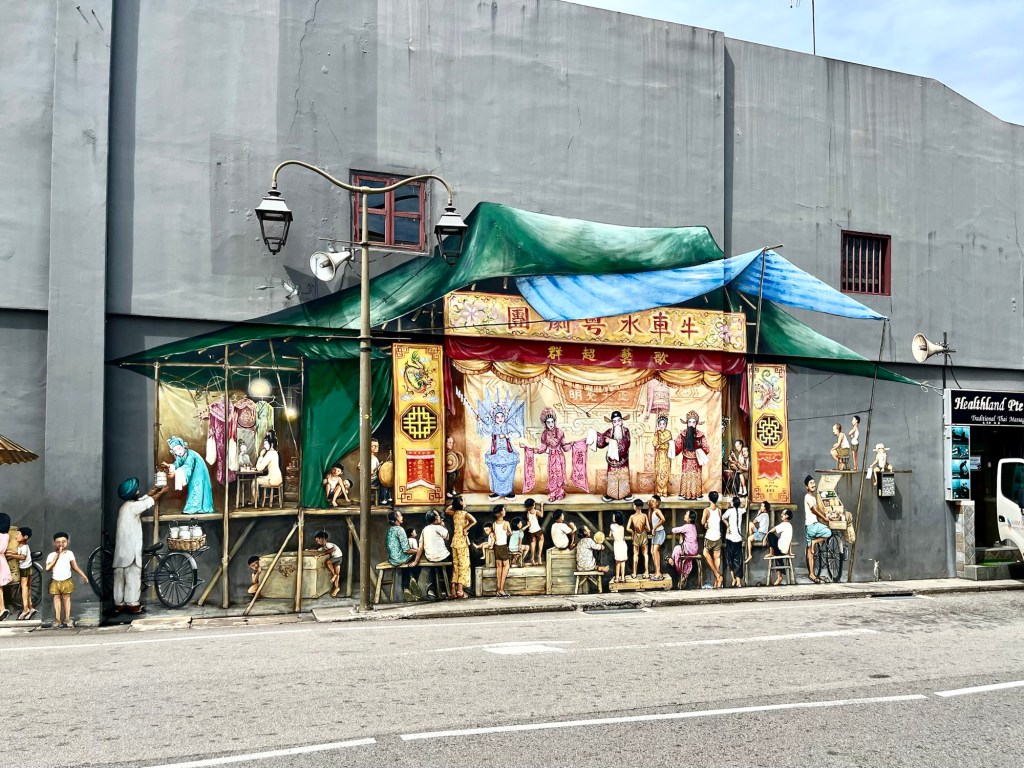
Here’s a mural at the entrance to Chinatown. There were several around town. We only spent a few minutes in Chinatown itself; it’s much like any other.
More about the Gardens by the Bay to follow in my next post…
 The Road Less Traveled