In my last post I called Singapore an “island city-state,” by which I meant it is all three: an island; a city; and a nation. Singapore is a fully developed, urban country and one of the leading financial and high-tech capitals of the world. And yet it isn’t even as old as me.
Singapore Island, the size of Crater Lake National Park in Oregon, sits just off the southern tip of the Malay Peninsula. Imagine Crater Lake filled up with 6 million people and you have an idea of the population density here.
Modern Singapore is an architectural wonder. Almost everyone lives in a high-rise. It’s part of government planning here. Everyone contributes (ie., is taxed) to fund housing, healthcare and retirement for all Singaporeans.
As I understand it from speaking with a few of them, every Singapore citizen has a right to free health care, a pension, and subsidized housing. I’m not talking about Section 8 public housing like we have in the U.S.A. I’m talking about a modern condominium in a high-rise tower with state of the art appliances.
On the other hand, it’s illegal to spit on the sidewalk and chewing gum is illegal. First-time offenders came be fined S$1,000 (US$773). And you can be executed for dealing drugs.
Although Singapore has an elected unicameral parliament, a single party has dominated political life since the country became independent in 1959 under the leadership of Lee Kuan Yew (1923-2015), viewed from the West as an authoritarian leader.
Lee Kuan Yew served as the country’s first Prime Minister (1959-1990) and subsequently in the Cabinet as Senior Minister (1990–2004). His son, Lee Hsien Loong, succeeded him as Prime Minister from 2004 to 2024.
Strong executive government can work very well, like here in Singapore. It can also fail spectacularly, like in Turkmenistan.
Speaking of Turkmenistan, there were echos of Ashgabat here. Amazing modern architecture everywhere you look. And everything clean, polished and organized.
Here’s the view from our hotel:

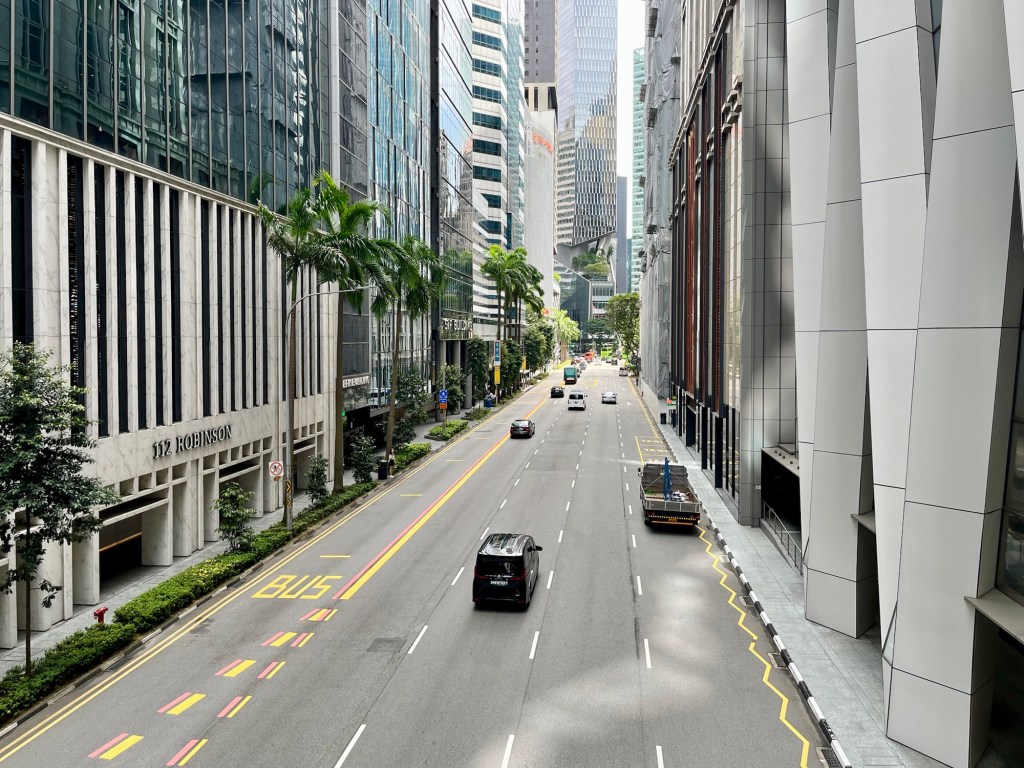
And this is what a typical downtown street looks like on a weekday morning (it gets a lot busier as the day wears on):
As I mentioned in my last post, we spent two days visiting the 260-acre urban park known as Gardens by the Bay. The Gardens opened in 2012.
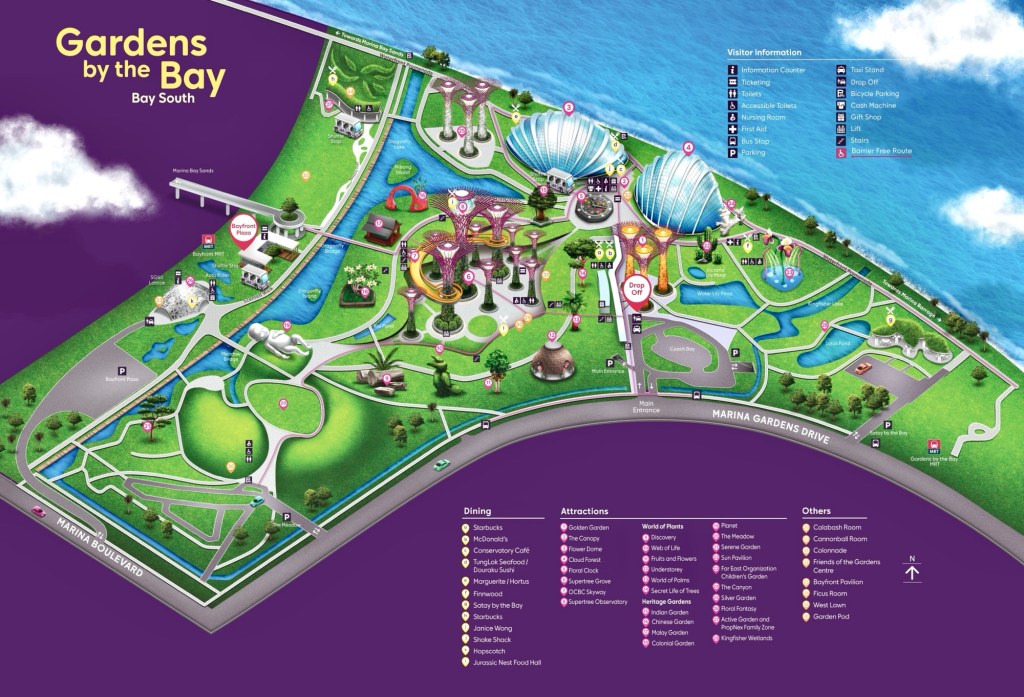
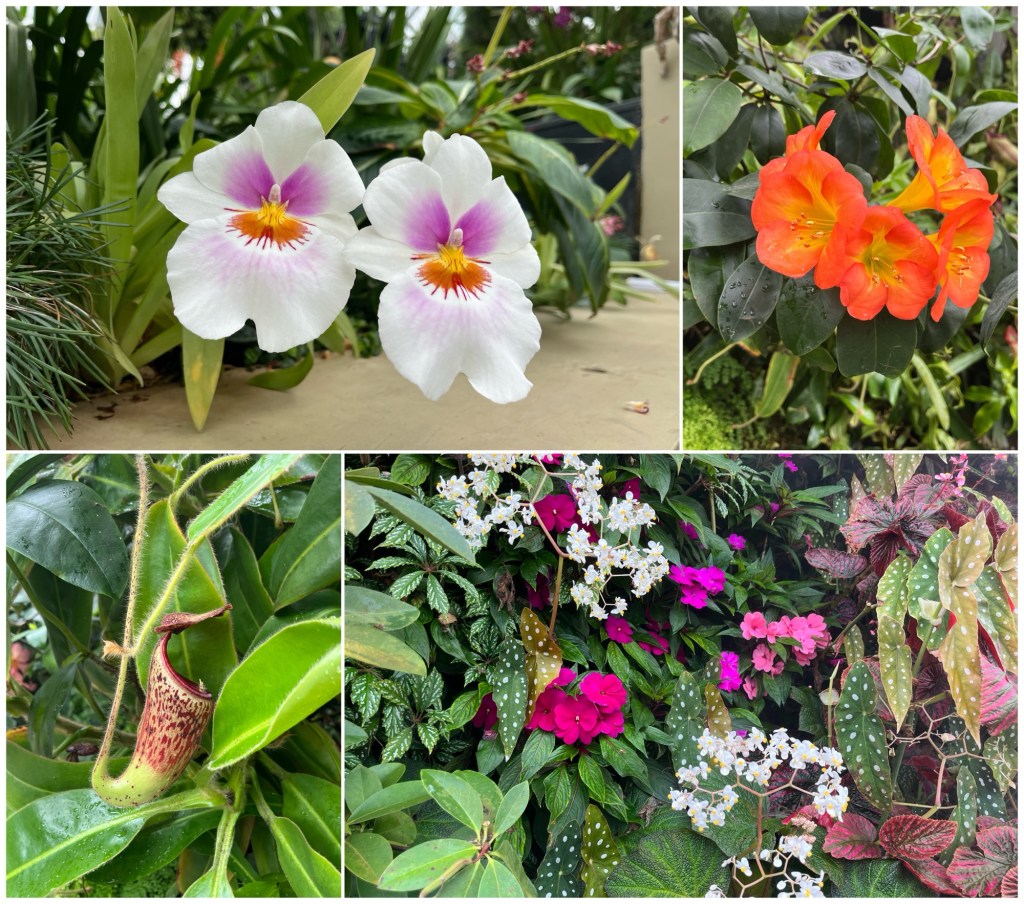
Although we found the Skytrees that we visited on a different day to be fascinating, most people these days come to the Gardens to visit Cloud Forest and the Flower Dome which combined display 2,000 exotic species of plants with over 1,500,000 on display.
Cloud Forest has a Jurassic Park theme. Here’s what greets you upon entry:
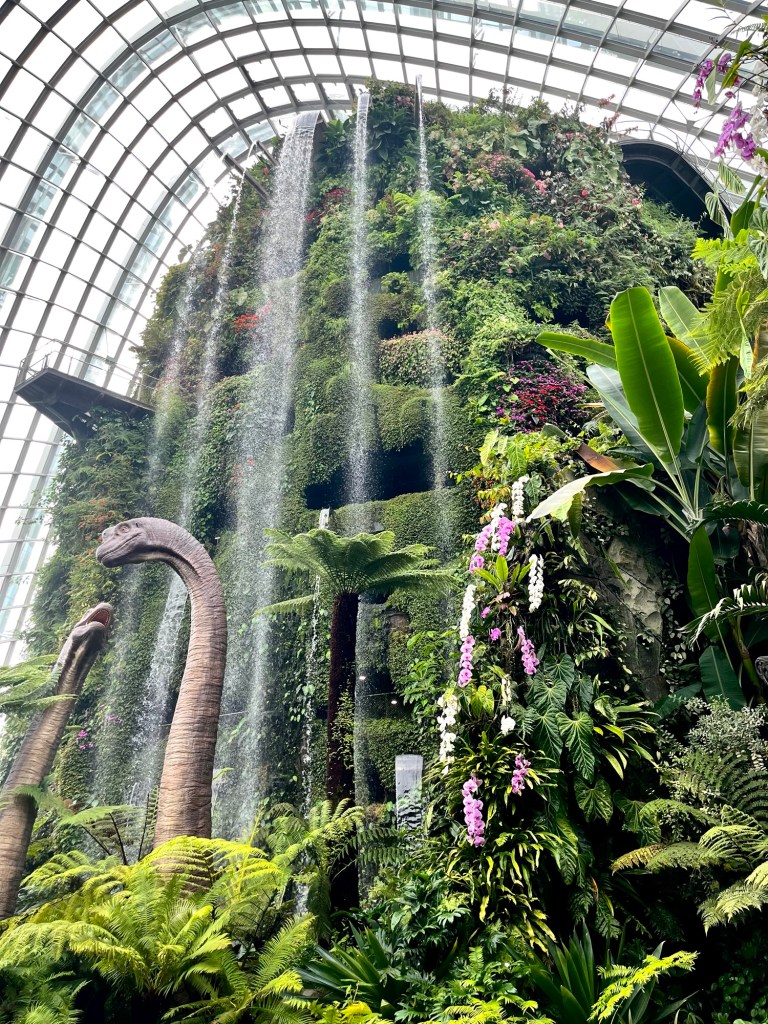
And around the corner is old T. Rex himself, right out of the movie, complete with robotic movement and roars of the jungle.

Cloud Forest is essentially a giant greenhouse covering two acres. It replicates the cool, moist conditions of tropical mountain regions found in Southeast Asia and Central and South America, and the vegetation reflects that.
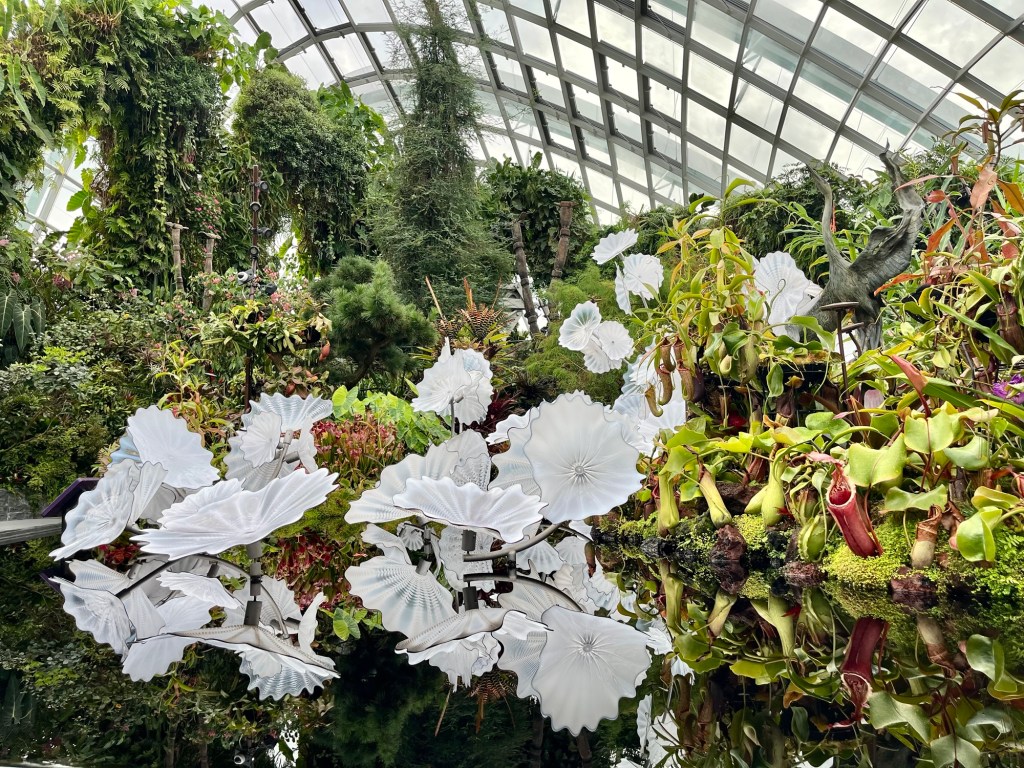
Like many places around the world, Cloud Forest had a Chihuly glass exhibit (his studio, by the way, is in Seattle, nearby our house in Washington).
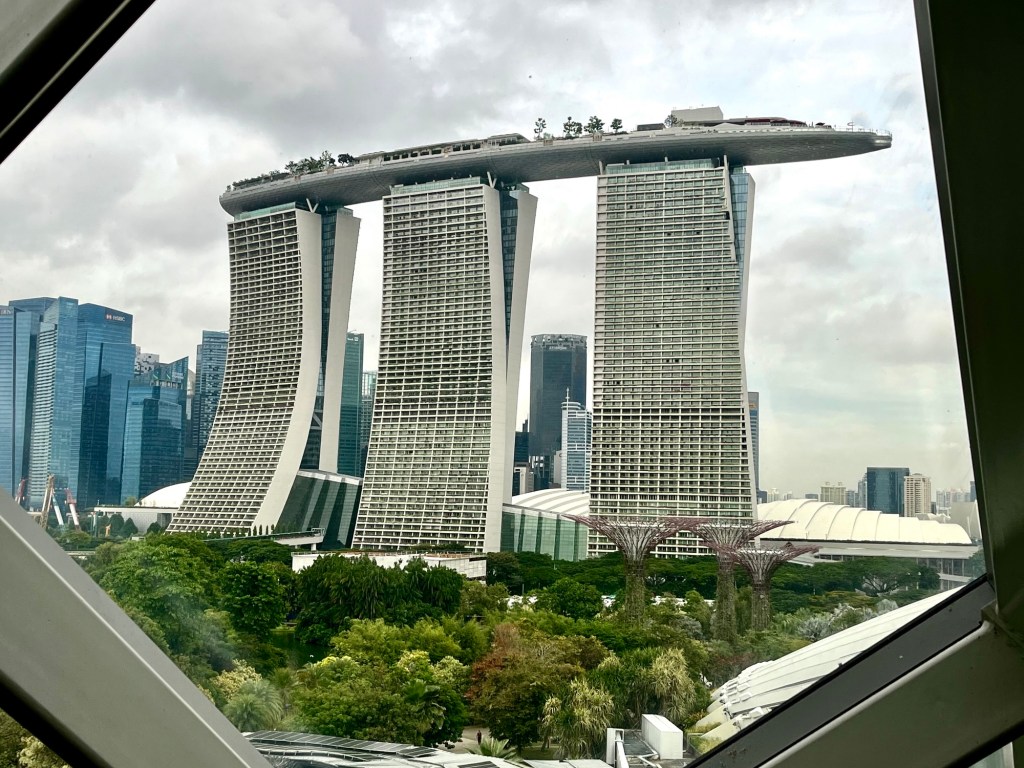
After passing the waterfall and dinosaurs at the entrance to Cloud Forest and walking around the base of the “mountain,” we took the elevator to the top and walked back down on the spiraling suspended path. There was a great view of Marina Bay Sands hotel from there:
Here’s a view of the suspended skywalk:

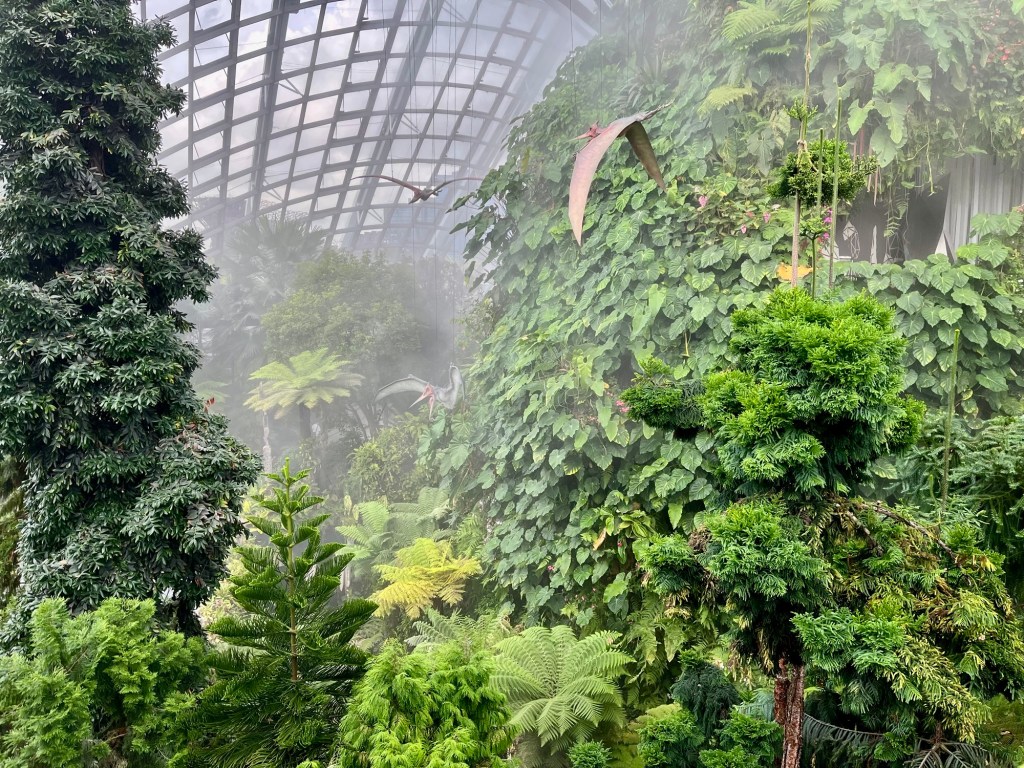
About halfway down, the misters turned on, creating a very Jurassic effect, complete with pterodactyls.
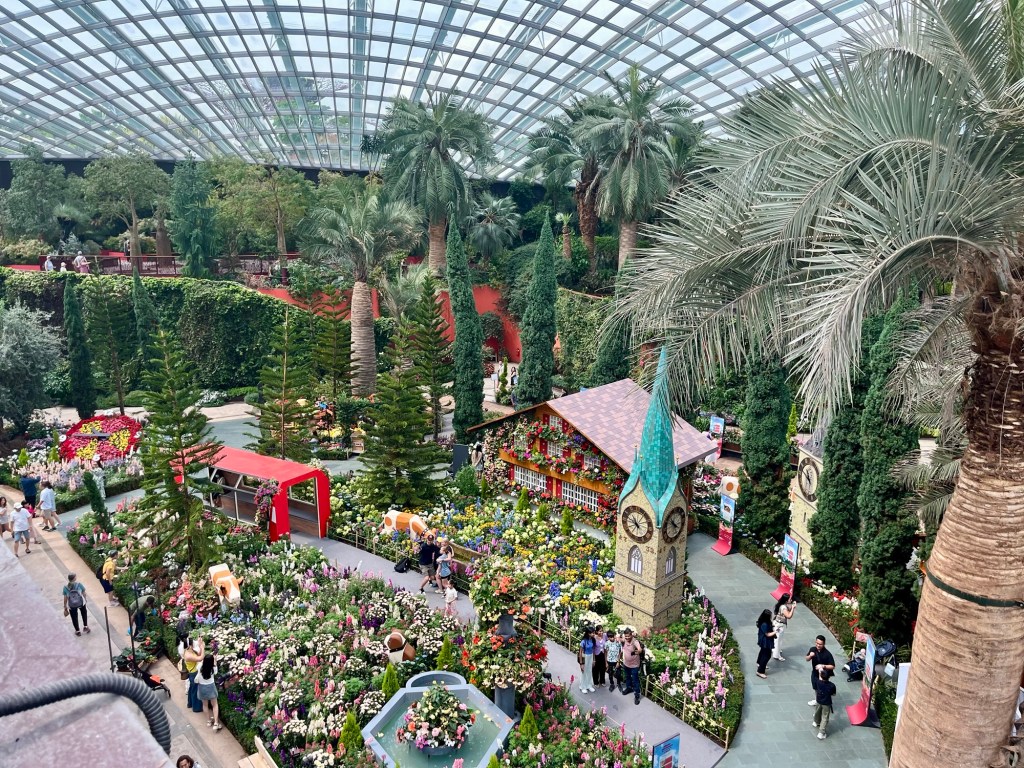
From Cloud Forest, we made our way over to the Flower Dome, the largest greenhouse in the world according to Guinness Book of World Records. It covers three acres and presents as a cool-dry mediterranean climate, divided into plant zones representing the Mediterranean, South America, California, Australia and South Africa, with special gardens for succulents, baobabs and an olive grove.
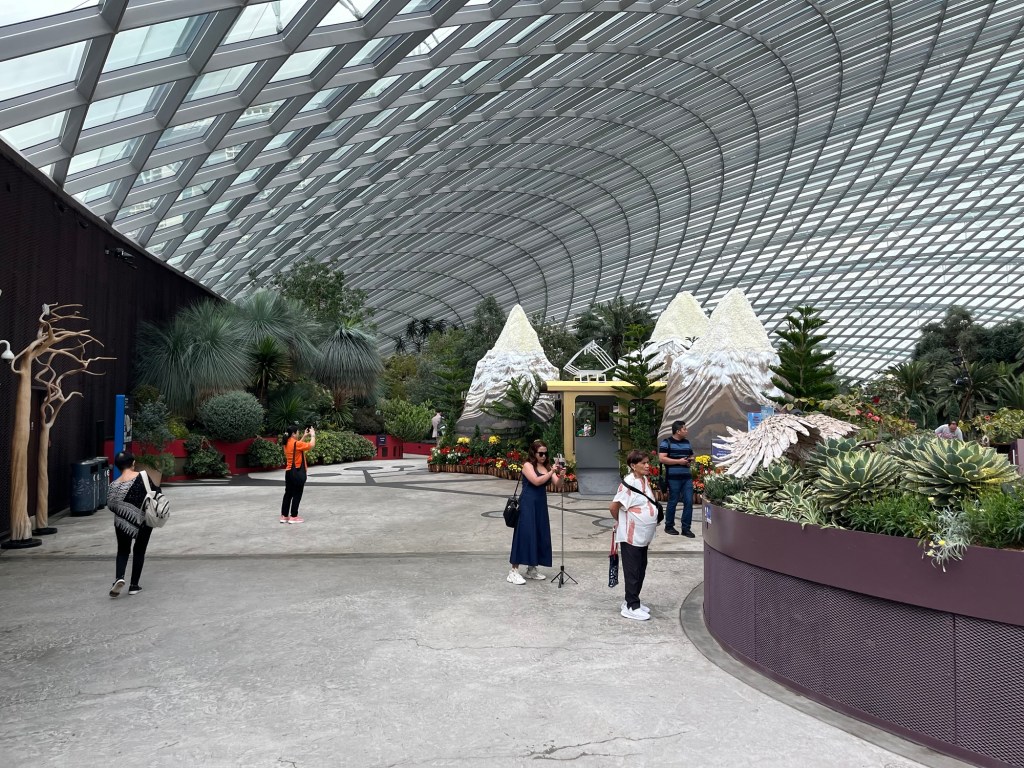
We especially enjoyed the succulents:

The Flower Dome also has an area for rotating exhibits. The current exhibit is called Alpine Adventure.
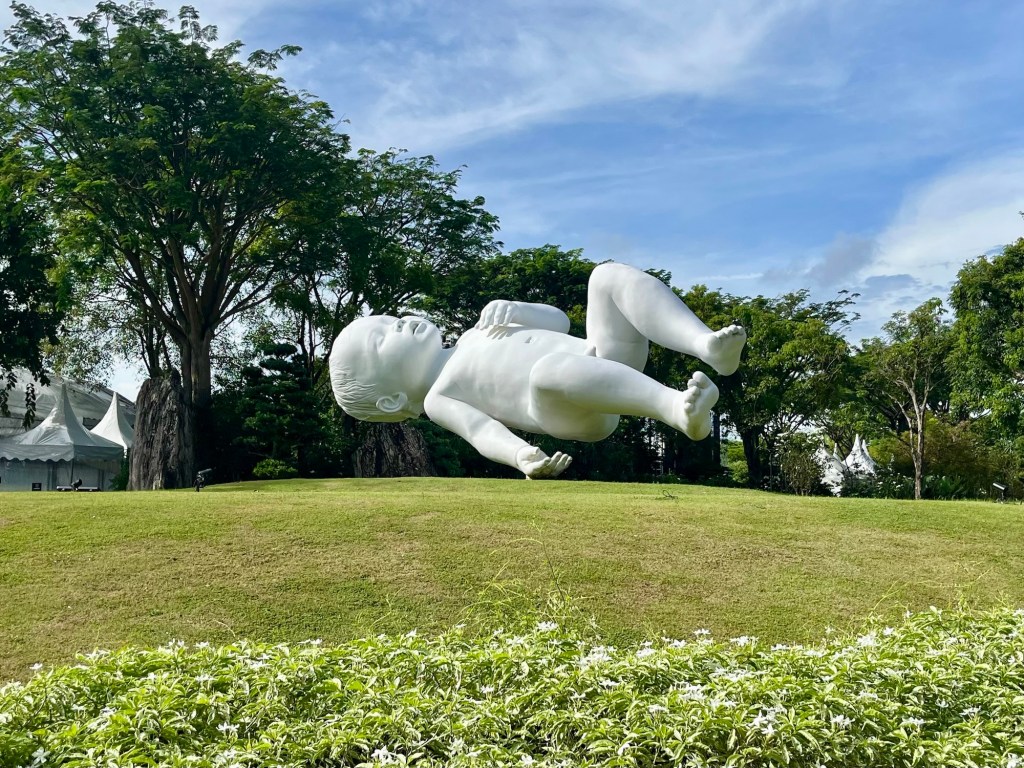
From the Flower Dome, we walked over to Marina Bay Sands, passing the 7-ton sculpture by British artist, Marc Quinn, called Planet. The model for the sculpture was Quinn’s 7-month-old son, suspended in mid-air as if in zero gravity or floating in a womb. The structure’s massive weight is balanced on a single point at the baby’s right hand.
Marina Bay Sands opened in 2010 with 1,850 hotel rooms in three 57-story towers connected at the top by a 1,120-foot long skyway, park and observation deck. Together with the rest of the Marina Bay Sands complex, it took four years and $8 billion to build. We paid the entrance fee and took the elevator up to the top, 650 feet above ground.
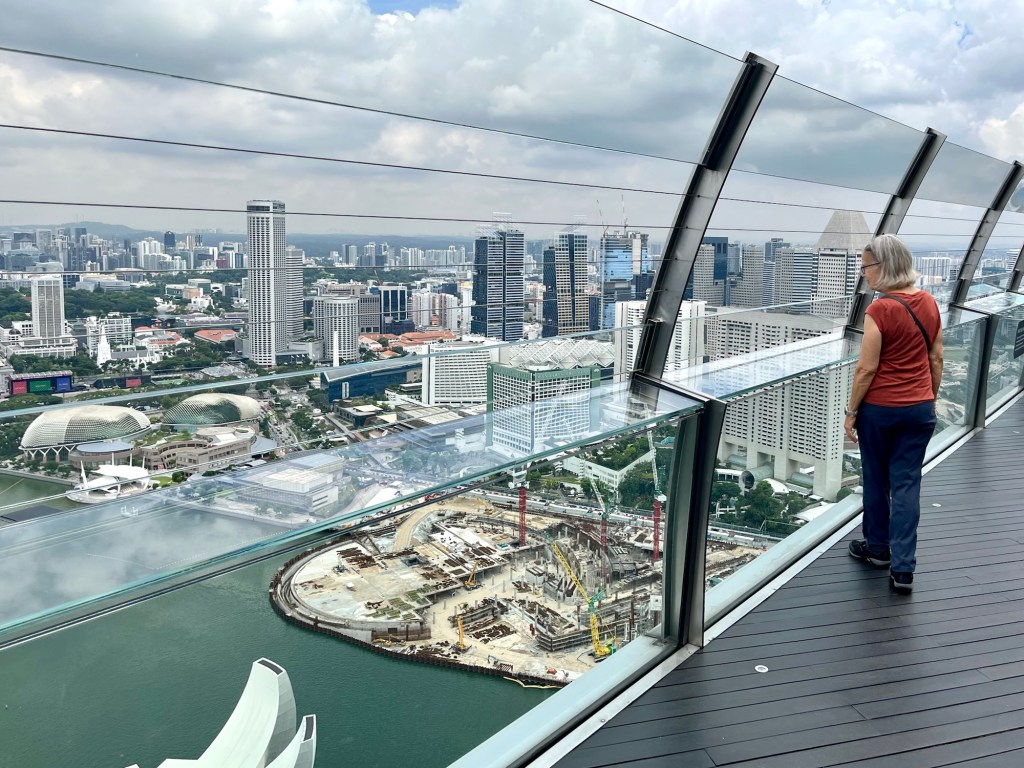
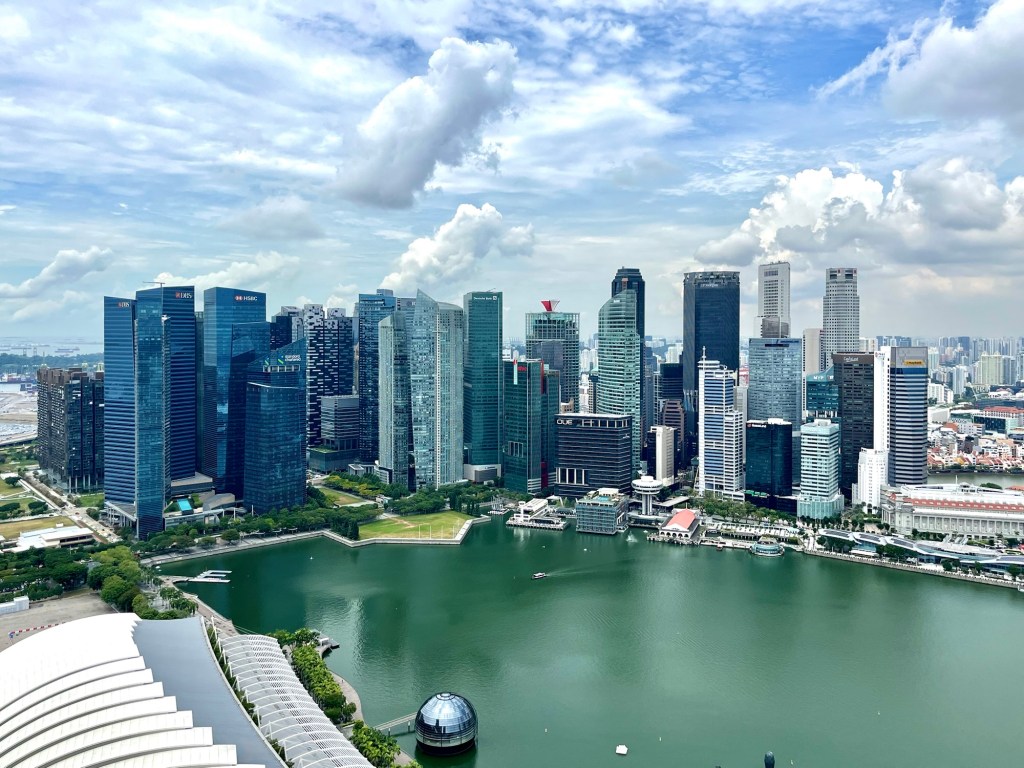
Here’s downtown Singapore from the top of Marina Bay Sands:
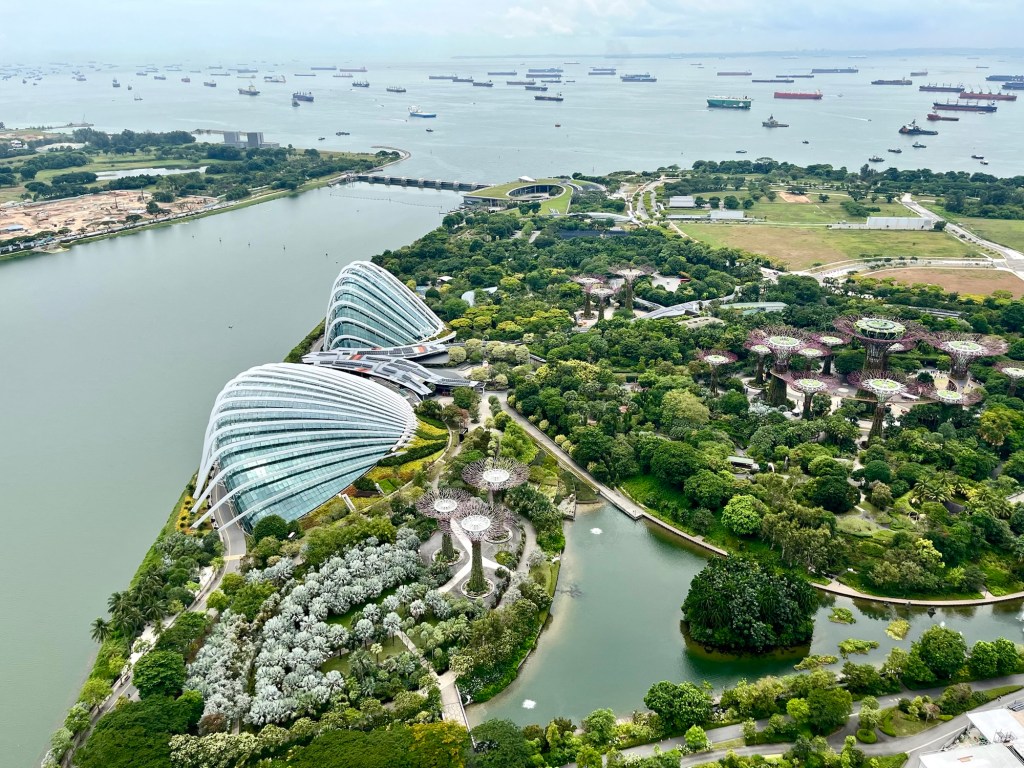
And here’s a view of Singapore Strait where it joins the Malacca Strait. Look at all the ships at anchor out there. Those two glass domes are Cloud Forest (farthest) and the Flower Dome (nearest).
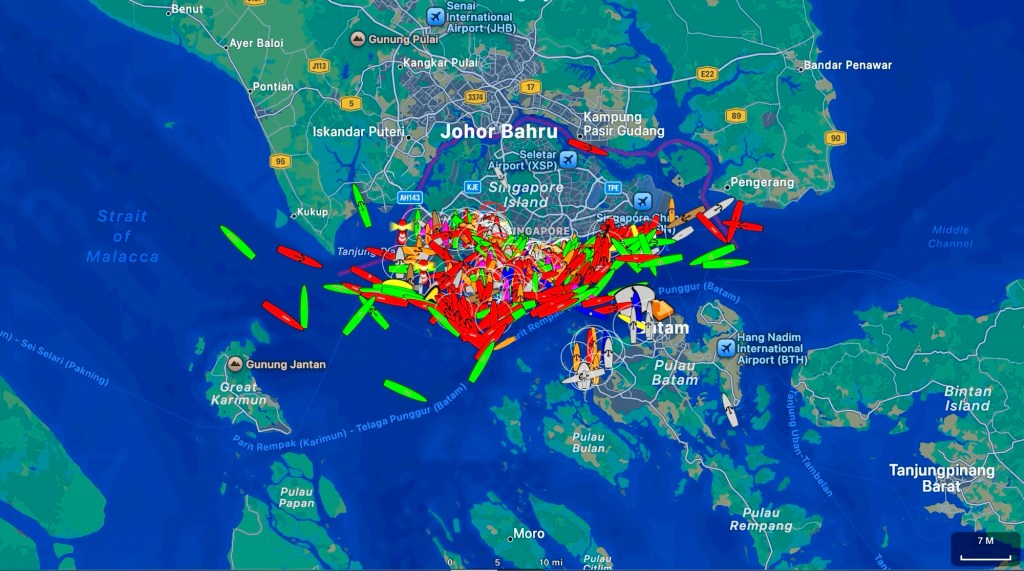
Here’s a different perspective from a ship-tracking app that also shows the outline of Singapore Island. The red ships are tankers; green are cargo vessels; and orange are working boats, like tugs. What a traffic jam!
Next stop, Malaysia.
 The Road Less Traveled