The country of Malaysia came into being in 1963 as a consolidation of four former British territories: Malaya; Sarawak; Sabah; and Singapore, whose participation was short-lived, seceding after just two years to become an independent nation.
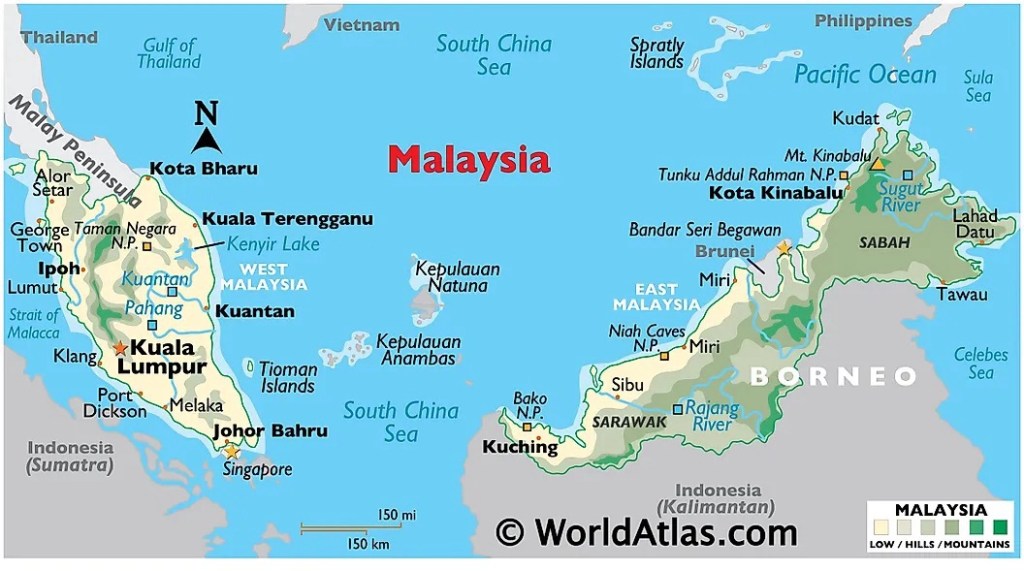
As you can see from the map, below, the country today is split between “Peninsular Malaysia,” formerly Malaya (left), and “East Malaysia” (right), comprised of the former British colonies of Sarawak and Sabah on the island of Borneo, separated on the coast by the independent islamic sultanate of Brunei. Malaysia is a federal constitutional monarchy with a bicameral legislature.
Like Brunei, Malaysia is a predominantly muslim country and Islam is the nation’s “official” religion. About a third of the women seem to wear traditional islamic dress with headscarves.
The country’s capital is Kuala Lumpur on the western peninsula, from which we will ultimately leave in about two weeks. Malaysia is now divided into 13 states – 11 on the peninsula, plus the states of Sarawak and Sabah on Borneo which, by the way, control their own borders and immigration independently from the rest of the country.
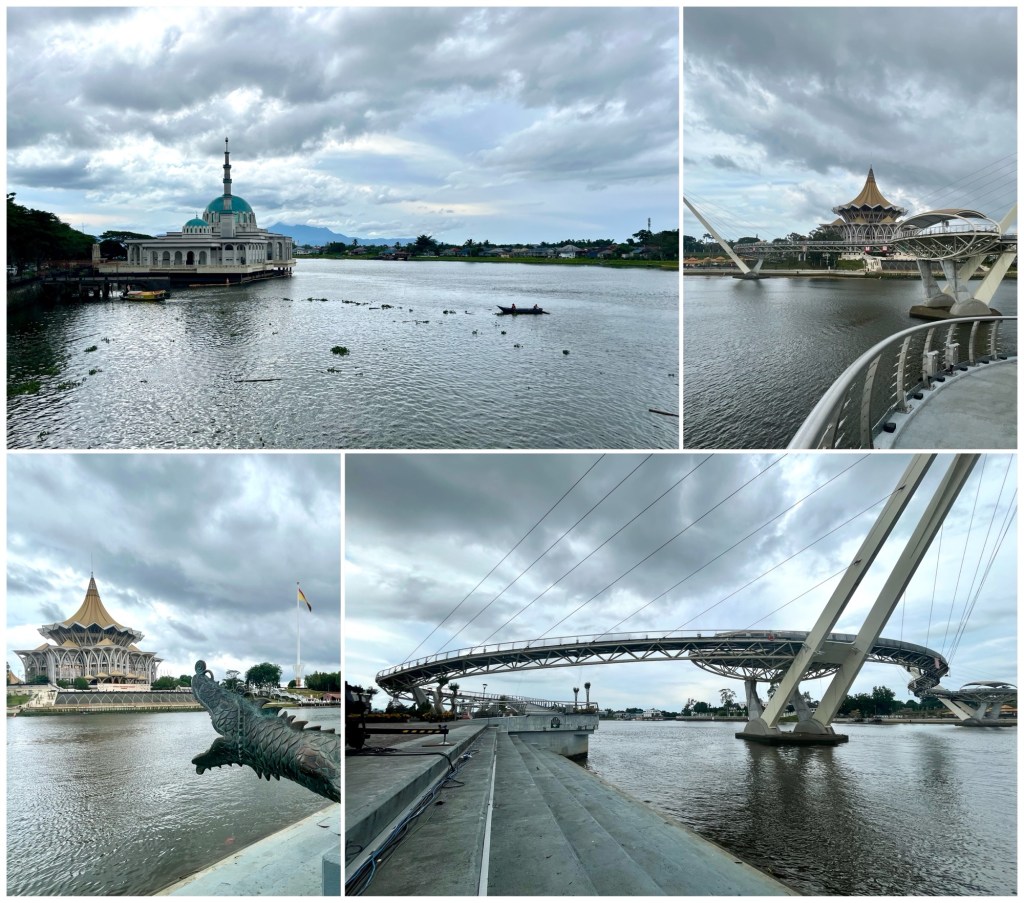
We arrived in Malaysia from Singapore at Kuching, the capital of Sarawak, and took a taxi to our hotel on the riverfront, the Ranee Boutique Hotel. Out our window we could see the Sarawak State Legislative Assembly Building on the other side of the Sarawak River (photo below, top right and bottom left).
Although it was raining when we arrived, we went for a short walk along the riverfront to a mosque built out over the river (top left) and then halfway across the Darul Hana pedestrian bridge (bottom right) before looking for somewhere to have dinner.
Kuching was merely a transit point for us, although we did stay two nights in order to visit Bako National Park. We had planned for a “down day” in Kuching to do laundry, which gave us time to take a side trip to the Sarawak Cultural Center, arranged through our hotel.
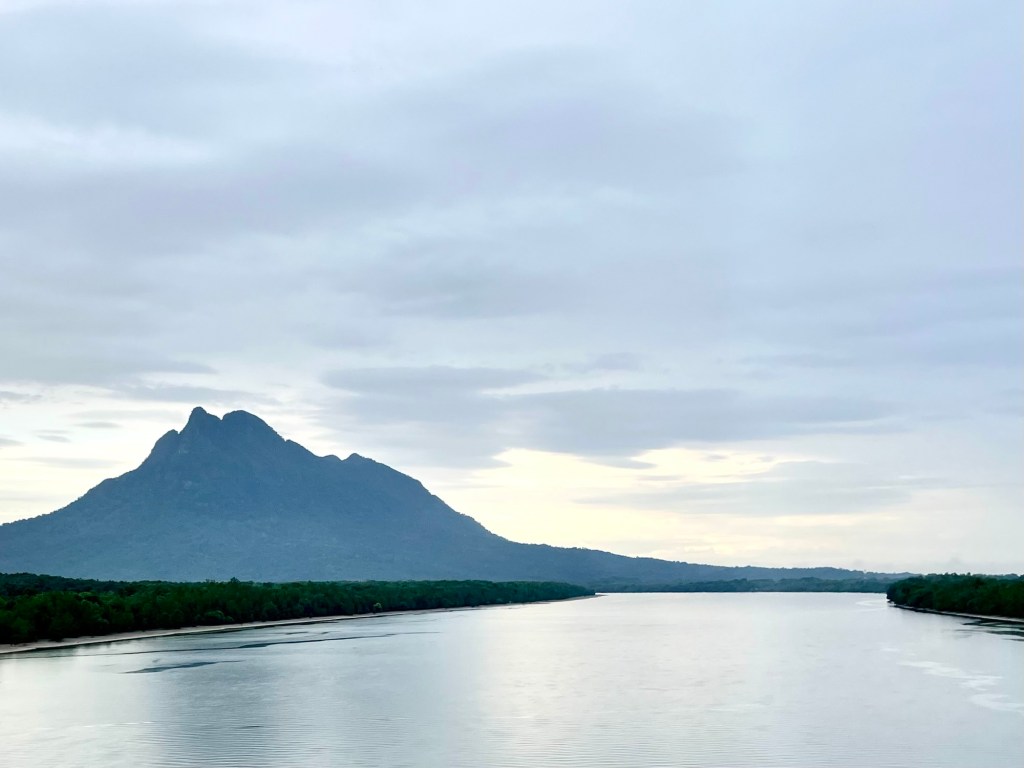
The photo below is of Santubong mountain (elev. 2,660 ft.) off in the distance as we drove out to the Cultural Center.
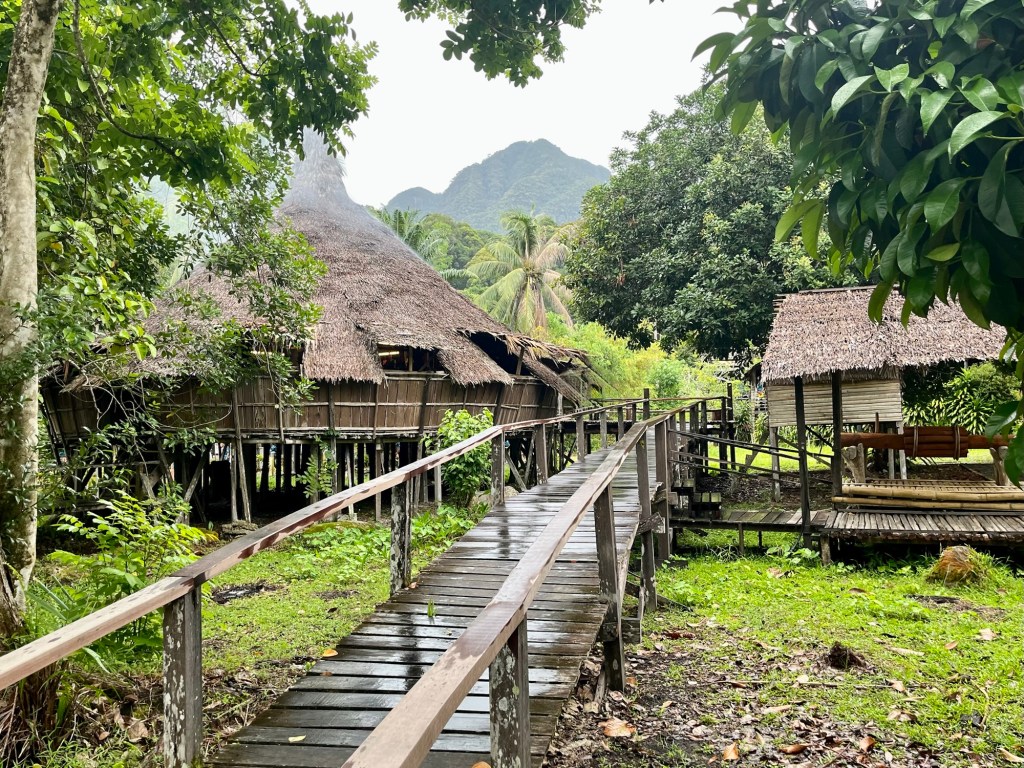
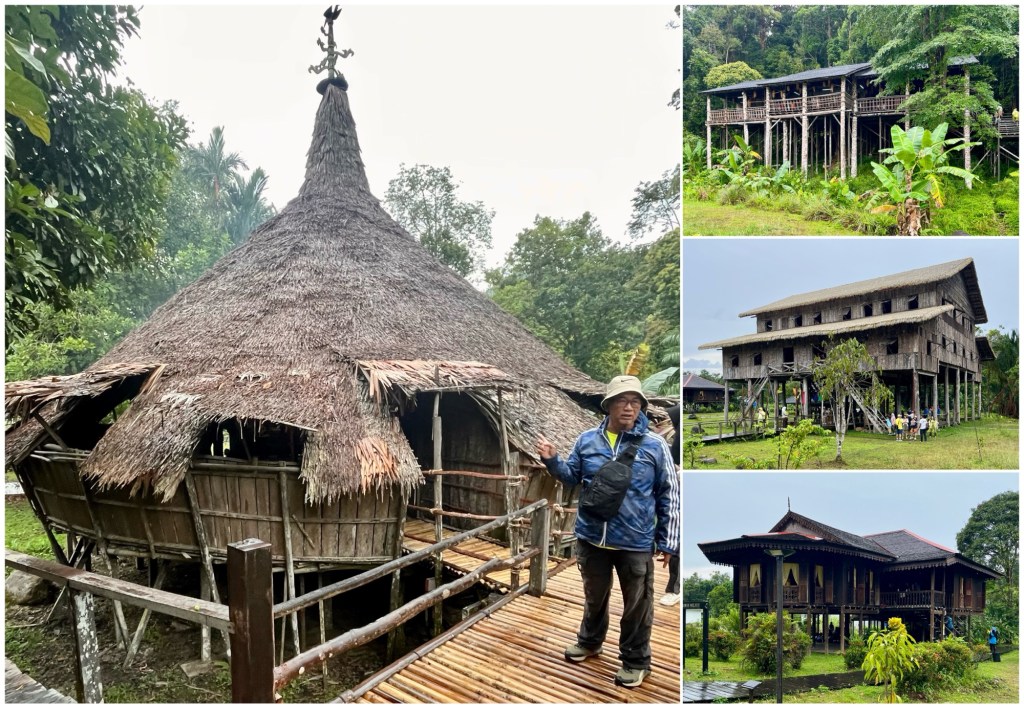
The Sarawak Cultural Village is a living-history museum containing a number of traditional houses and lodges of the indigenous people of Malaysia. We visited four of them. On the left, below, is a round Longhouse of the Bidayuh tribe, an ethnic group native to the island of Borneo:
We came to Malaysia to see its wildlife and rainforests, not for its history or culture, so I’m not going to dwell on those topics, other than briefly in this post.
At the cultural center, we were accompanied by a guide who explained in broken English that the buildings we visited were each from a different ethnicity or tribe, progressing historically from oldest to most modern.
From the photo on the left, then clockwise, they are: the Bidayuh Longhouse; Orang Ulu Longhouse; Melanau Tall House; and the Malay Town House. Only the Malay Town House is currently still built and inhabited in Malaysia.
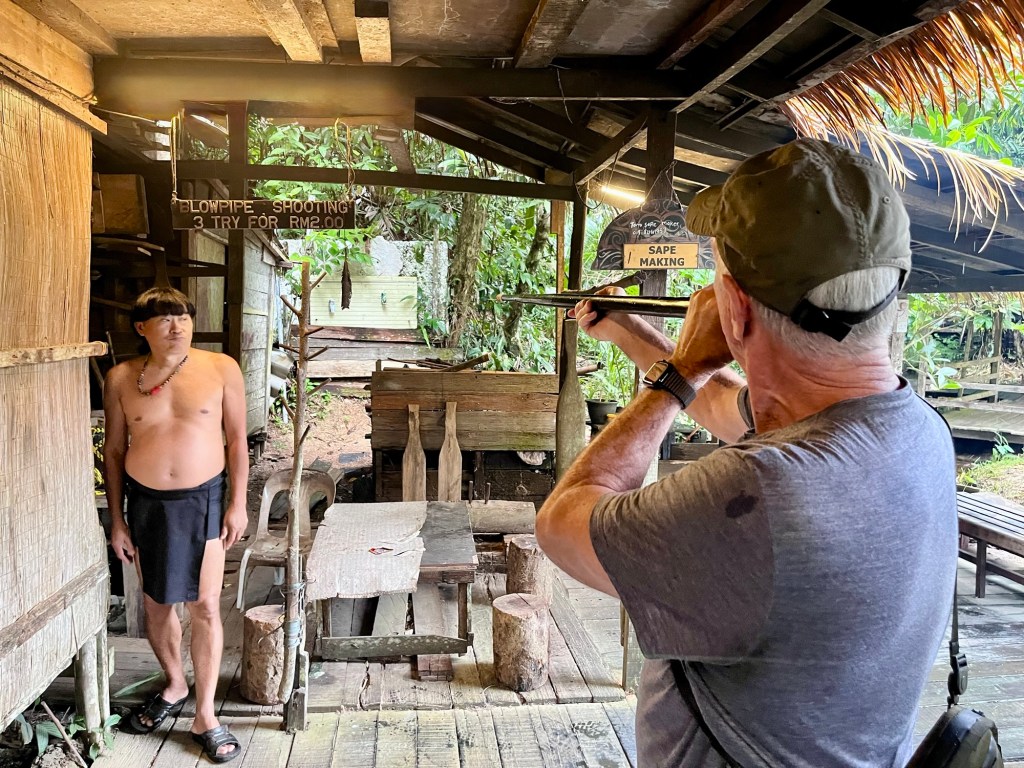
There were several exhibitions of native crafts and traditions. I got a chance to be a blowhard with a blowgun. The local headhunter was not impressed.
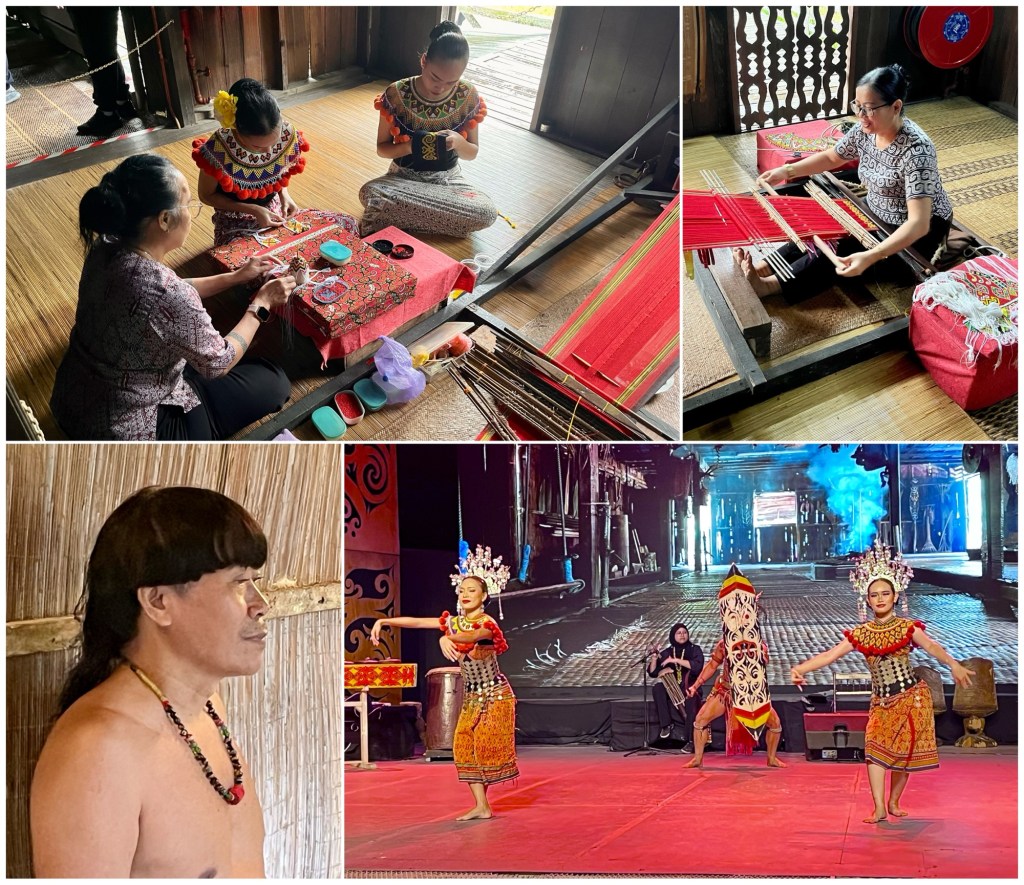
We also got to watch traditional beadwork and weaving. The day ended with a traditional Malaysian dance.
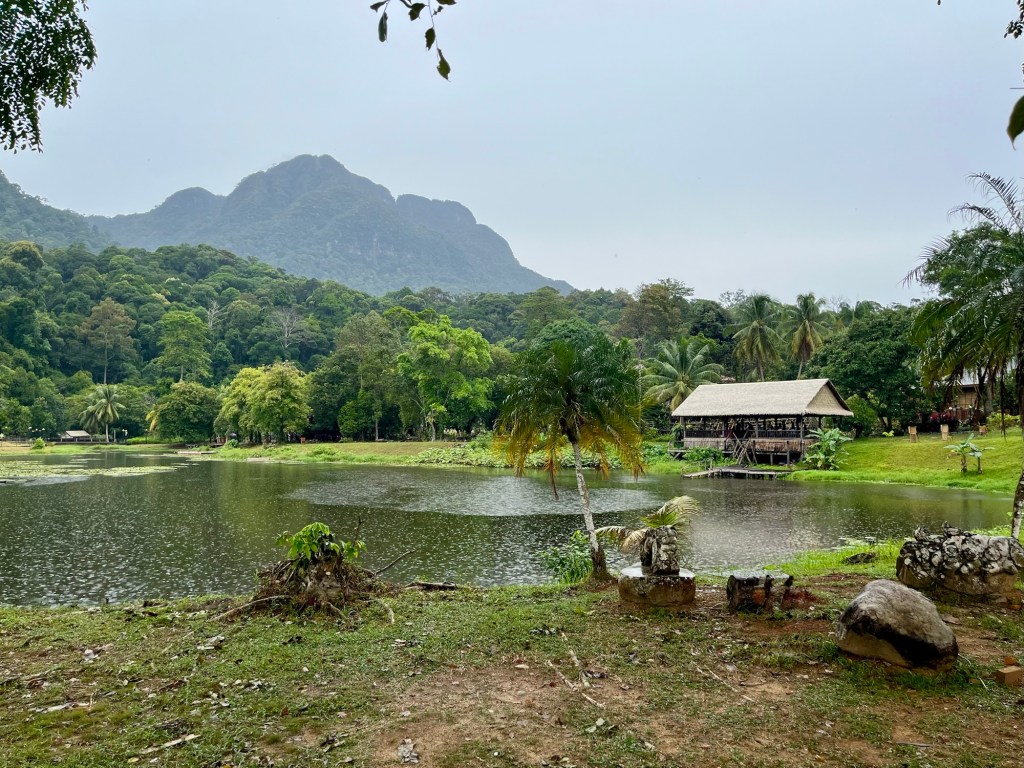
Here’s a view of the cultural center as we left.
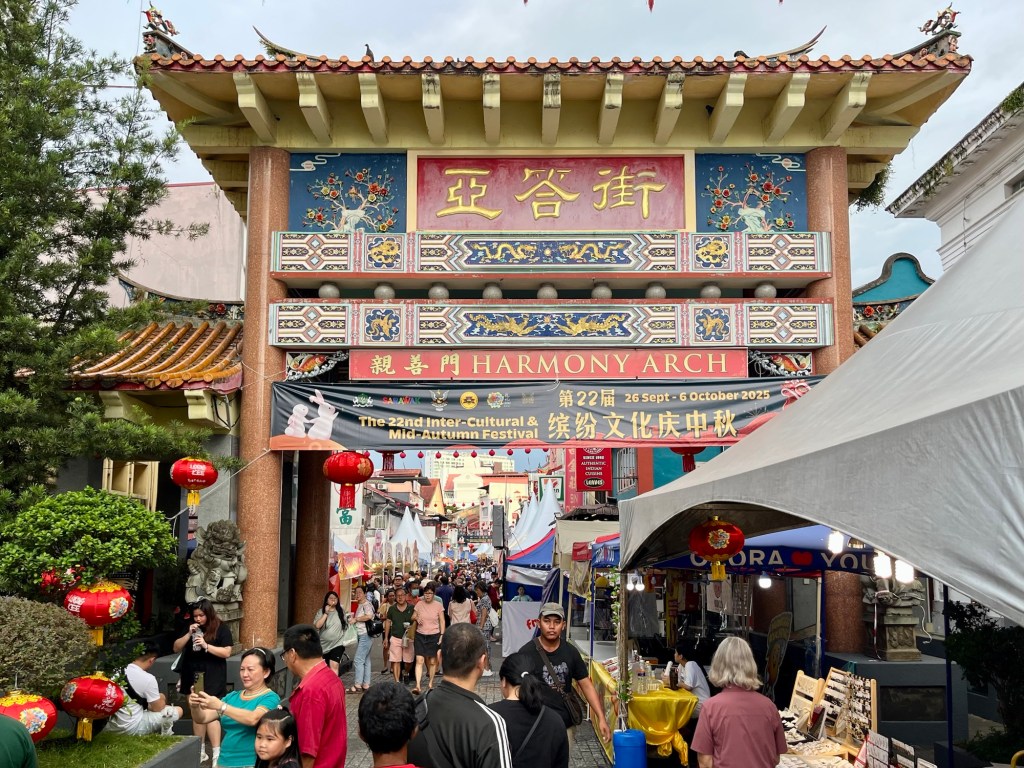
Back in Kuching, we wandered around the central riverfront shopping area, ending at Chinatown, directly behind our hotel.
Tomorrow, a hike in Bako National Park.
 The Road Less Traveled