I left off at Sandakan where we saw the orangutans and sun bears being rehabilitated for repatriation into the forest. Now we’re going to see what animals we can find in the wild.
In the afternoon of Wednesday, October 8, we left Sandakan Jetty for a boat ride up the Kinabatangan, the longest river in this part of Borneo. Here’s a map of our last couple days:
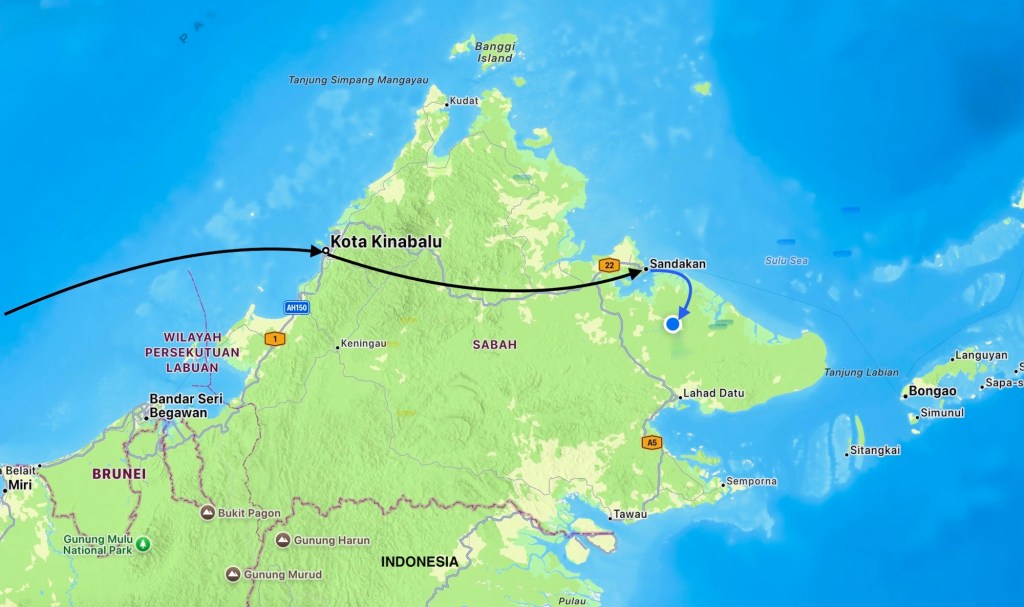
The Kinabatangan River is navigable for 200 of its 350 mile course from the delta at its mouth on the Sulu Sea, traversing a heavily forested plain into the interior. With only minor exceptions, the river and its tributaries are the only means of transport and communication between the interior and the coast.
Heading out from Sandakan Jetty, we could easily see from the change of water color where we entered the river, laden with sediment.
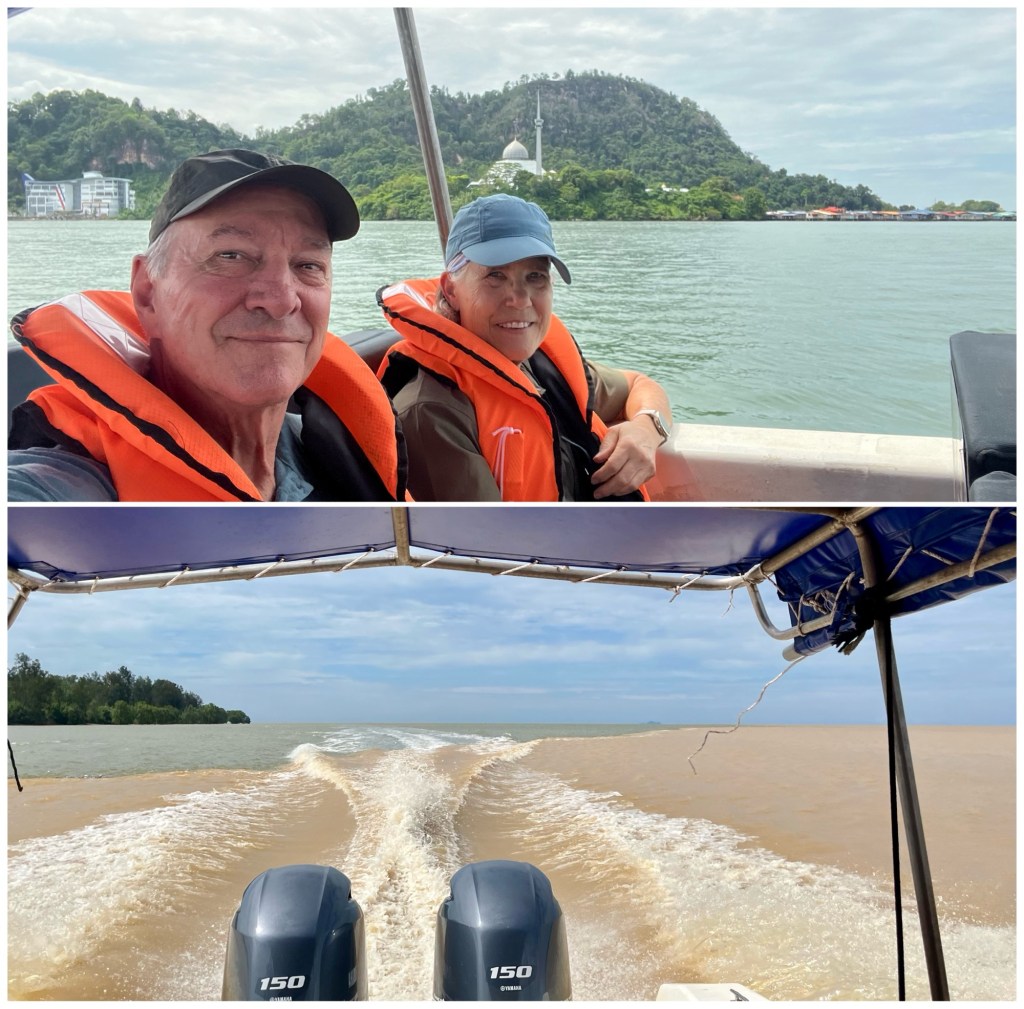
[As an aside, note in the top photo above the mosque in the distance. Unlike Sarawak, the state of Sabah appears to be nearly completely Muslim. Nearly all women wear a scarf.]
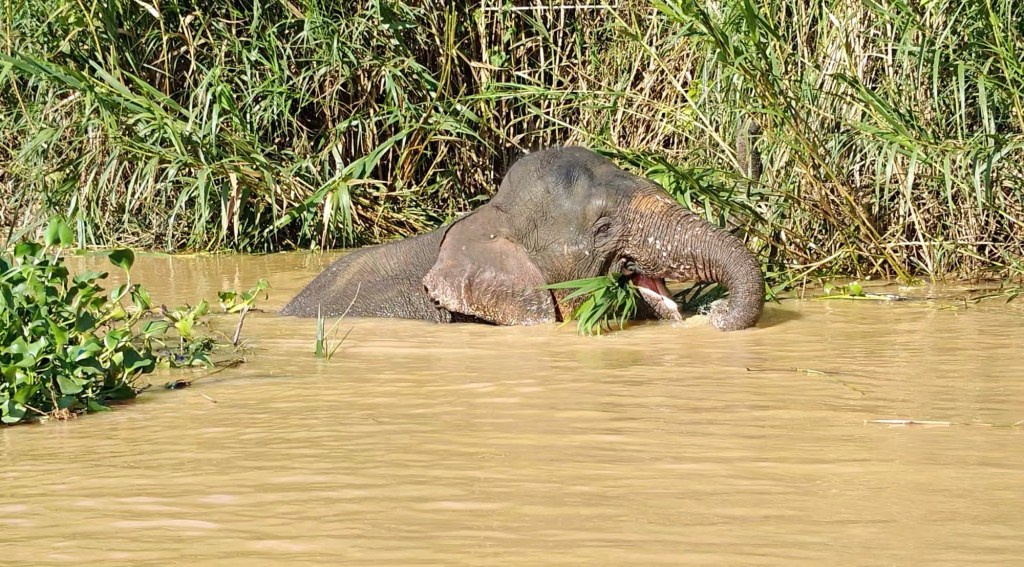
We traveled upriver, docking briefly twice to register with river authorities. At one stop, we spotted an Estuarine Crocodile, but I wasn’t able to get any decent photos. A little while later, we came upon a Borneo Pygmy Elephant and her baby.
Unbeknownst to us, our captain and guide had been constantly on the lookout for the “Borneo Big 5,” the wildlife of Kinabatangan that all visitors hope to see.
The brochure describes the Big 5 as:
“the ever popular Orangutan, elusive Borneo Pygmy Elephant, majestic Rhinoceros Hornbill, unusual Proboscis Monkey, and mysterious Estuarine Crocodile.”
We had checked off two of the Big 5 within an hour of the jetty!
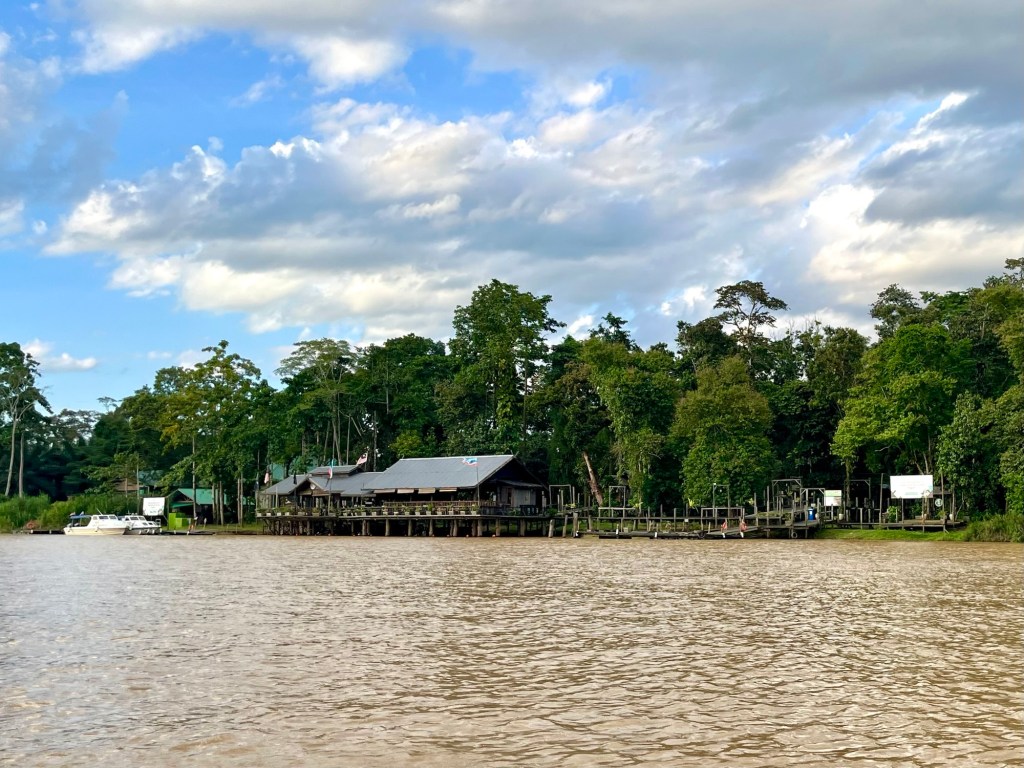
It took a little under three hours on the boat to reach our destination, Sukau Rainforest Lodge. Here it is from the river with the dining area on the left and the dock on the right; villas are up a boardwalk into the forest from the dock.
Beginning in the early 1950s, the lower Kinabatangan was commercially logged and 150,000 acres of its lowland rainforest developed into palm oil and cocoa plantations.
The result of this activity was the degradation of the quality of the river, negatively impacting the villagers along its length. By 1987, the Sabah government was roused to take action, resulting in a reforestation project along the river around Sukau, a political district surrounding our lodge.
Most eco-tourism in the Kinabatangan River area is concentrated around Sukau since it is also accessible by road from the western bank near the Menanggol tributary (in fact, that’s how we will be departing in a few days).
After getting our luggage to our villa, we took a smaller boat up the Menanggol in search of wildlife, quickly becoming fast friends with our boat-mates.
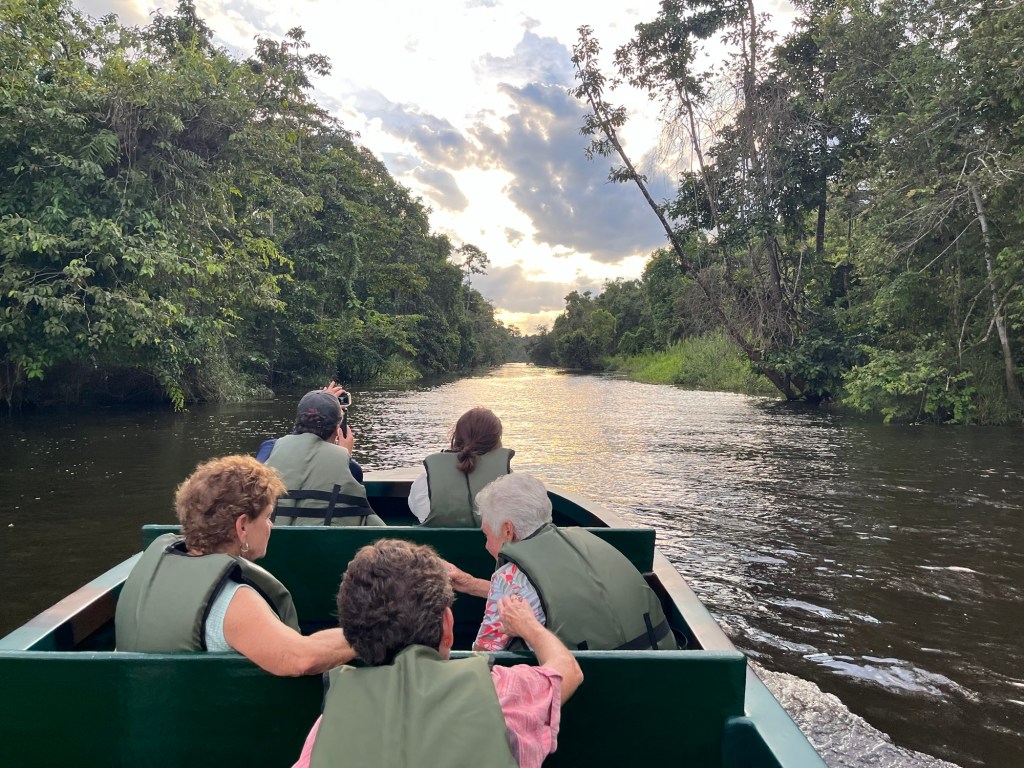
Approximately 70,000 acres of the deeper river area is protected as the Lower Kinabatangan Sanctuary, established in 1999. That’s about the same size as Theodore Roosevelt National Park in North Dakota, our favorite.
We sighted several Long-Tailed Macaque, which I call (counter-clockwise from left): Papa Mac; Mother and Child; and, Five Little Monkeys Sitting in a Tree.

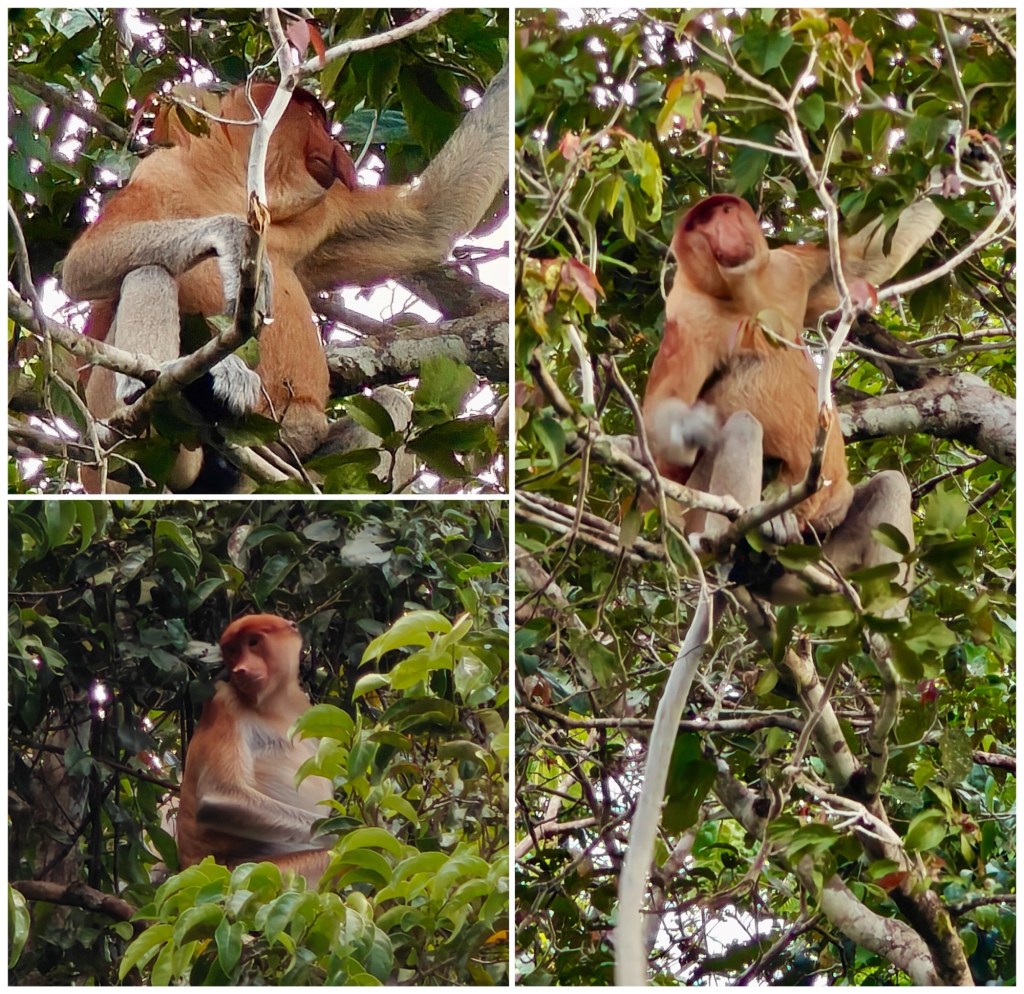
We also located our third of the Big 5, the Proboscis Monkey, the males being distinctive with their big noses. You can see the male proboscis’ schnoz in the photos below, top left and right; the proboscis at the bottom left is a female.
It was obvious from this short boat ride that we were going to see lots of wildlife here in Sukau. We returned to the lodge smiling.
When we were welcomed at the lodge upon arrival, we were told there were sarongs in our rooms and encouraged to wear them to dinner, which we did every night, usually the first to arrive.

The food and fellowship were great.
 The Road Less Traveled