On Thursday, April 25, we went on an all day, small group tour from the Midgard basecamp at Hvolsvöllur called the Þórsmörk Super Jeep adventure. Þórsmörk loosely translates to Thor’s valley. Thor, of course, is the Norse Thunder God. You know, the guy with the gigantic hammer.
Leaving Hvolsvöllur, we travelled east on the Ring Road to the Seljalandsfoss we visited the previous day, then turned north on an “F Road” for an outback, 4-wheeling ride in our “Super Jeep.” (Rental cars, by the way, are prohibited from driving on F Roads.)
As it turned out, our off-road vehicle was not a Jeep. It was a modified Mercedes Sprinter, or at least that’s what it looked like to me. It was lifted about a foot and had oversized tires that could be inflated or deflated even while we were moving.
Our driver and guide for the day was a friendly, informative 20-something named Sæbjörg. “Call me Eva,” she said, introducing herself. “Eva” is certainly better than “Sa-mumble-mumble-ork.”

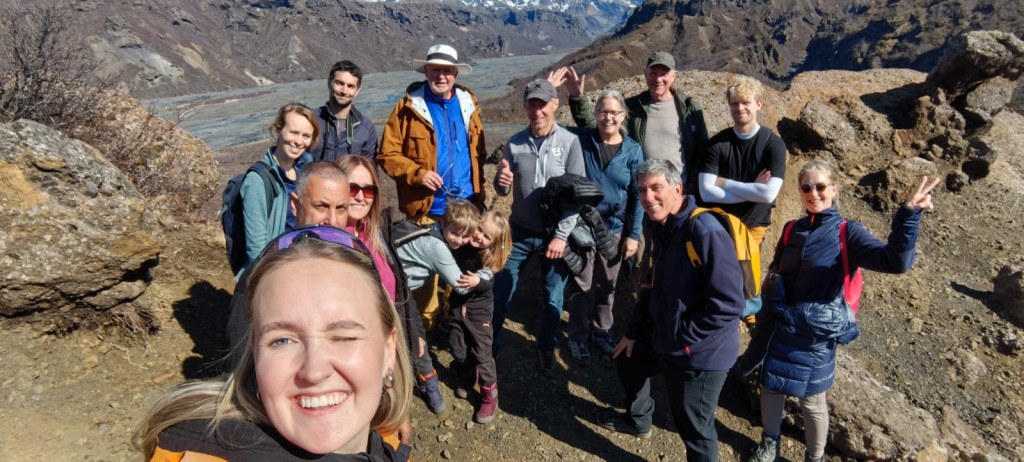
Eva’s boyfriend was along for the ride. Besides him and Eva, our group consisted of a French family, two Greek couples, me, Dale and two other Americans. One of the Greeks had a drone. I was wishing I had brought along a slingshot.
Thor’s valley runs up to the ice cap encompassing the top of the volcano known as Eyjafjallajökull, which, as I mentioned in my last post, last erupted in 2010. The photo, below, is where the eruption took place.
That ice flowing down the hillside is the remnant of the Gígjökull glacier. Prior to the eruption, that glacier tumbled down into the gravel area before us, filling the whole place with ice and meltwater and creating a lake where I was standing when I took this photograph.
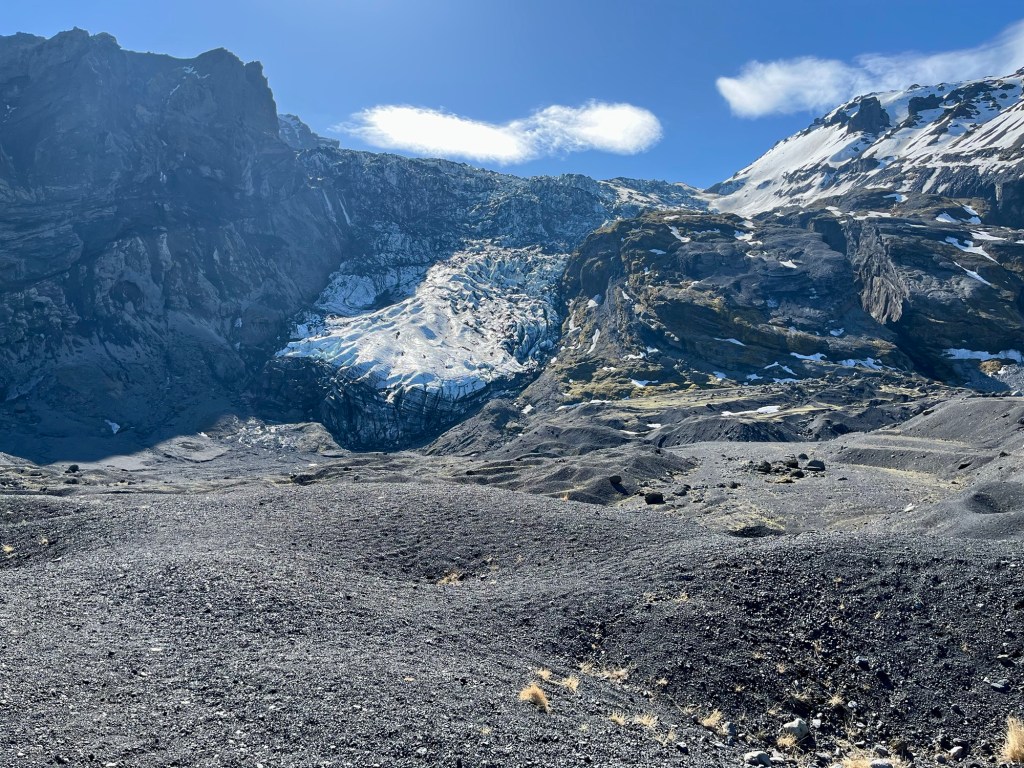
When Eyjafjallajökull blew, it launched so much debris into the lake that it overwhelmed the downstream moraine and drained the lake, the water and ice rushing down the Markarfljót (translation: “Mark’s River”), carrying the remains of the moraine into the ocean.
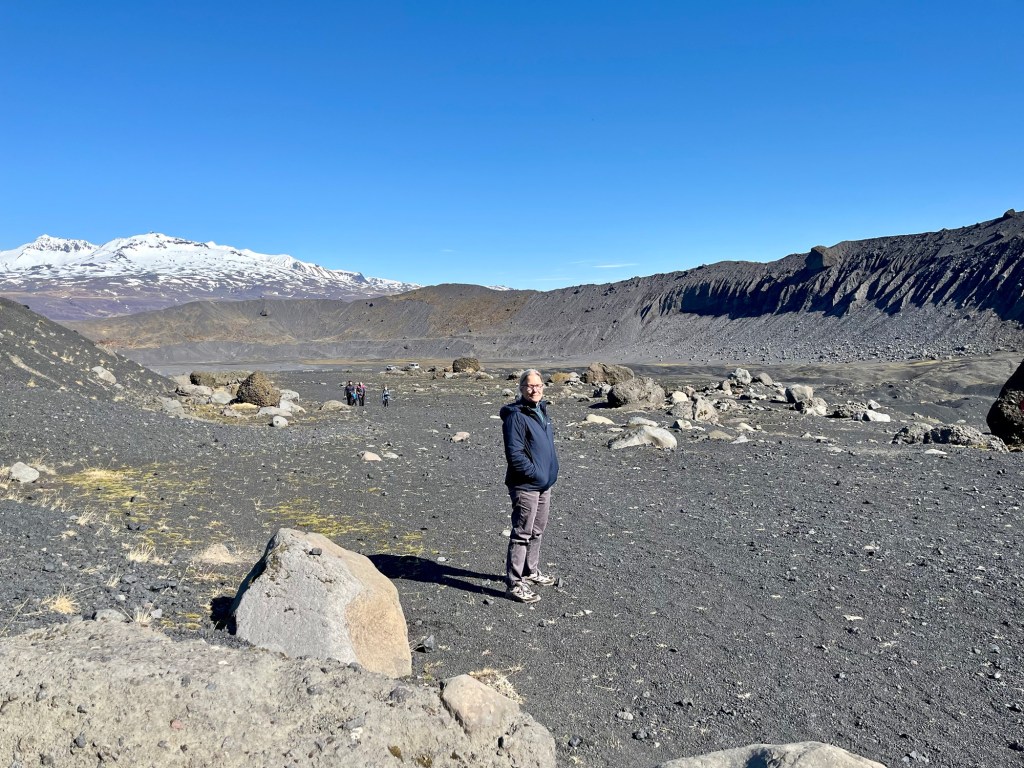
In the photo, below, Dale is standing in the former lake bed. Take a look at how high the side moraines were. They are some of the tallest in Iceland, pushed up by the Gígjökull glacier in the 1700s during the Little Ice Age.
Eva told us that she was 10 years old when Eyjafjallajökull erupted. Her family lived on their dairy farm nearby, but when the volcano blew, she and her siblings were home alone. They were able to find refuge at a relative’s house until their parents returned.
Eva remembers the whole area being blanketed with ash several inches thick. The ash covered the surrounding grazing lands, resulting in their livestock grinding their teeth down to stubs so dire that they became malnourished. The family dairy farm suffered financially for several years as a result.
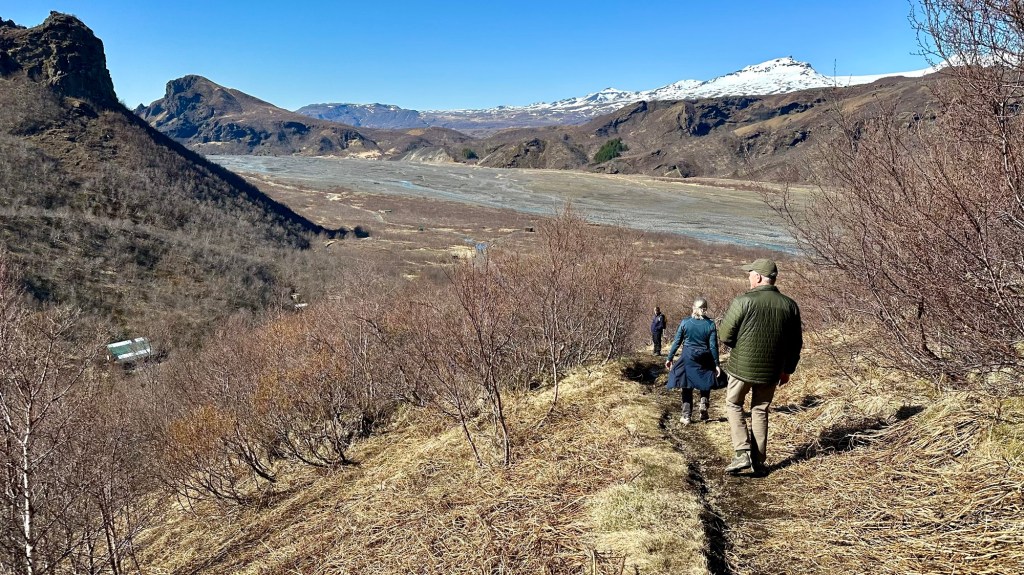
We continued our drive up Thor’s valley, stopping to hike up to an overlook.
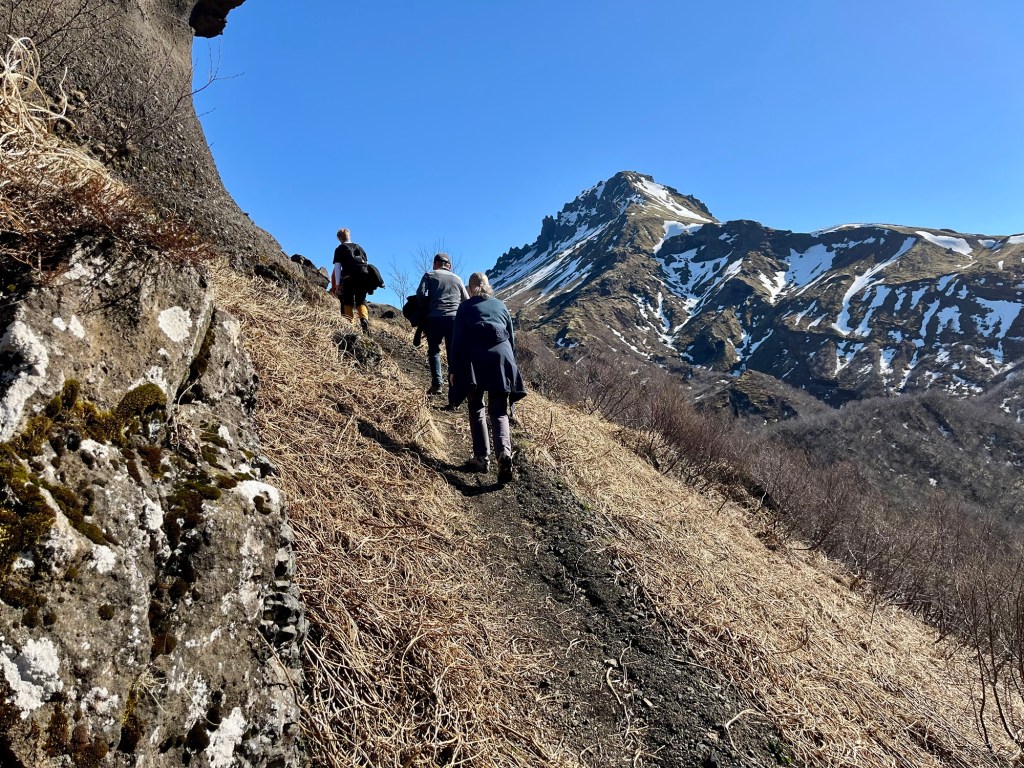
Again, the weather was beautiful. A great day for a hike.

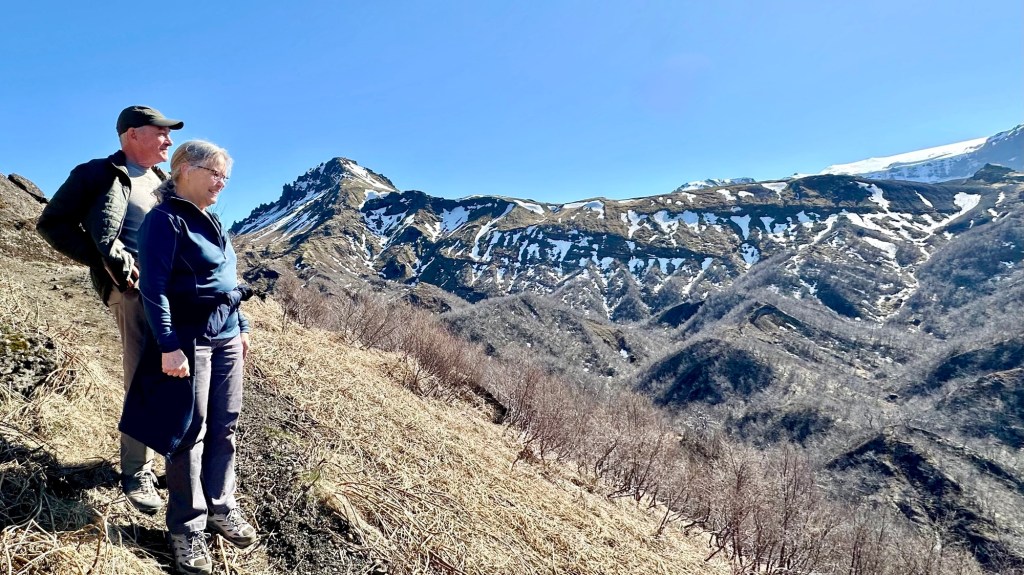
What a vantage point.
Back down to the “Super Jeep.”
The ancient Icelandic calendar had two seasons: six months of “short days,” that is, winter; and six months of “nightless days,” that is, summer.
As it happens, today is the First Day of Summer here in Iceland, a national holiday celebrating the transition from winter. The days are now getting longer, rather then shorter.
But now that summer has begun, the arrow of time points toward winter. So, as was said in Game of Thrones, “Winter is coming.” Which is apropos, given that our final stop was the valley where episode 6 of season 7 was filmed.

We departed Thor’s valley with a final river crossing, easily handled by Eva at the wheel.

A good time was had by all.
Tomorrow we’ll be heading to Vík and the shoreline and beaches of Iceland’s southern coast.
 The Road Less Traveled
Love your travelogues! Such adventures you two have. I’m forwarding every one of these to Laurie so we can both travel with you vicariously. ~April