Our first excursion in Milford Sound was to explore the entire sound by boat, an afternoon voyage with Southern Discoveries (iPhone app here).
We left Freshwater Basin in the early afternoon. Just around the point from the harbor was the first of many beautiful waterfalls we would see, Bowen Falls.
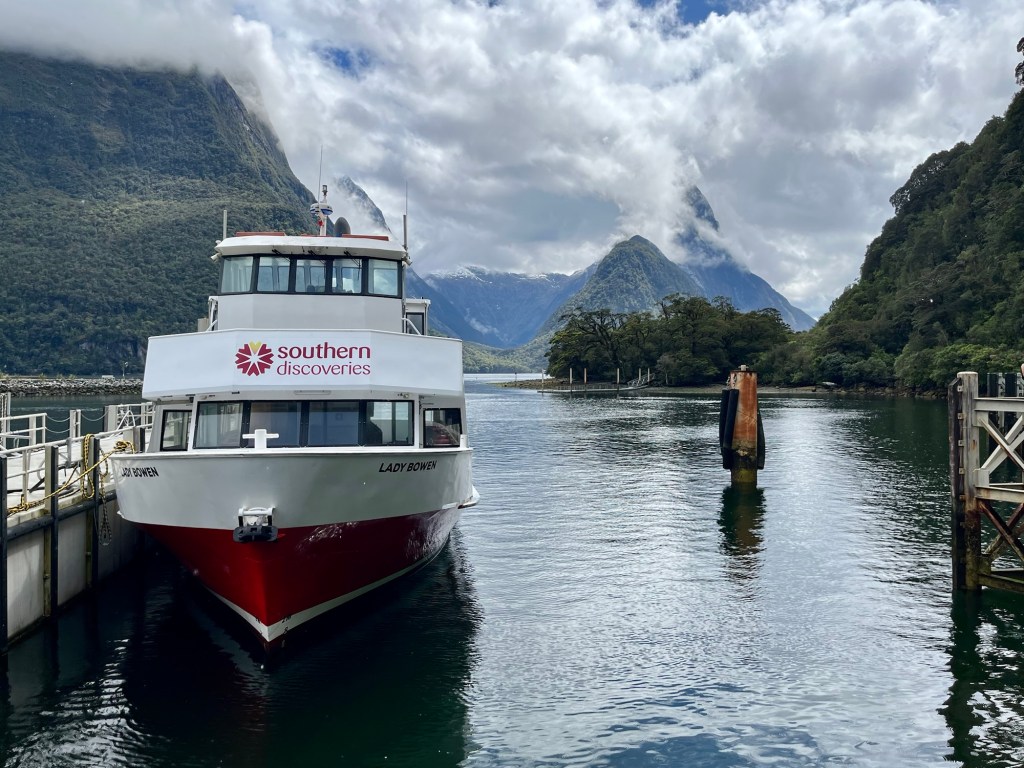
Here’s a view looking back at Bowen Falls and Freshwater Basin as we departed:
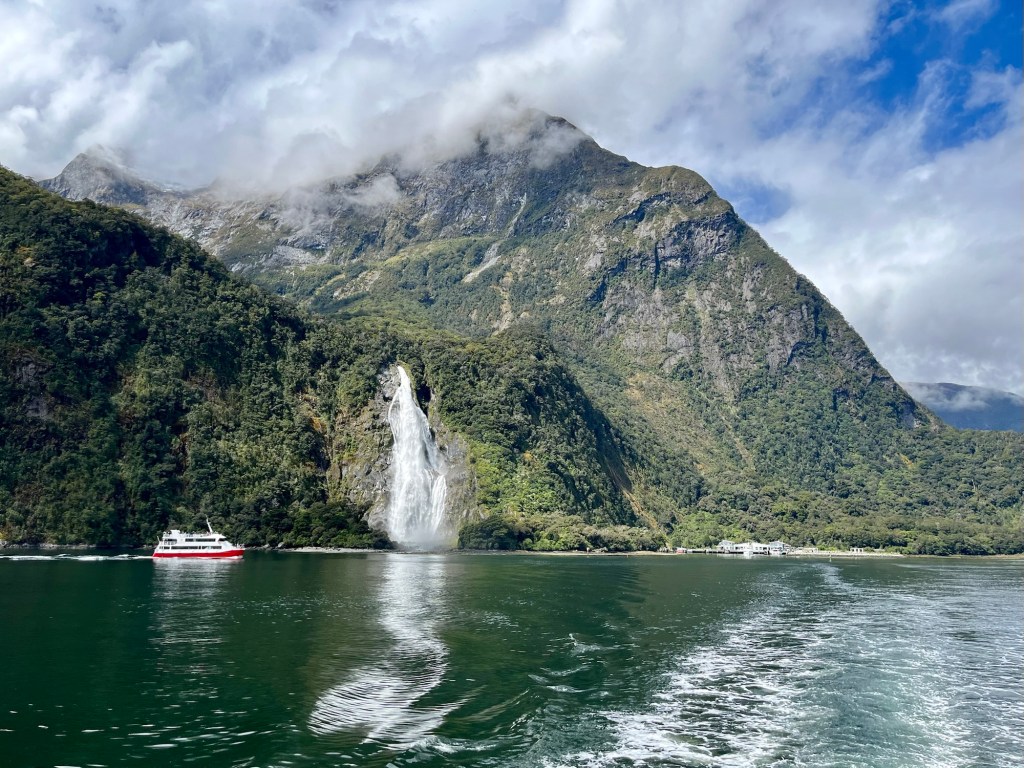
And here’s what lies ahead:

Milford Sound is actually misnamed; it’s a fjord, not a sound. Sounds are created by river erosion of the softer rock, whereas fjords are created through glacial advance and retreat, leaving horizontal scars on the adjacent, hard granite and gneiss.

We hugged the southern shoreline as we headed west toward the ocean. Across the sound, on the northern shore, we could see Stirling Falls, fed by the glacier atop Mount Pembroke (elev. 6,600 ft.) in the background.
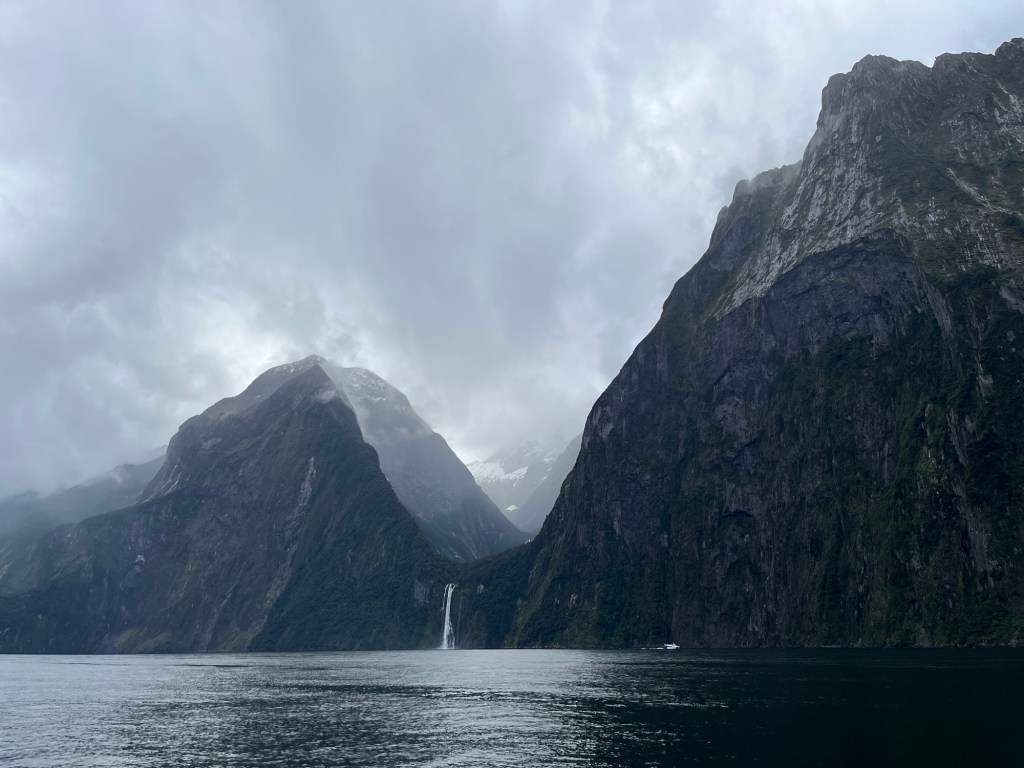
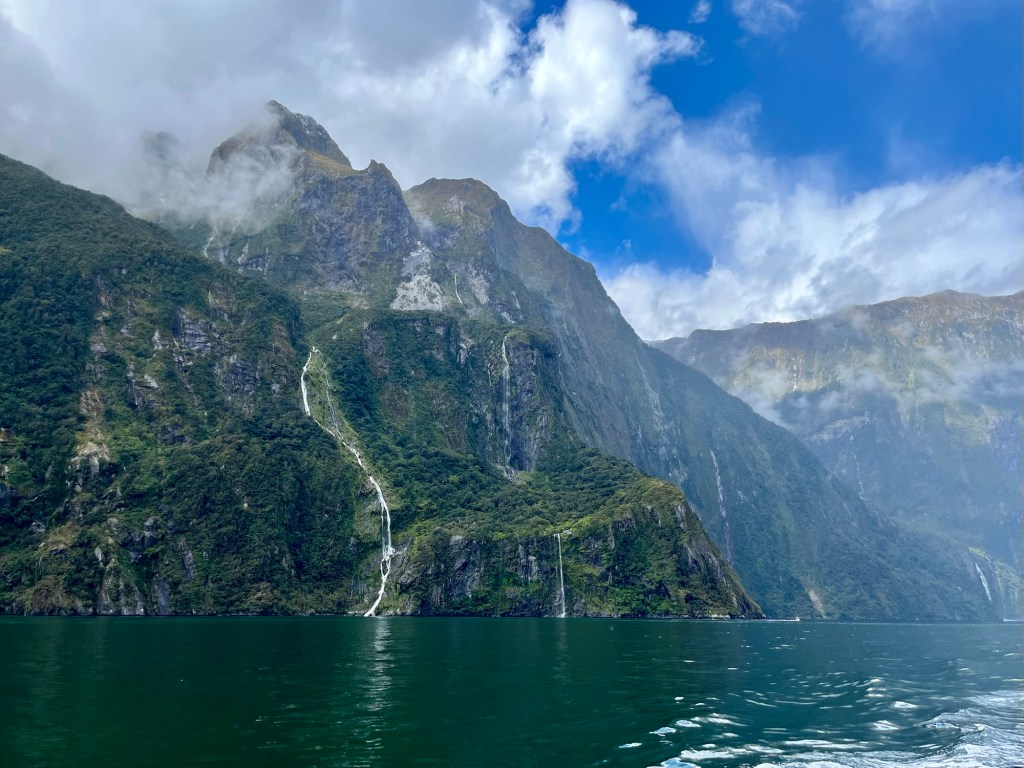
The rain over the weekend resulted in numerous waterfalls throughout the sound.
Occasionally, we glimpsed veins of white quartz in the granite, and splotches of green and rust, indicating the presence of copper and iron, respectively. In days past, gold was occasionally found and mined here.

Dale and I both felt that Milford Sound is more dramatic than the fjords of Norway we visited near Bergen several years ago. The hardness of the rock here results in very steep embankments.
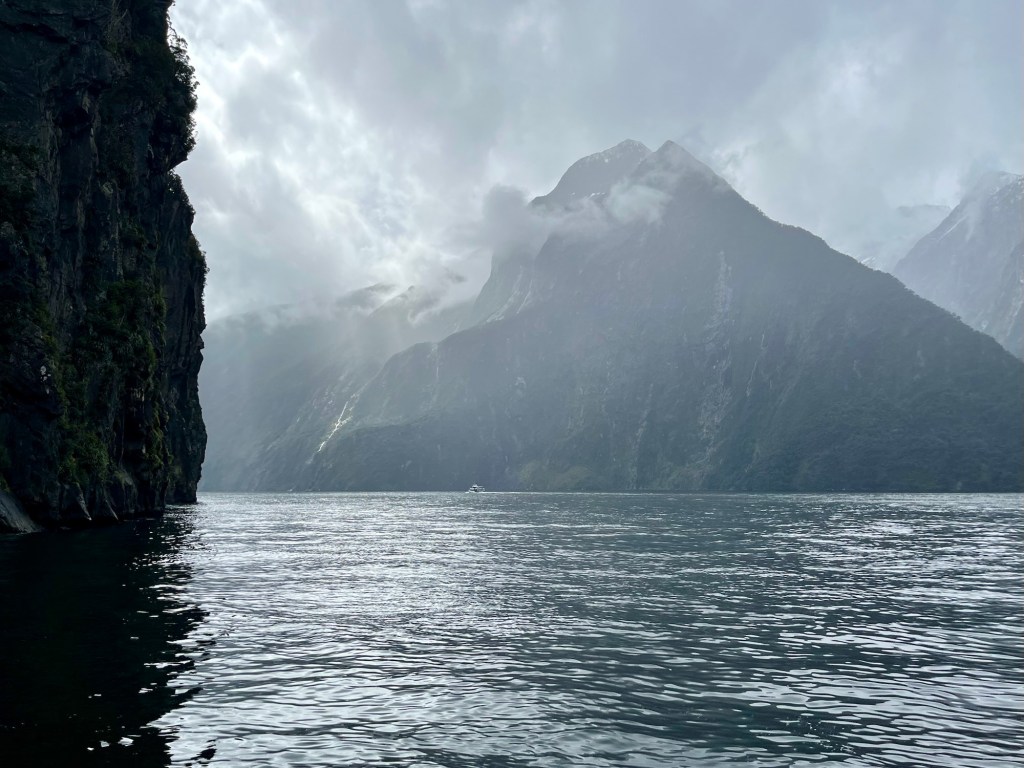
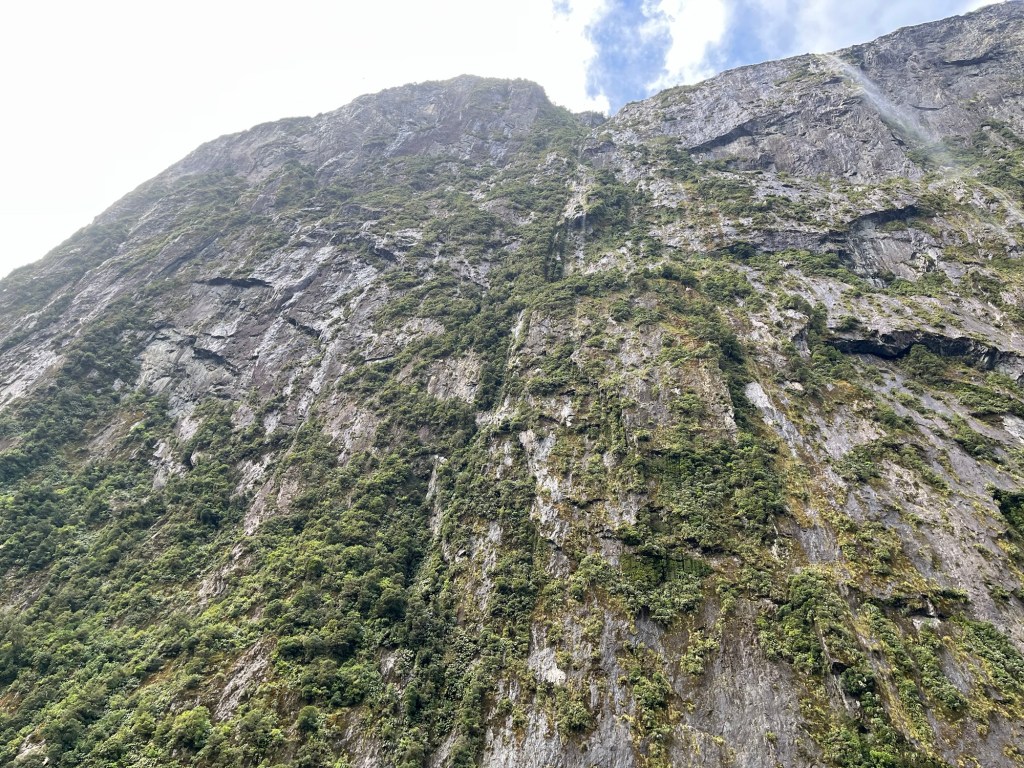
Although there is plenty of vegetation, including large trees – beech, mostly – the greenery clings to the rocky face for dear life. And when torrential rains cause a tree high up on the mountain to break loose, the interlocking roots cause great gashes to appear on the mountain sides as all the vegetation below the falling tree is pulled down as well.
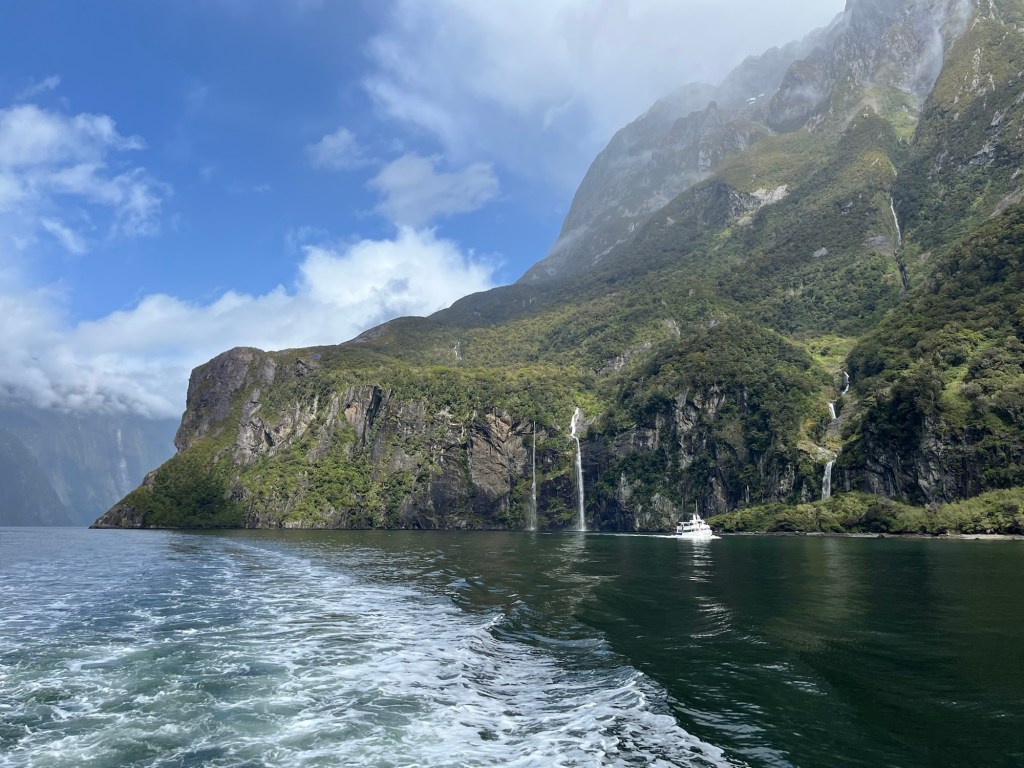
The photo above is the southern shore; the one below is opposite on the northern shore.
Our boat was quite comfortable. Plenty of room and a snack bar to get a flat white or cup of tea. This below deck, shown here, was duplicated with another seating and viewing area above it, sans snack bar.

Our journey terminated at the Tasman Sea, named after the Dutch explorer, Abel Tasman, the first European to observe New Zealand in 1642. Capt. James Cook also sailed through here in 1770 and again in 1773.
As we powered west into the “Roaring Forties” of the Tasman Sea, we passed “Dale Point” to starboard. The wind is primarily from the west here and can reach speeds in excess of 140 mph, in the range of a category 4 hurricane.
Had we continued on a due west heading, our landfall would have been Patagonia in South America. The much closer Australia, is northwest of our location.

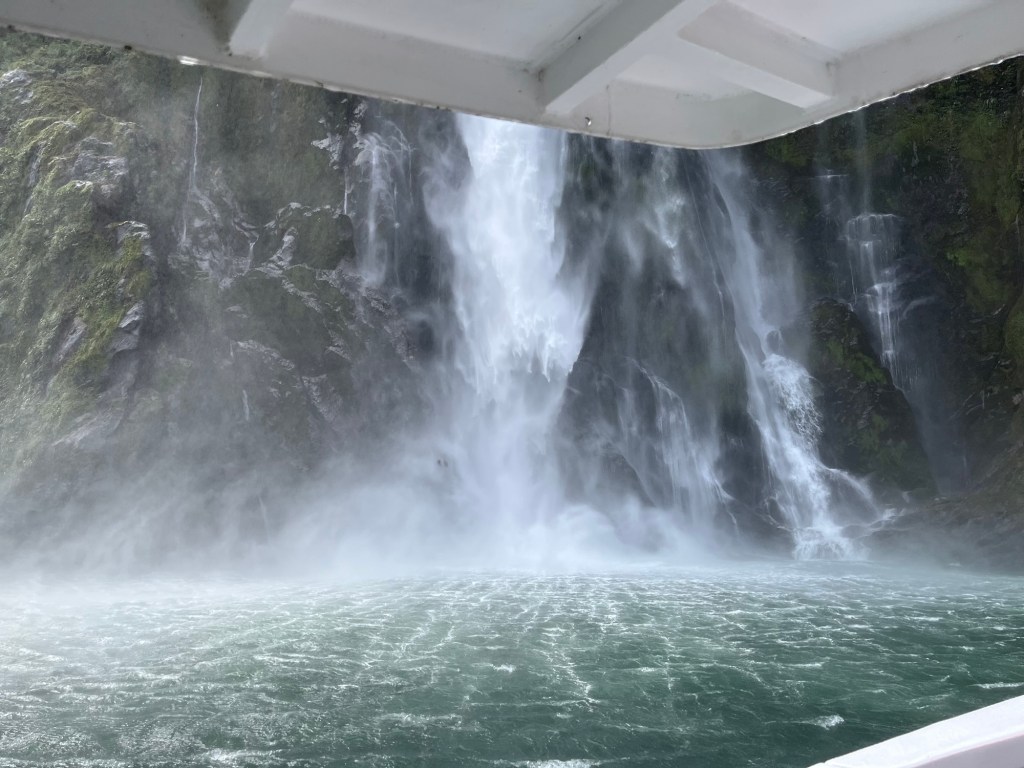
Returning to port, we stopped at several waterfalls on the northern shore, the captain giving the passengers a little adrenaline rush by going right up underneath this one.

I stayed undercover to avoid getting drenched.
As we motored along close to shore, I took this photo looking straight up. It was nearly vertical here.
Just before reaching Bowen Falls, we came upon two Fiordland Crested Penguins, known locally as “Tawaki.” We were told they spend about eight months of the year in the Southern Ocean without touching land before returning here, apparently to breed.

It was a nice introduction to the sound, and a beautiful day to be aboard. Tomorrow we’ll be retracing some of our route from a different vantage point, kayaking.
 The Road Less Traveled
Your travelogues are so enjoyable! And New Zealand is at the top of my list, so thank you! Love to you both, ~April