Given the morning Wednesday to catch our breath, we repacked our bags, incorporating cleaned laundry, then lounged around the madrassa/hotel.
At noon we were transported to the border crossing from Uzbekistan into Turkmenistan, Farap-Alat, another hectic immigration point. We hiked across No-Man’s-Land beyond border stations to meet our Turkmen guide, Byrat, a gregarious wheeler-dealer who clearly knew the ropes for dealing with bureaucracy.
As we waited in the immigration line, I noticed the woman behind us, struggling to get through customs with a dozen bundles of cotton (photo below, top row center). It seems that local artisans import Uzbek cotton for textile production in Turkmenistan.
Growing cotton has been a big industry in Uzbekistan ever since the Russians first arrived on the scene in the 1860s, looking to source a replacement for the cotton they imported from the American South before it was blockaded during the American Civil War.
Pending our arrival, Byrat had been busy greasing the wheels at immigration, asserting we were part of a diplomatic group ahead of us, so that we were ushered to the front of the line and given priority to clear. A much better ruse than the Tajik “late for a funeral” line.
On the Turkmenistan side, we were shuttled to the airport in Türkmenabat for an evening flight to Ashgabat, the capital. The Türkmenabat airport was empty (bottom row, left), as was the Ashgabat airport when we arrived later that night (bottom row, center and right).

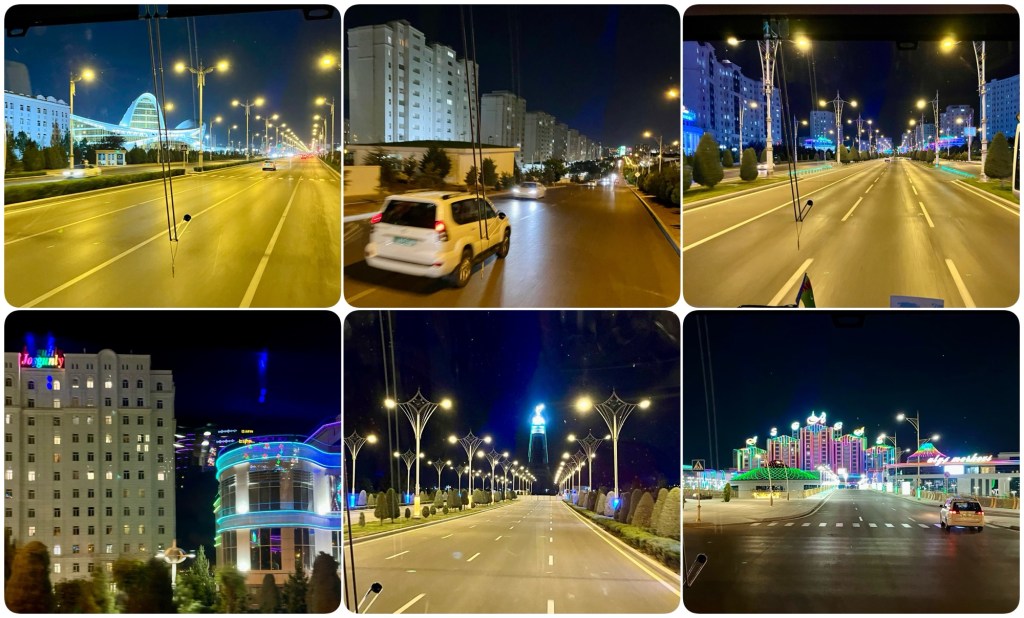
We were treated to a night-time tour of the bizarre streetscape of Ashgabat, a city I can only describe as Las Vegas after the Rapture. Everything was lit up but very few people wandered the streets.
We checked into the opulent Archabil Hotel on Arçabil şaýoly (Archabil Avenue), formerly Tump Tower the “President’s Hotel.” Here’s the lobby; check in is up the stairs.

A terrible earthquake rocked Ashgabat in 1948, destroying nearly the entire mud-brick city and killing nearly 2/3 of the population, somewhere around 175,000 people. The entire city had to be rebuilt by the Soviets in the 1950s and ‘60s. It was then further improved after the U.S.S.R. disintegrated and Turkmenistan became an independent nation in 1991.
That more recent rebuilding program was the brainchild of Turkmenistan’s first president, Saparmurat Niyazov (1940-2006), who envisioned a magnificent futuristic city built entirely of white marble.
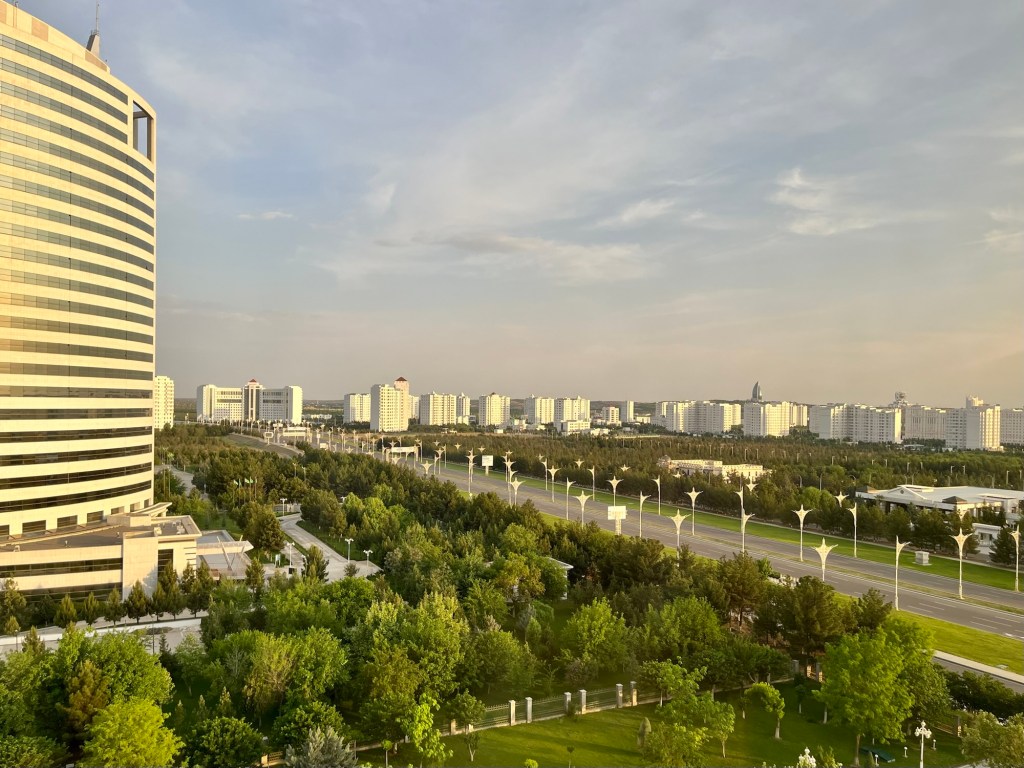
Niyazov’s building plan was a success, assuming you measure success by goals attained. In 2013, the city was included in the Guinness Book of Records for possessing the world’s highest concentration of white marble buildings – 543. One road alone, Bitrap Turkmenistan Avenue, has 170 of them!
Here’s a view of just a few buildings of the marble city from the balcony of our hotel room:
Turkmenistan also holds 19 other Guinness world records, including world’s largest gerbil species. Really. I checked.
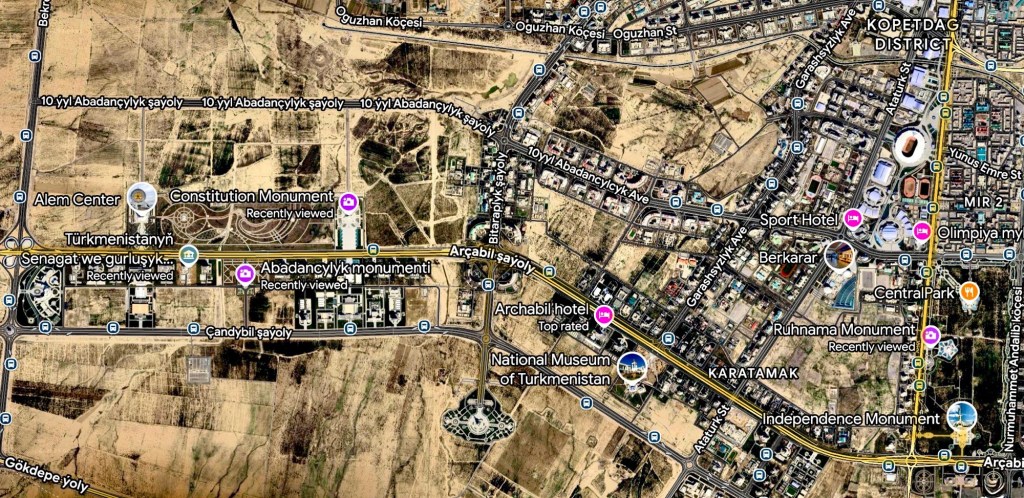
We started our driving tour Thursday at the southern end of Bitrap Turkmenistan Avenue. Our tour was almost exclusively limited to the southernmost edge of the city. You should be able to locate our hotel and the roads and monuments we visited (which I will discuss in this post) in the photo, below:
At the southern terminus of Bitrap Turkmenistan Avenue is the Monument of Neutrality which is currently being refurbished (the photo, below, is looking south). The top of this monument used to be adorned with a 39-foot tall gold statue of President Niyazov that rotated so that he always faced the sun. Niyazov’s statute was removed when the monument was reconstructed.

Turning to face north (photo below), is the view up what Apple maps calls Bitrap Turkmenistan Avenue. Google maps calls this road Bitaraplyk şaýoly, which Google translates to Independence Avenue. The road runs north-south. Maybe it depends on which way you’re going.
At any rate, behold, the city of white marble:
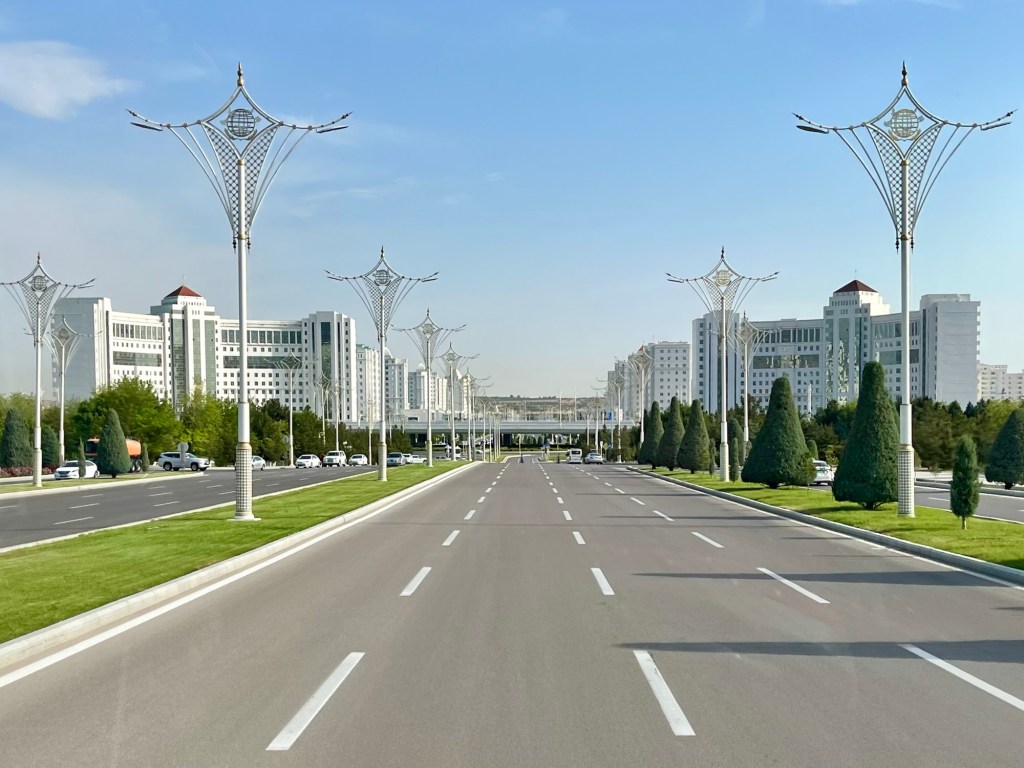
One of the many incongruous things we saw during our short visit to Ashgabat was women sweeping the streets. There was not a single piece of trash anywhere. I’m guessing that the fine for littering is astronomical.
By the way, it’s not just buildings that are white. Niyazov also mandated that all cars be white. That law has recently been relaxed, however, so every now and then a silver Mercedes can be spotted.
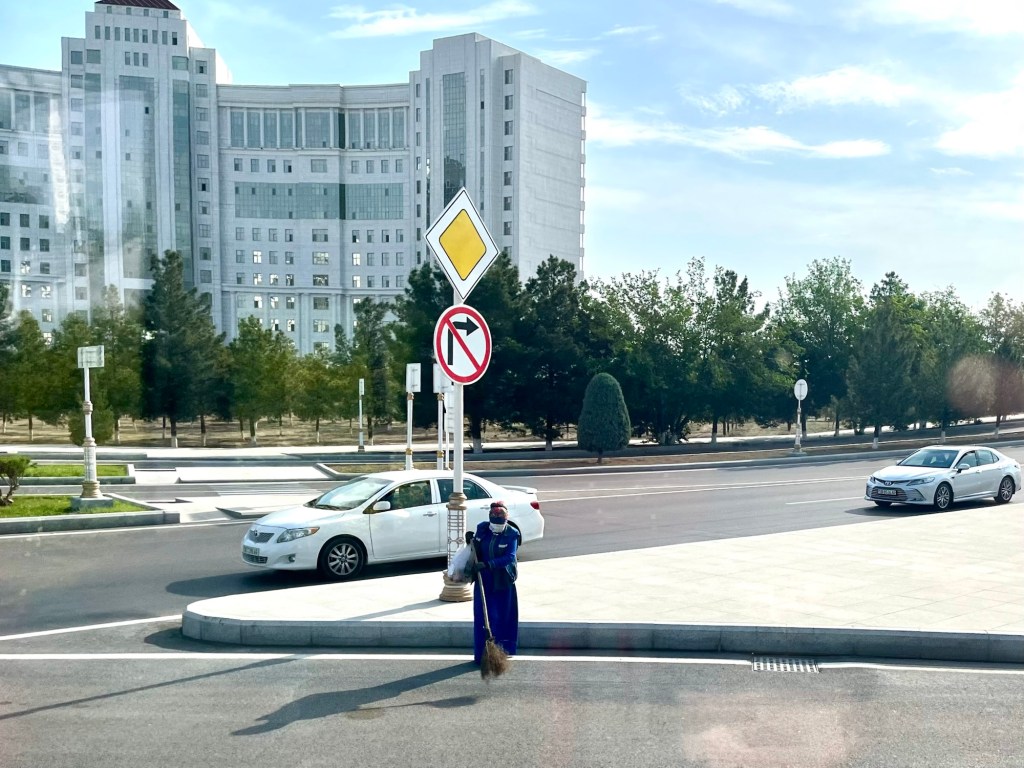
According to Wikipedia, “a large percentage of the employment in Ashgabat is provided by state institutions, such as the ministries, undersecretariats, and other administrative bodies of the Turkmenistan government.”
Many of those government offices are located on Archabil Avenue, which we turned onto, passing the Ministry of Construction on our left…
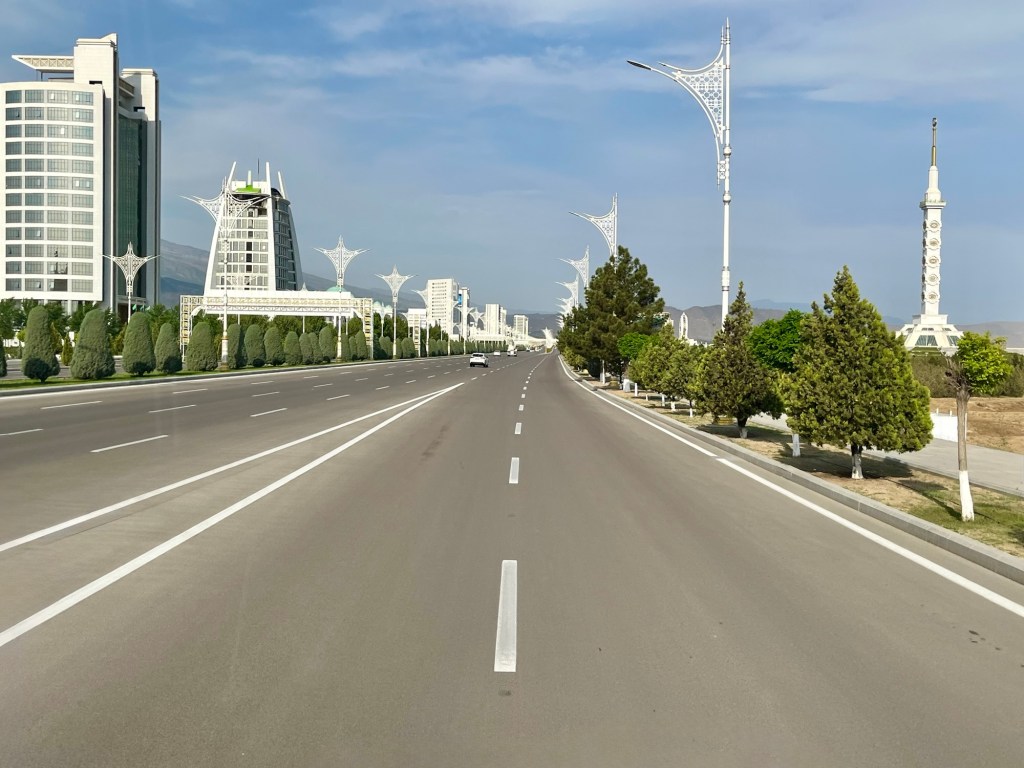
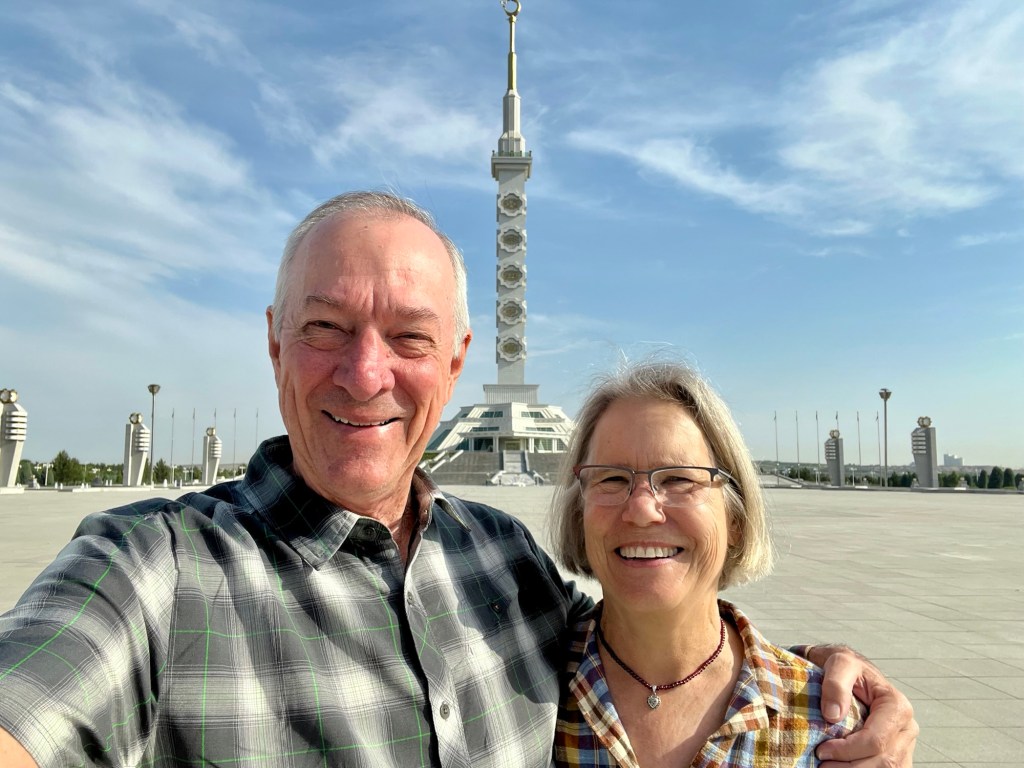
… and Constitution Monument on our right. We stopped for a selfie.
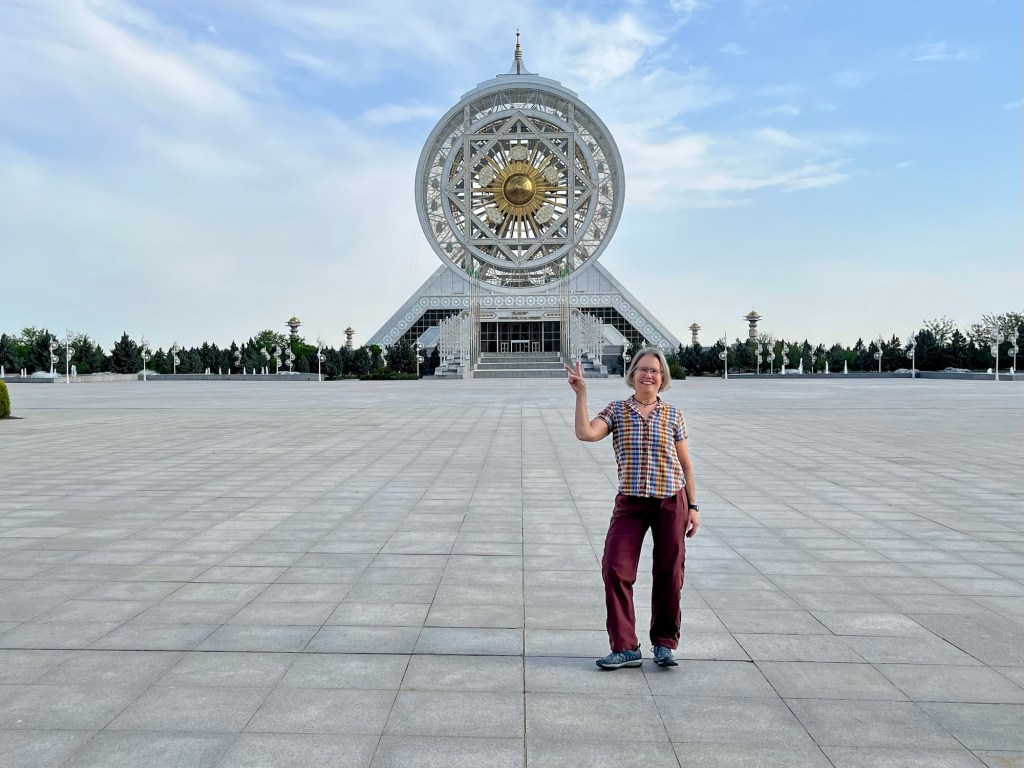
Continuing down Archabil Avenue, we came to the Alem Center, the world’s largest enclosed ferris wheel (another Guinness Book record), on our right.
Across the street from the ferris wheel was this random government building, perhaps the regional government administration office? None of my mapping programs had a name for it. It must be super secret, maybe the Ministry of Missing Persons.
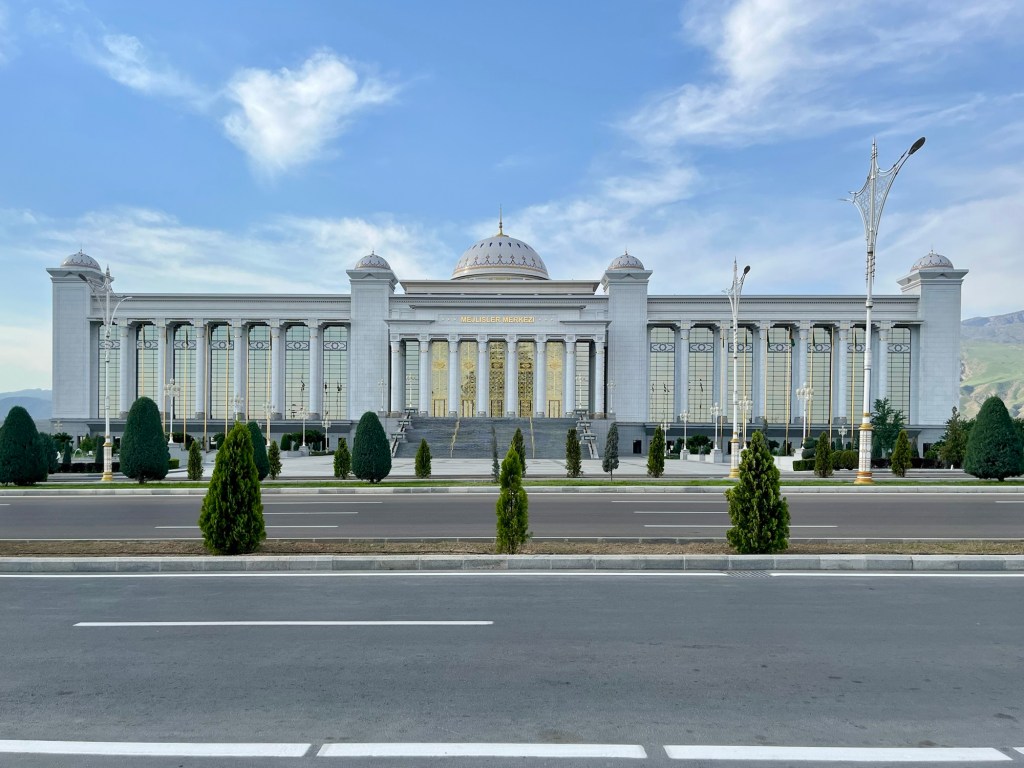
As we clambered back aboard our white tour bus, I took the photo below. Across the street were, in this order, the State Customs Service Headquarters, the Ministry of Industry and Construction, and the Ministry of Motor Transport. No private offices here, just government ministries.
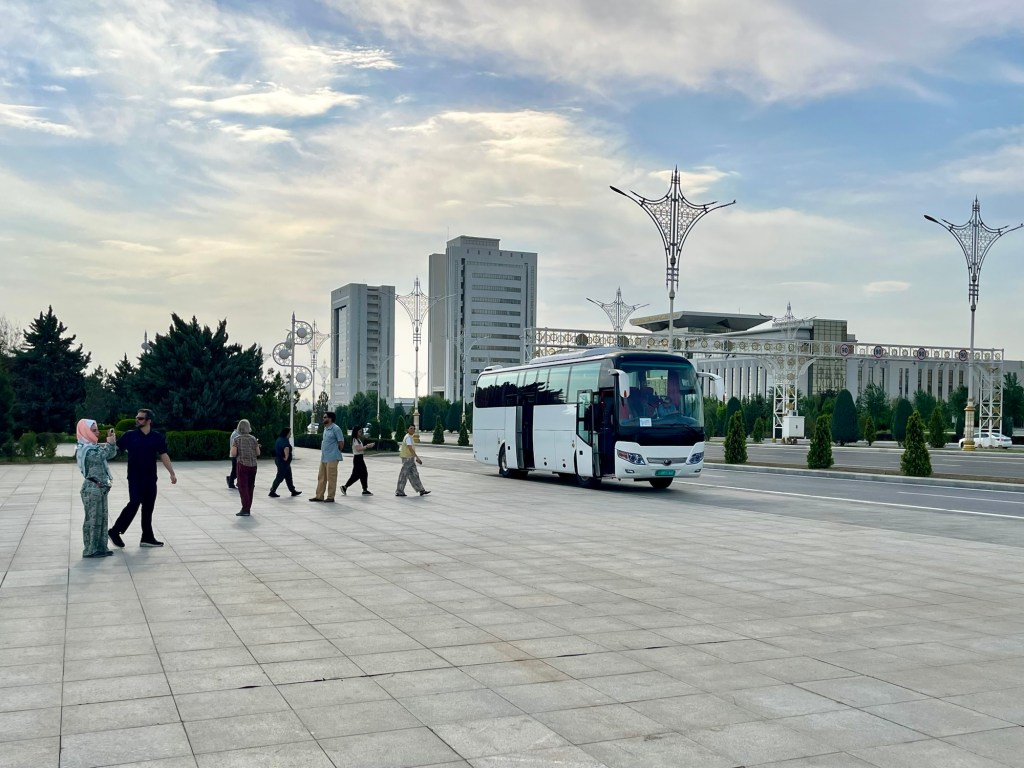
Later in the day, we drove over to Beyik Saparmyrat Türkmenbasy şaýoly, that is, Great Saparmurat Turkmenbasy Avenue, to visit Independence Park and the Independence Monument.
Currently, foreigners can only visit Turkmenistan as part of an authorized tour group. Visitors are not issued individual visas. Instead, the group is provided with a Letter of Invitation. Supposedly, this is about to change, but nobody’s holding their breath.
Oddly, our tour did not take us into any of the monuments or buildings, with one exception. Government policy? Who knows.
The exception was the National Museum of History which we did visit and enter later in the day, a rather bizarre experience which I’ll have more to say about in my next post.
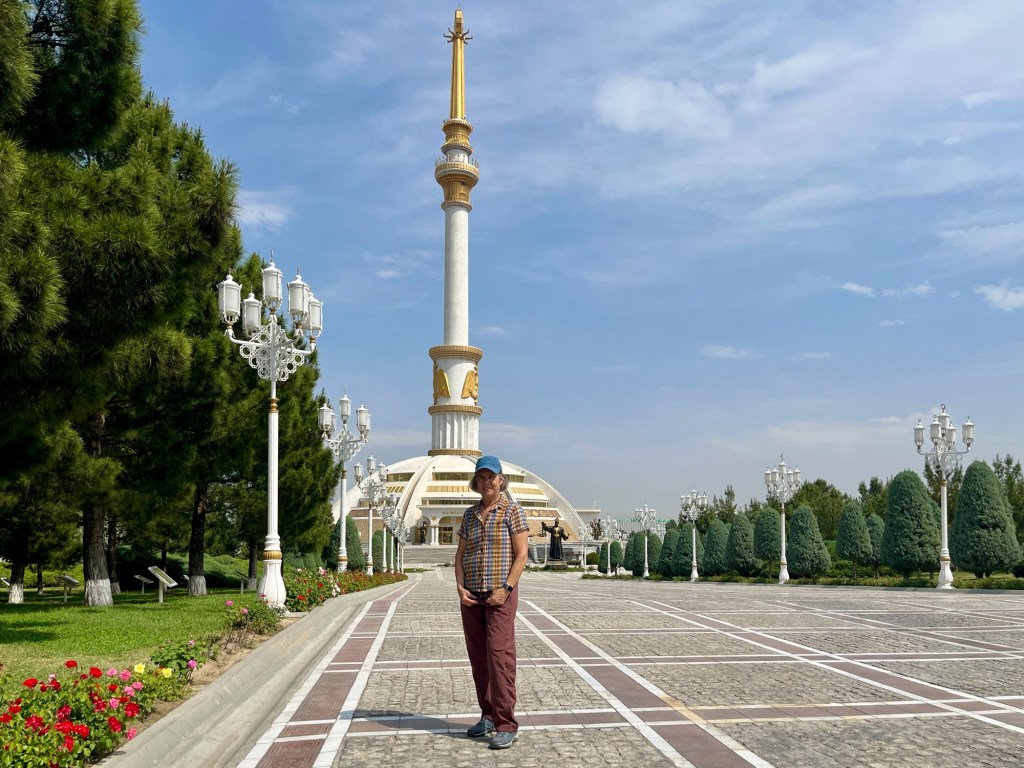
Here’s Dale standing in front of the Independence Monument, the base of which is supposed to resemble a yurt, a nomadic “house.” The tower is just short of 390 feet tall.
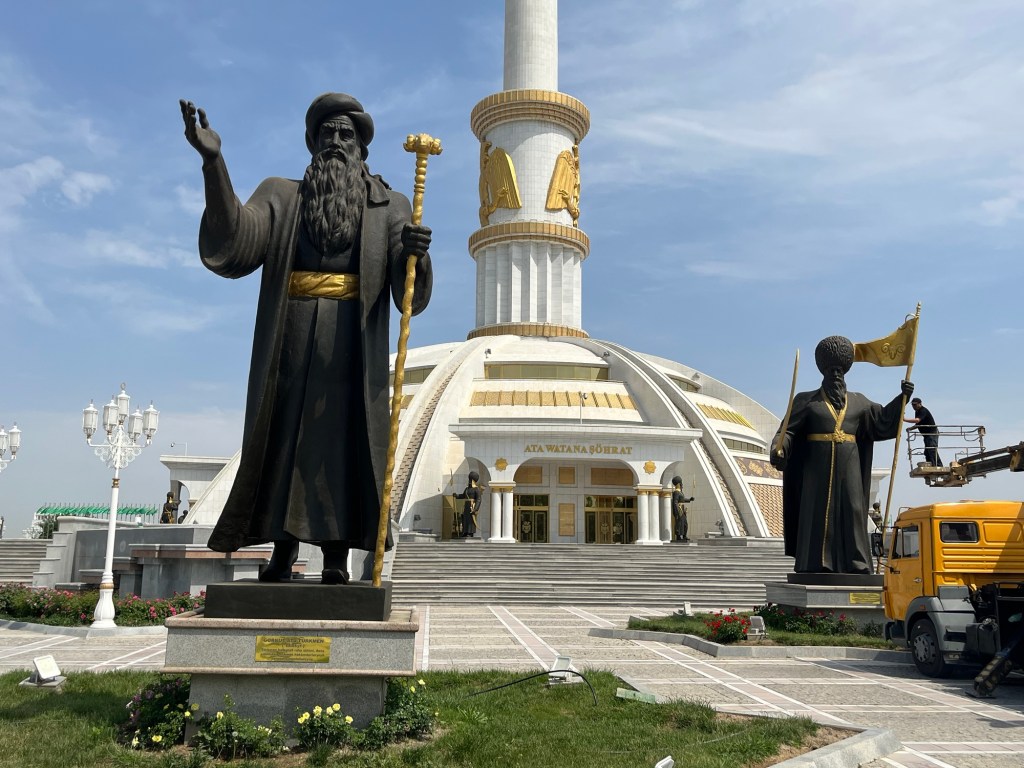
Independence Monument is guarded by statutes of several Turkmen warriors and tribal leaders. Crews were busy cleaning them from bucket trucks when we stopped by – no bird droppings allowed!
As we walked around to the other side of the monument, Byrat warned us not to take photos of the real guards, standing at attention at the entrance to the monument. That’s them, over my shoulder, when I accidentally on purpose caught them in this selfie:
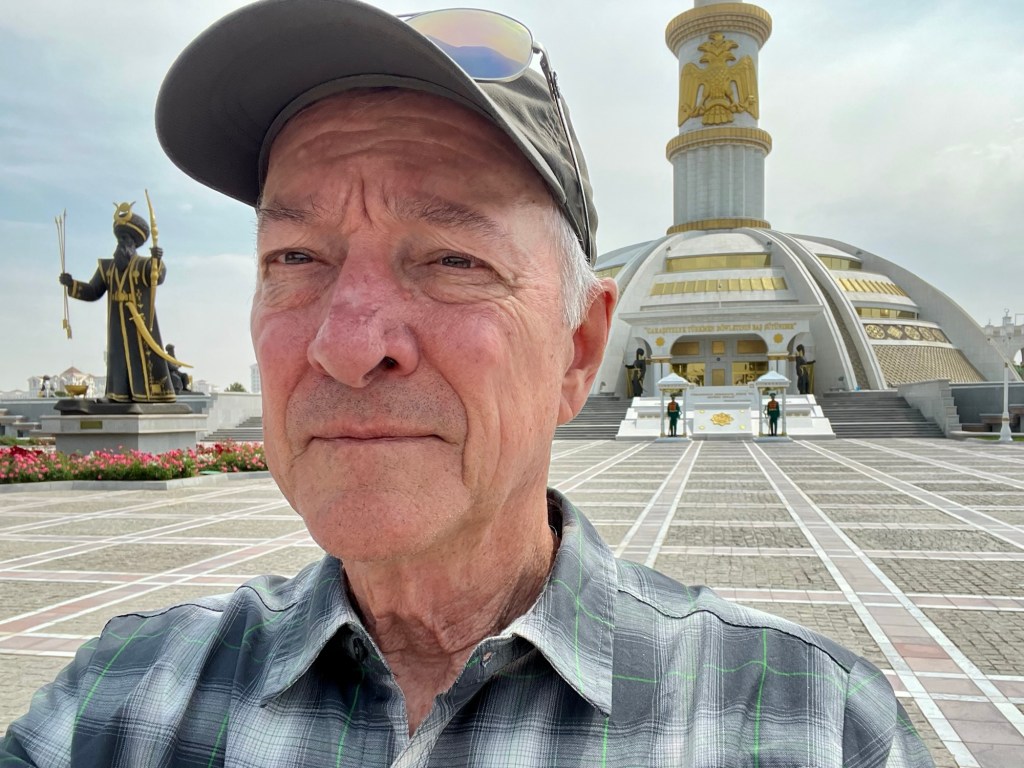
In the selfie above, I’m looking at the Saparmurat Niyazov Monument which rounds out the things to see at Independence Park.
By the way, have you noticed that there are never any other people besides guards and cleaners in my photos of Ashgabat? That’s because there aren’t any. We’re told there are plenty of residents, toiling away in the government ministries. And Wikipedia lists the population of Ashgabat at over one million. But I’d be exaggerating if I said I’d seen more than a hundred people as we drove around this part of town.
Here’s Niyazov, the former president, surrounded by five double-headed golden eagles:
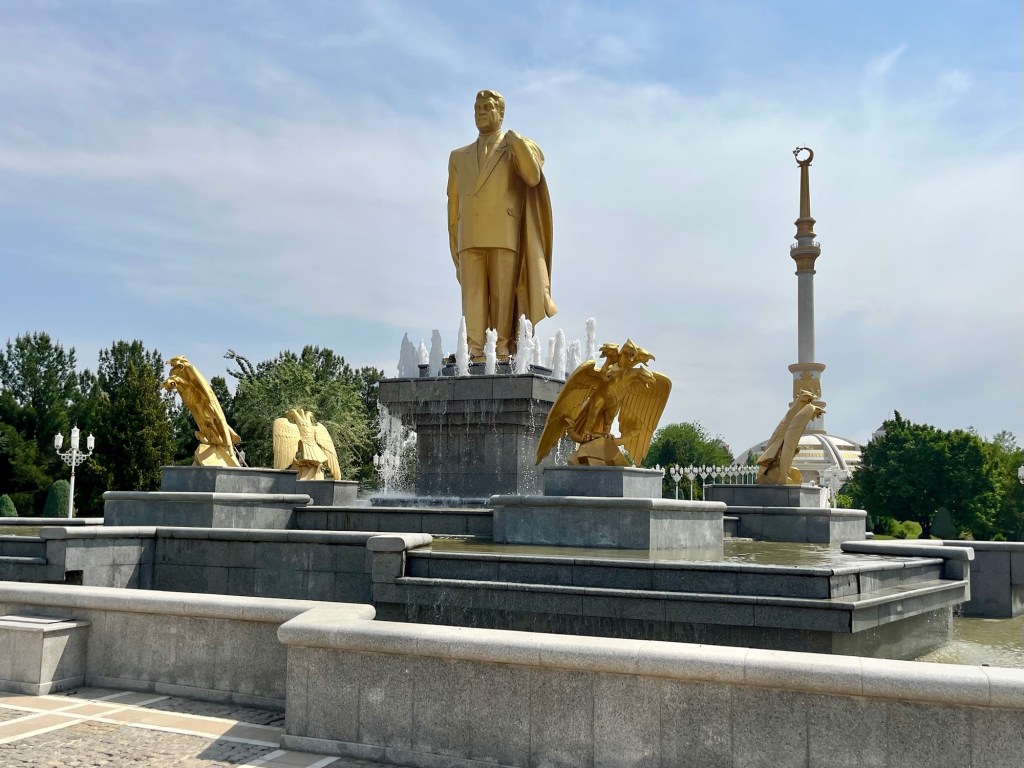
Saparmurat Niyazov referred to himself as the Türkmenbaşy, that is, the “Father of All Turkmen.” He was also referred to as “President for Life.” Unfortunately, for him, that only meant 15 years. He died from a heart attack in 2006, age 66.
Wikipedia says Niyazov “was one of the world’s most totalitarian, despotic, and repressive dictators. He promoted a cult of personality around himself and imposed personal eccentricities upon the county….”
Here’s a partial list:
- He created a new alphabet for Turkmenistan for no particular reason other than to be different.
- He renamed the days of the week and the months of the year (naming January after himself and April after his mother).
- He closed all the hospitals in the country except those in the capital, saying “if people are ill, they can come to Ashgabat.”
- He closed all the libraries, claiming that the only books worth reading were the Koran and his own musings, the Ruhnama (more on this, below).
- He banned lip syncing at public concerts.
- He banished dogs from the capital because of their smell.
- He built an ice skating rink near the capital so that people living in the desert could learn to skate.
- He created “Melon Day,” a national holiday, to honor his favorite food.
- He banned smoking, chewing gum, opera, ballet, circuses, philharmonic orchestras, video games, car radios, gold teeth, beards and long hair on men.
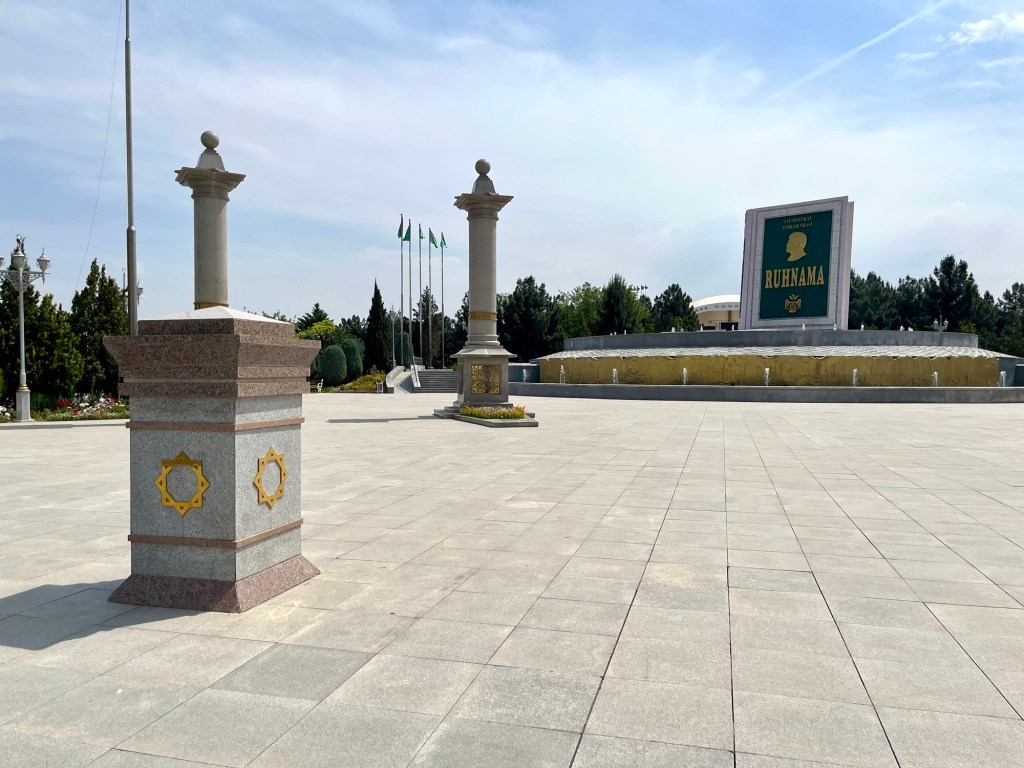
Further up the road was the Ruhnama Monument, featuring the book written by Niyazov that, during his reign as president, was mandatory reading for schoolchildren, university students and government employees – job applicants were quizzed on its teachings.
The Ruhnama is a jumble of Niyazov’s autobiography, his version of Turkmenistan’s history, and an exposition on the way the Turkmen people should live, ie., the crazy list above.
Niyazov’s successor, Gurbanguly Berdymukhamedov (b.1957), was his dentist and a former Health Minister. He, too, was an authoritarian leader, just as quirky as his predecessor. Similar to Niyazov, Gurbanguly was partial to gold monuments of himself, erecting one depicting himself astride an Ahkal-Teke horse. He fancied himself to be a great horseman and jockey.
Gurbanguly passed the baton and scepter to his son, Serdar (b.1981), the current president, in March 2022 while the country was locked down for COVID. Only time will tell whether the tradition continues.
 The Road Less Traveled
great stuff as always Mark and truly enjoy your posts. I knew we pretty much agreed about most things but reading your post I confirmed we are politically aligned as well!😆
…from Allen!
I thought that might be you. I’ll give you a call when we get back to the USA.
perfect!
so interesting! Thank you for your posts. I really admire yours and Dale’s adventurous spirit!
Pingback: Gardens by the Bay | The Road Less Traveled