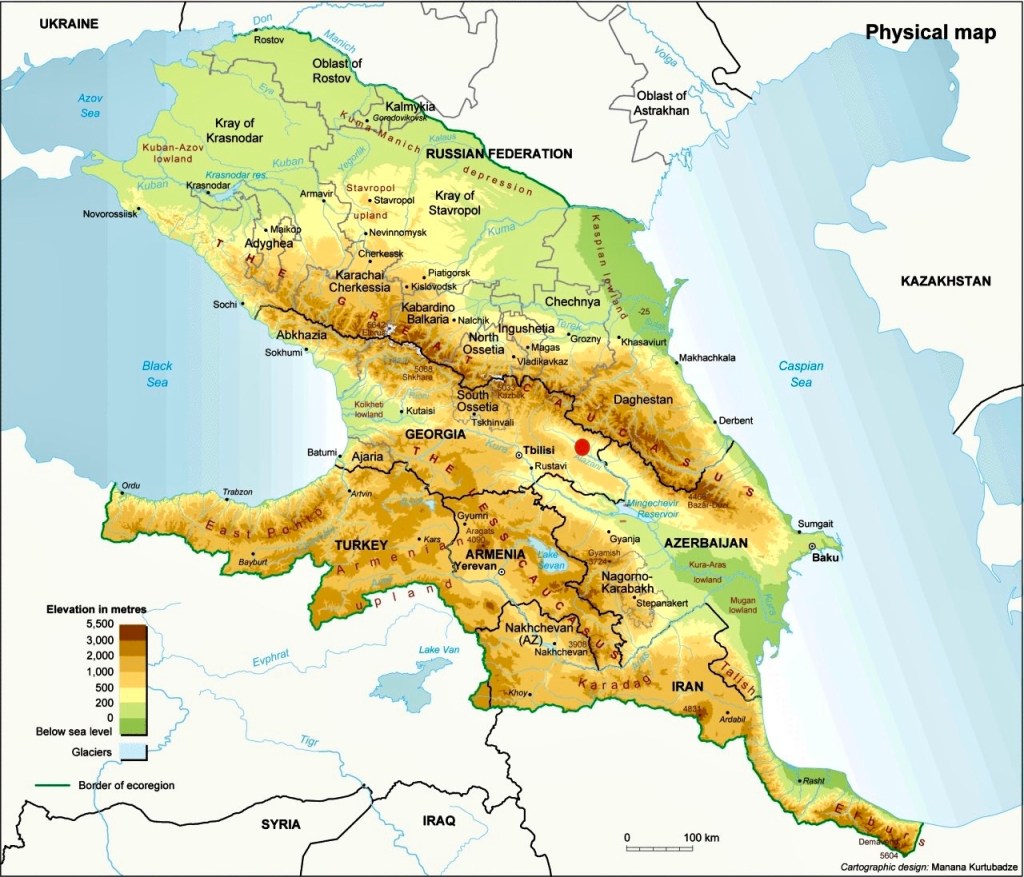
The Alazani River valley is the heart of the Kakheti wine region (red dot on map, below), the “Napa Valley of Georgia” where people have been producing wine for 8,000 years.
Here’s what Wikipedia has to say about Georgian wine:
The roots of Georgian viticulture have been traced back by archeologists to when people of the South Caucasus discovered that wild grape juice turned into wine when it was left buried through the winter in a shallow pit. This knowledge was nourished by experience, and from 6000 BC inhabitants of the current Georgia were cultivating grapes and burying clay vessels, kvevris, in which to store their wine ready for serving at ground temperature. When filled with the fermented juice of the harvest, the kvevris are topped with a wooden lid and then covered and sealed with earth. Some may remain entombed for up to 50 years.
They’re still making wine this way in the Alazani valley.
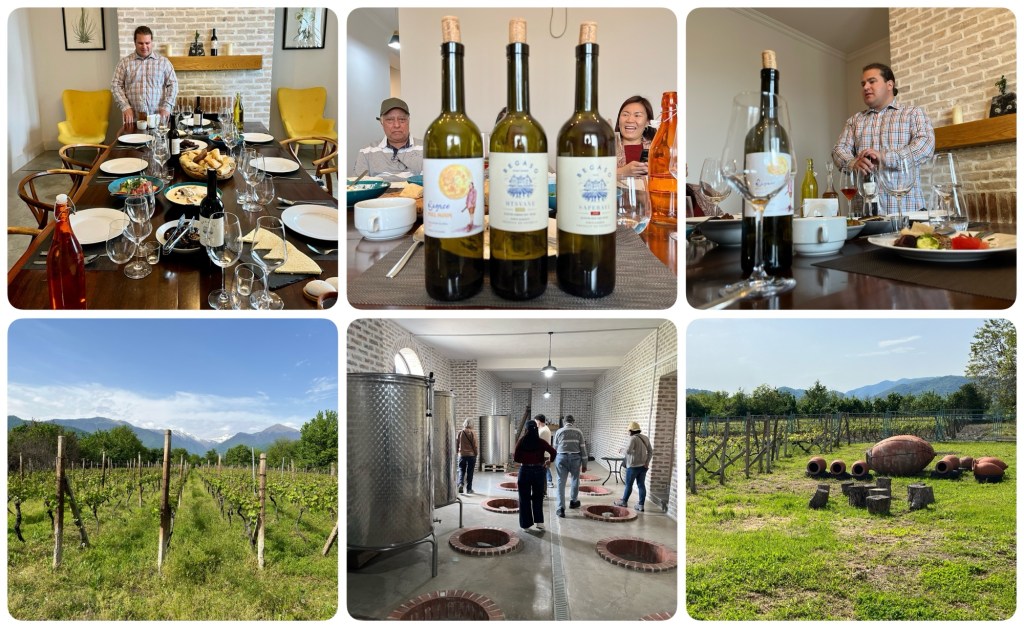
Our first stop in Kakheti was the Begaso Family Winery near Gremi, Georgia. The owner of the winery, Erekle Bezhitashvili, produces dry, amber-colored white wines from Kisi, Khikhvi, Mtsvane and Rkatsiteli grapes, and a dry red wine from Saperavi grapes, varieties I had never heard of before. All the grapes come from Begaso’s own vineyards.
We had a wine tasting with lunch, prepared by Erekle’s wife, followed by a tour of the cellar where Erekle makes his wines and has 20 buried kvevris with a total capacity of 1,500 liters (photo below, bottom row, center; the photo to its right shows an unearthed kvevri in the vineyard).
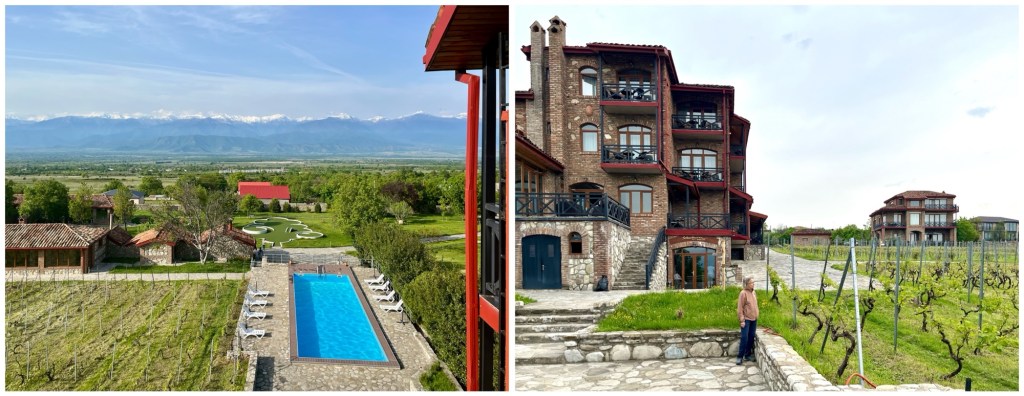
There are numerous vineyards and wineries throughout the valley. From the Begaso winery, we drove southwest across the valley to its other side to the Schuchmann Wine Estate near Telavi where we spent two nights. We had a beautiful view of the Greater Caucasus Mountains from our balcony there which we enjoyed while taking off a day for laundry and rest.
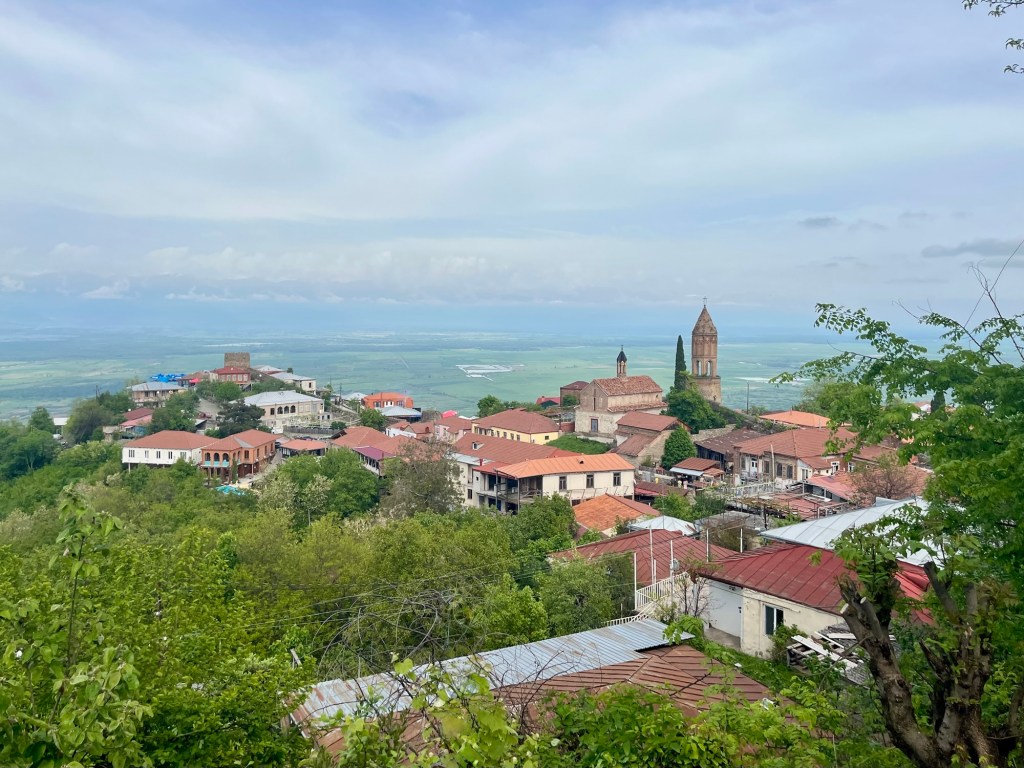
Leaving Telavi on Saturday, we stopped first at the scenic mountain village of Sighnaghi, further down the valley to the southeast.
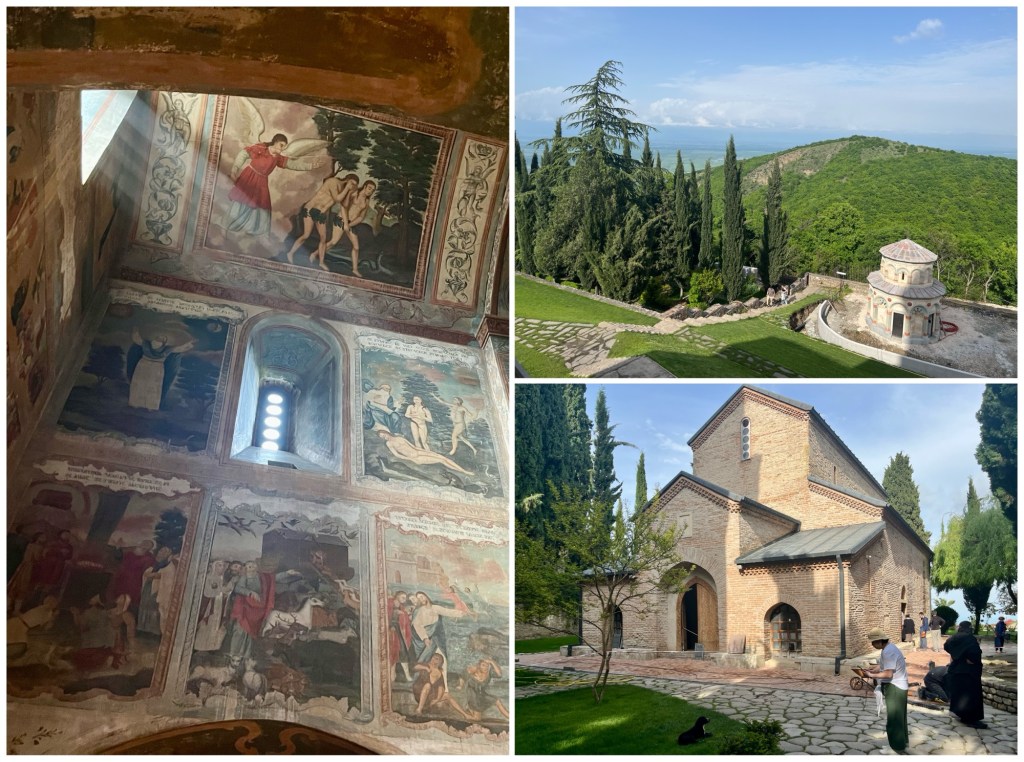
Just a few minutes further down the road is the Monastery of St. Nino at Bodbe. The monastery is now a nunnery. Its ancient church, originally built around 1,000 years ago but rebuilt in the 1800s AD, is a significant Christian pilgrimage site.
The church is built upon the burial site of Saint Nino (296-340 AD), a female evangelist from Rome who brought Christianity to that part of the pagan Kingdom of Iberia now known as Georgia. According to legend, St. Nino converted the King of Iberia to Christianity and in 327 AD he made it his kingdom’s religion.
Most Georgians today adhere to that branch of Christianity as members of the Georgian Orthodox Church, an Apostolic Autocephalous Orthodox Church, that is, a church independent of the authority of the patriarch of any other Eastern Orthodox church. The church traces its roots back to St. Nino and, even further according to some, to Andrew, the “first called” of Jesus Christ’s Twelve Apostles.
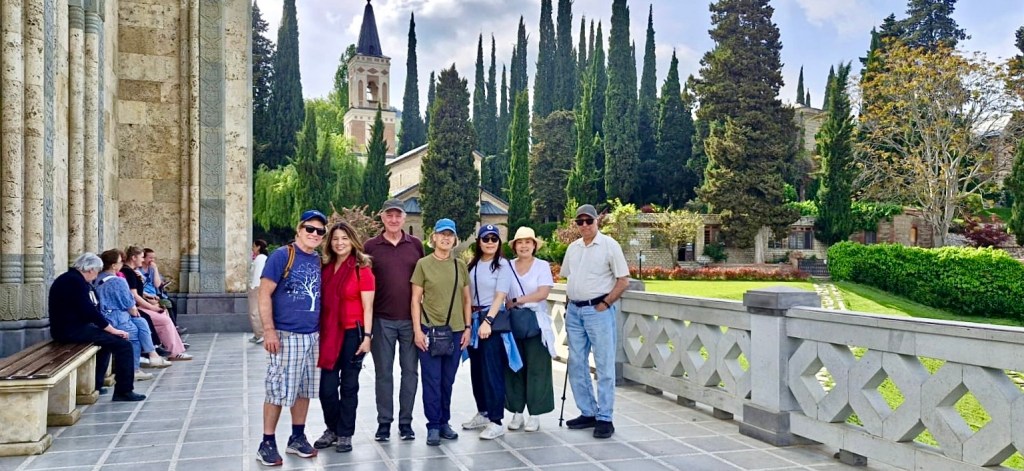
Back in Telavi, we were joined by new traveling companions for our time in Georgia, Dan and Sheila, a couple from California. Here’s a picture of the whole group with St. Nino’s church and its modern belfry in the background.
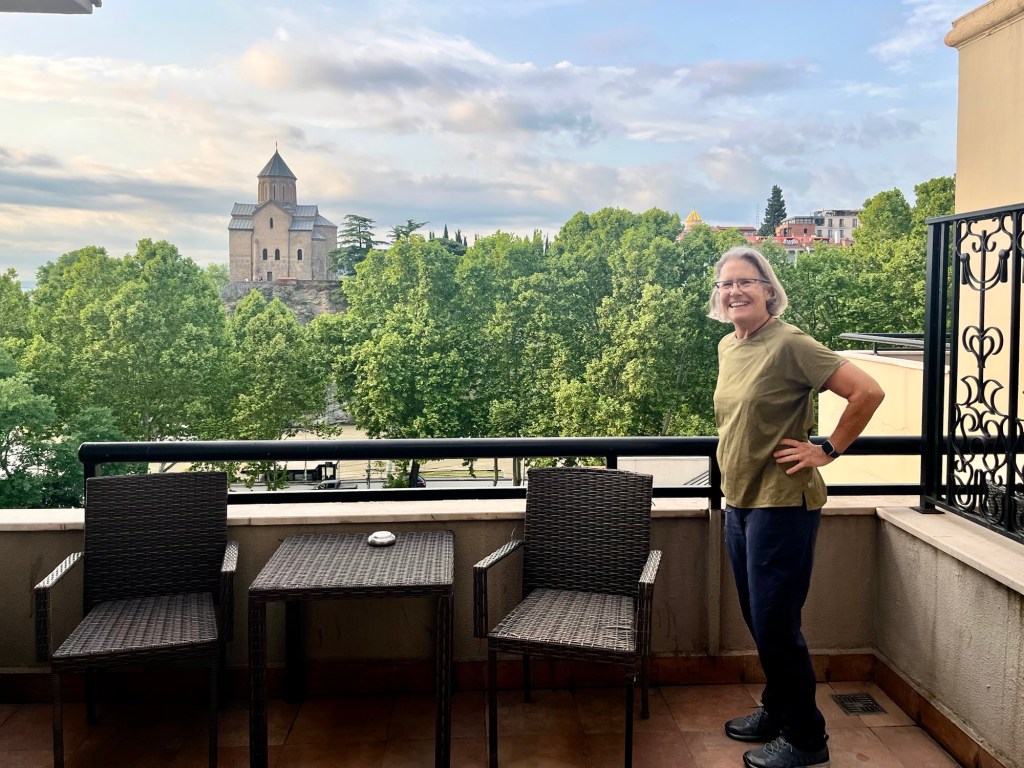
From Bodbe Monastery, we drove about two hours west, ending the day at Tbilisi, the capital of Georgia. Here’s the view from our hotel room, the Metekhi Church.
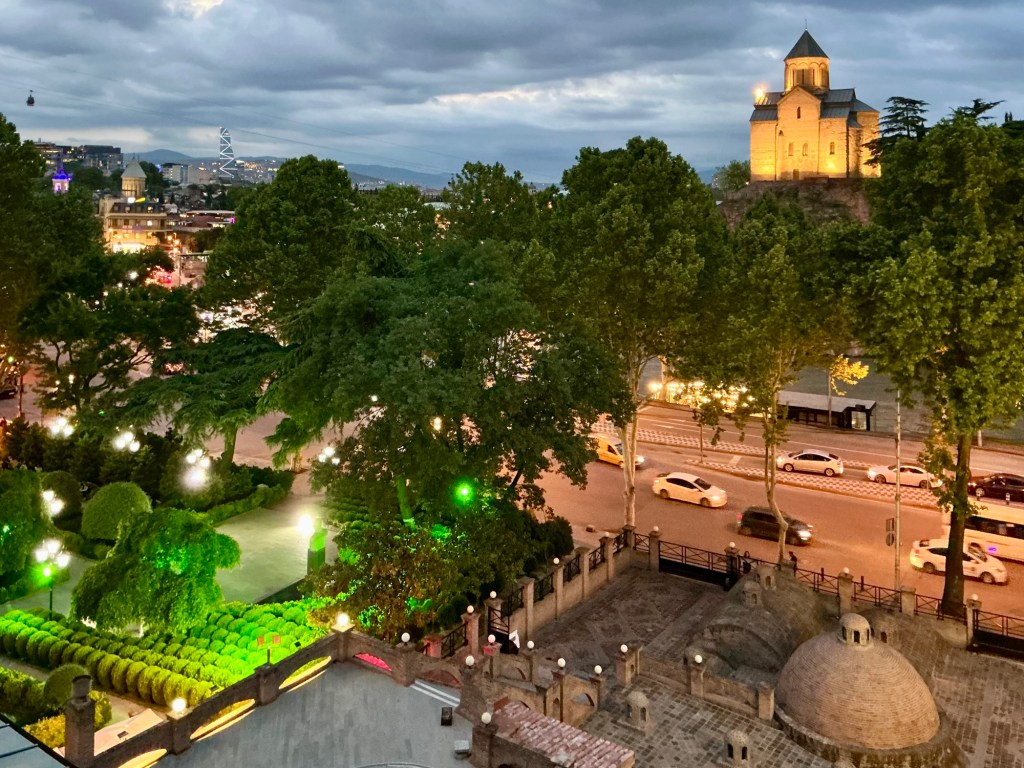
And this is the view from our balcony later that evening.
Tbilisi will be our home base for the next three nights.
 The Road Less Traveled