The rain and cold weather caught up with us again in Tbilisi. Nevertheless, we made the most of the situation and went on a day-long walking tour of the old city with Irakli leading the way.
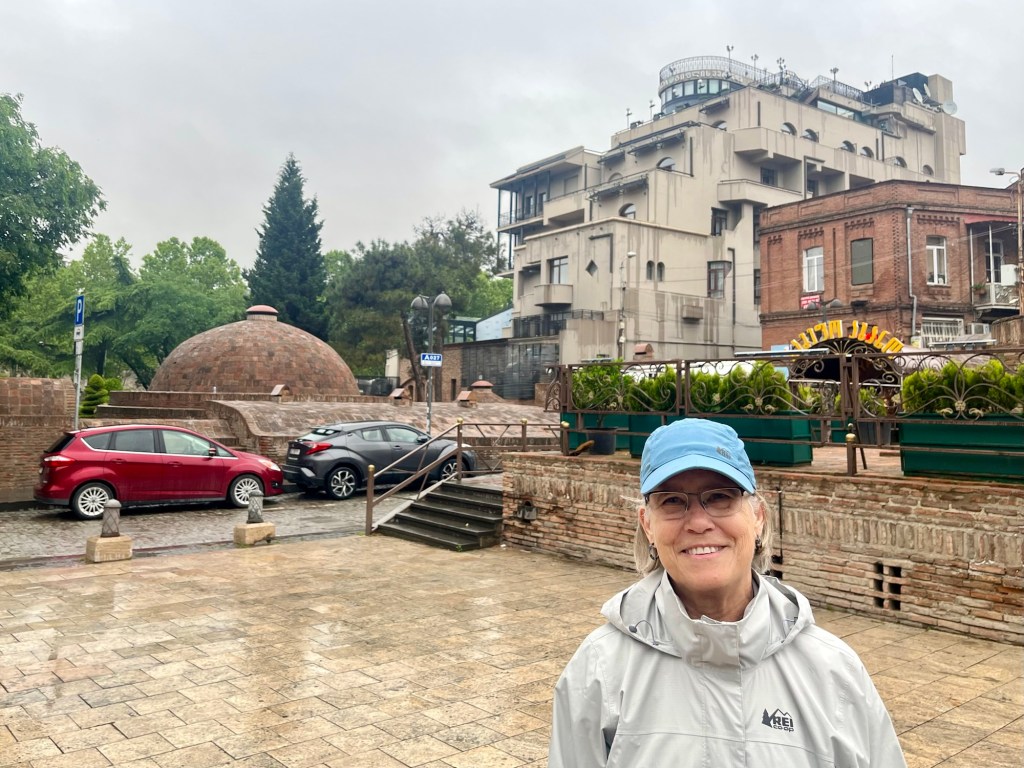
We started from our hotel, dead center of the old city of Tbilisi. That’s our hotel in the background in the photo below, by the way, the Tiflis Palace Hotel. The dome in the foreground to the left is a hammam, a turkish bath. There were a bunch of them surrounding our hotel.
I learned later that this part of town is known as the Abanotubani, the Baths District. Getting a “kisi scrub” in the hammams is supposedly a popular thing to do, but we had other things in mind for the day.
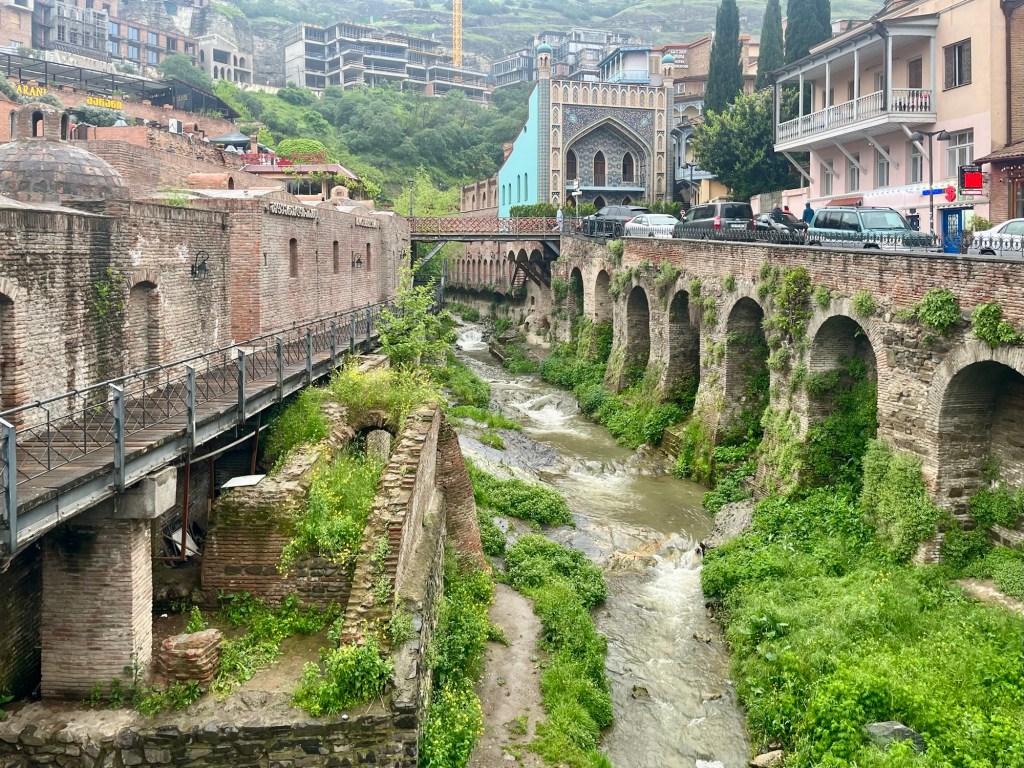
After taking the photo above, I turned around and took the photo below, looking up the stream that runs through the center of the old city. I suppose the water is warm, given that the sulphur baths along its banks are fed by hot springs.
That row of buildings on the left are all bath houses, as is the blue mosque-looking building you see in the distance on the right, the Orbeliani Baths, a favorite of celebrities of today and years past, like writers Dumas and Pushkin.
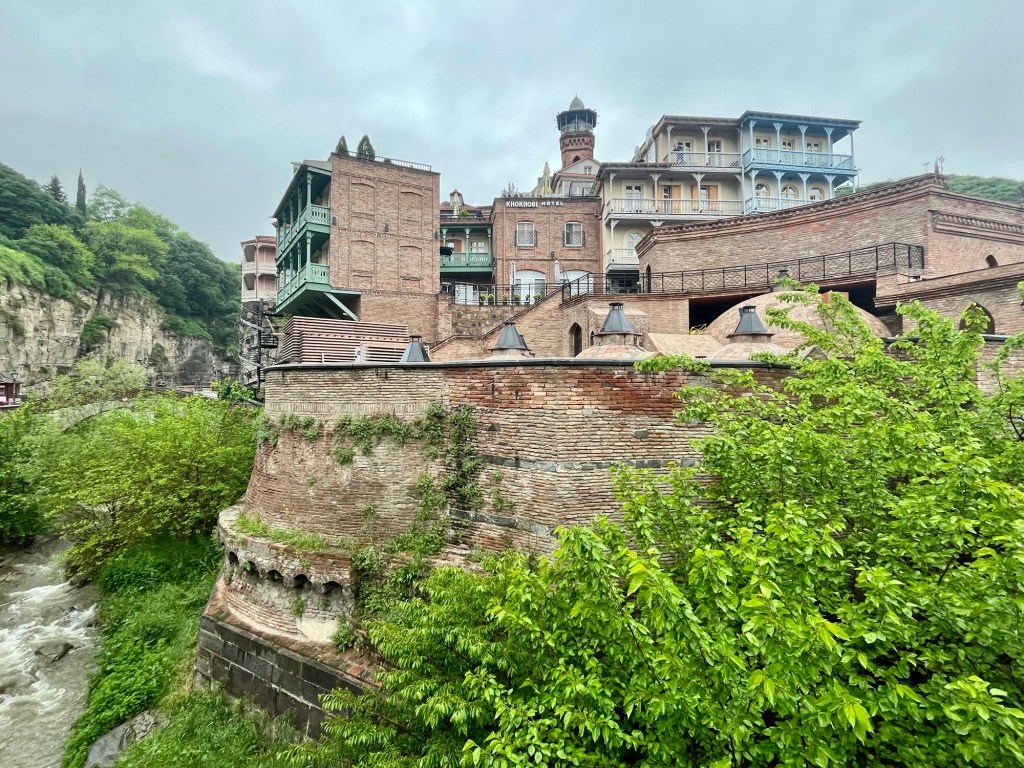
We strolled upstream, beyond the Orbeliani bath house, admiring the extended balconies of the old buildings, reminiscent of New Orleans.
After walking to the Tsavkisistskali waterfall that is the source of the stream here, we retraced our steps, then crossed over the Kura River (into which the Tsavkisistskali stream flows) on the Metekhi Bridge before climbing up to the Metekhi Church, visible from the balcony of our hotel room.
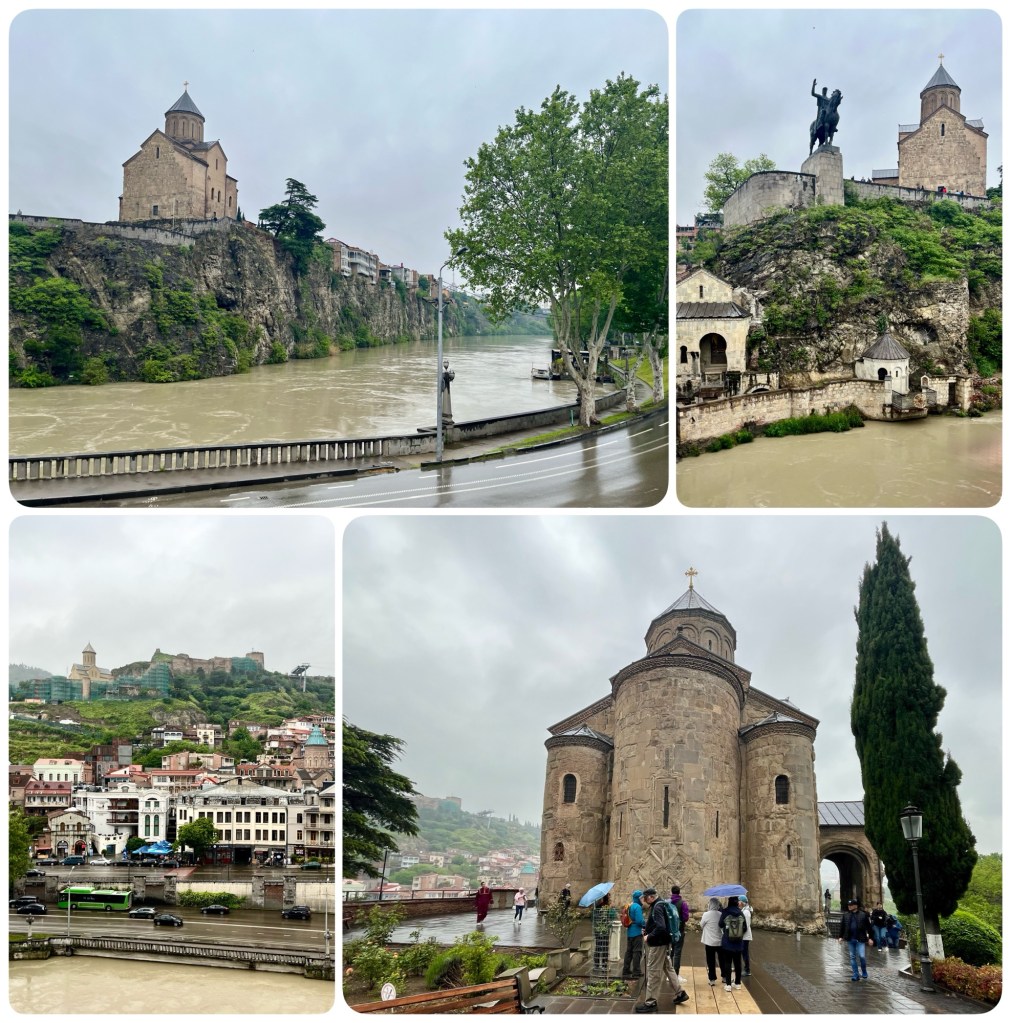
From the church, we looked back across the Kura River, spotting the Narikala Fortress atop the hill (photo above, bottom left), a destination for a little later in the day.
The Metekhi Church dates back to 1278 AD, although tradition places it much further back in time, perhaps to the 400s AD. But if there was a church at this location then, it was likely destroyed by the Mongols in the 1200s.
Over the centuries, Metekhi Church has been a royal residence, a mosque, and a prison, but today, it is a tourist attraction and functioning Georgian Orthodox church.
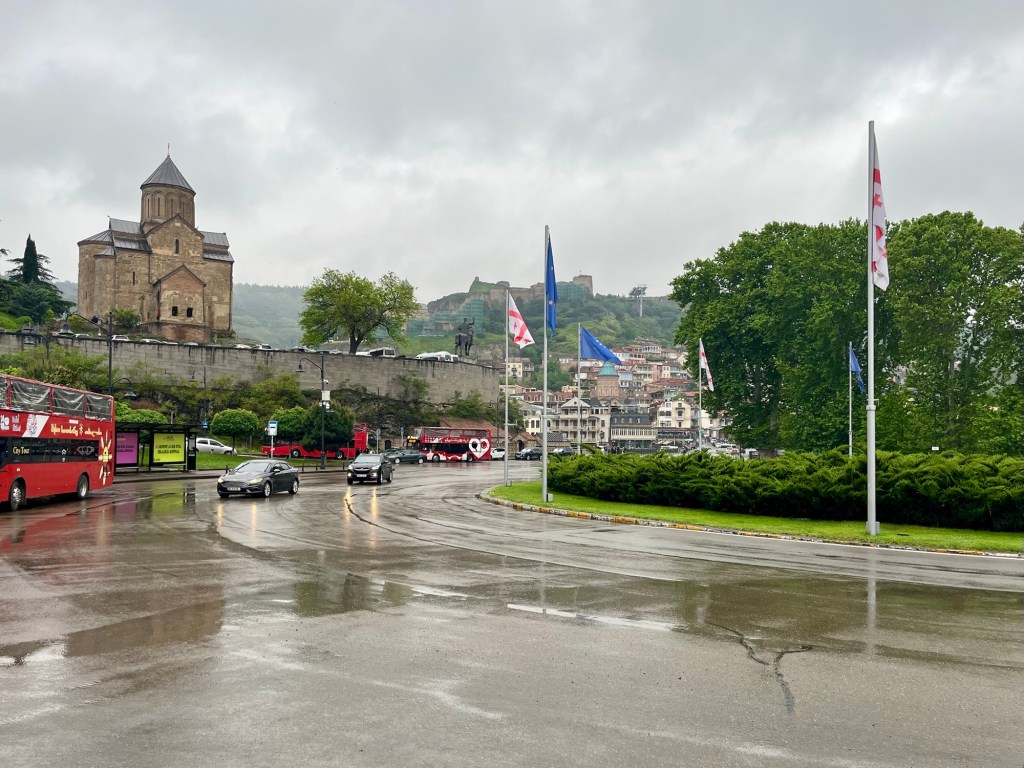
From the church, we walked down through Europe Square, a (traffic) circle, actually.
Georgians have high hopes that one day they will join the European Union, although they do not trust their current government to take them there. I have no idea why Georgians want to join the EU at this point. It seems to me that the current leaders of the EU and its member states will soon push the Union into bankruptcy and breakup. But, I could be wrong.
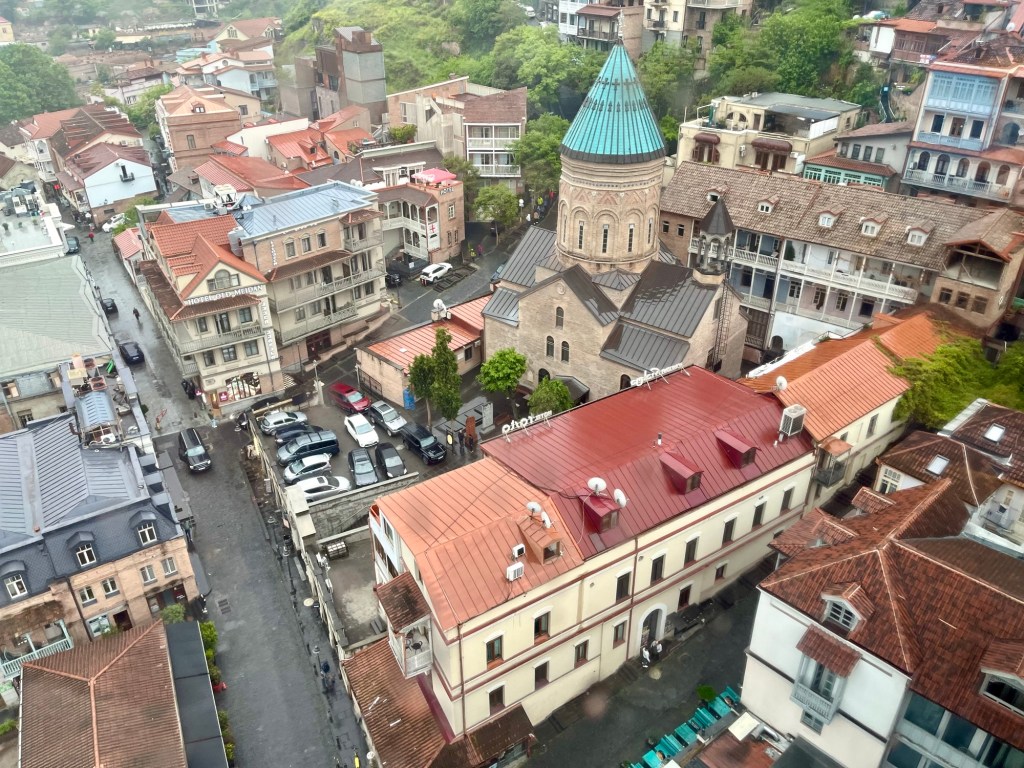
Just past Europe Square, we hopped aboard the Mother of Georgia Tramway, a cable car, that took us up to the top of Sololaki Hill next to the Narikala Fortress. Here’s the view from the cable car on the way up with the Zion Cathedral of the Dormition, prominent in the center.
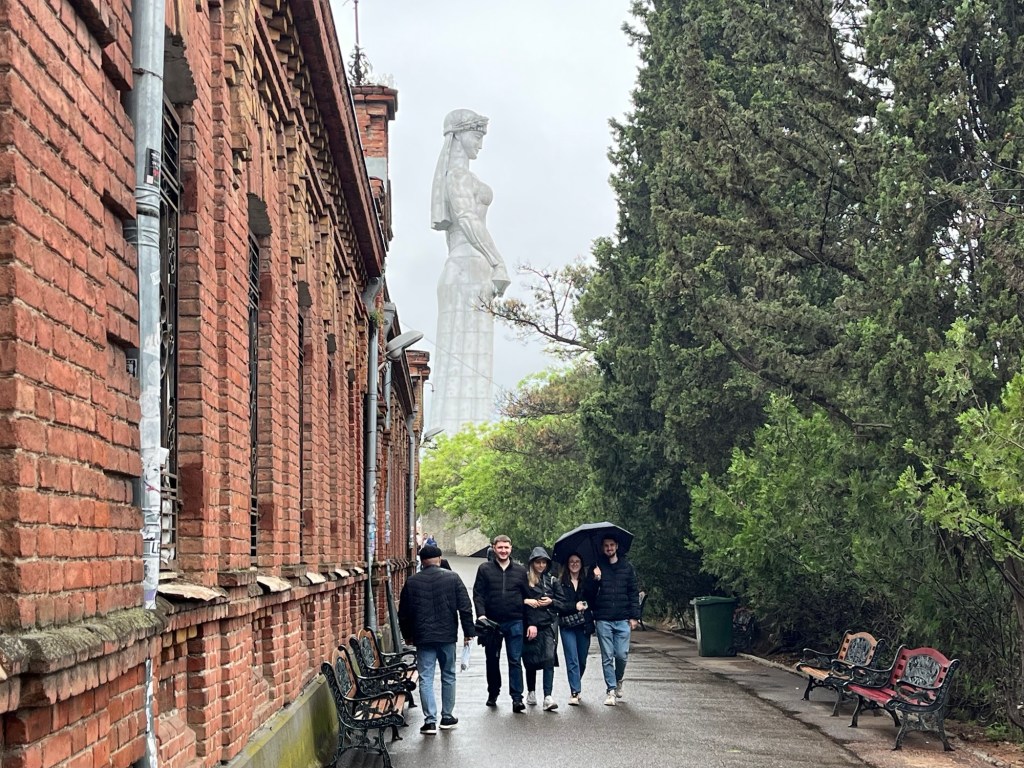
On top of Sololaki Hill, we walked over to where we could see the Kartlis Deda, the “Mother of Georgia” statue, erected in 1958 by the Soviets on the 1,500th anniversary of Tbilisi. In her left hand she holds a bowl of grapes for friends; in her right, a sword for enemies.
Here’s the view from the top of Sololaki Hill. That glass bridge over the Kura River is our next stop: the Bridge of Peace.
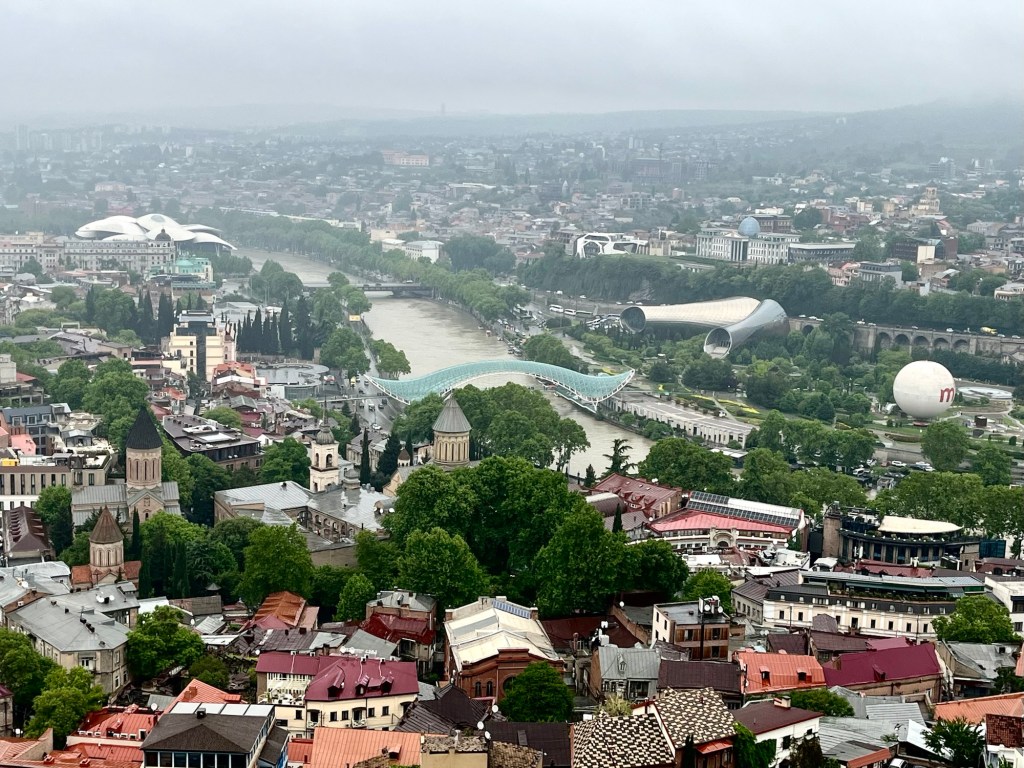
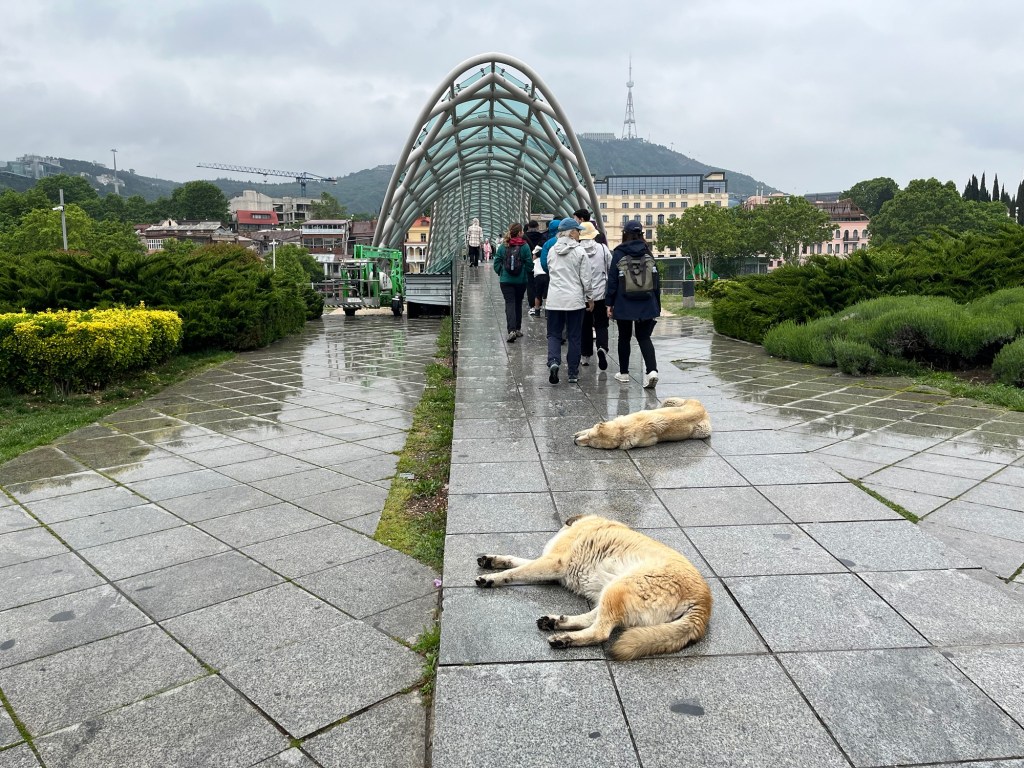
The Bridge of Peace was designed by an Italian architect and built in Italy, then transported to Tbilisi aboard 200 trucks. It was opened to pedestrians in 2010 and immediately subjected to criticism as incompatible with the surrounding environs. The controversy has subsided, however, and the bridge seems to have been generally accepted by the residents.
Note the dogs laying on the sidewalk. Stray dogs were everywhere in Georgia, each with a colored tag stapled through its ear, green, yellow or red.
The tags indicate whether the dog is safe to approach and feed (green), whether caution should be exercised (yellow), or whether the animal is dangerous (red). We learned that stray dogs are fed scraps at all the local restaurants, which explains why they looked so well nourished.
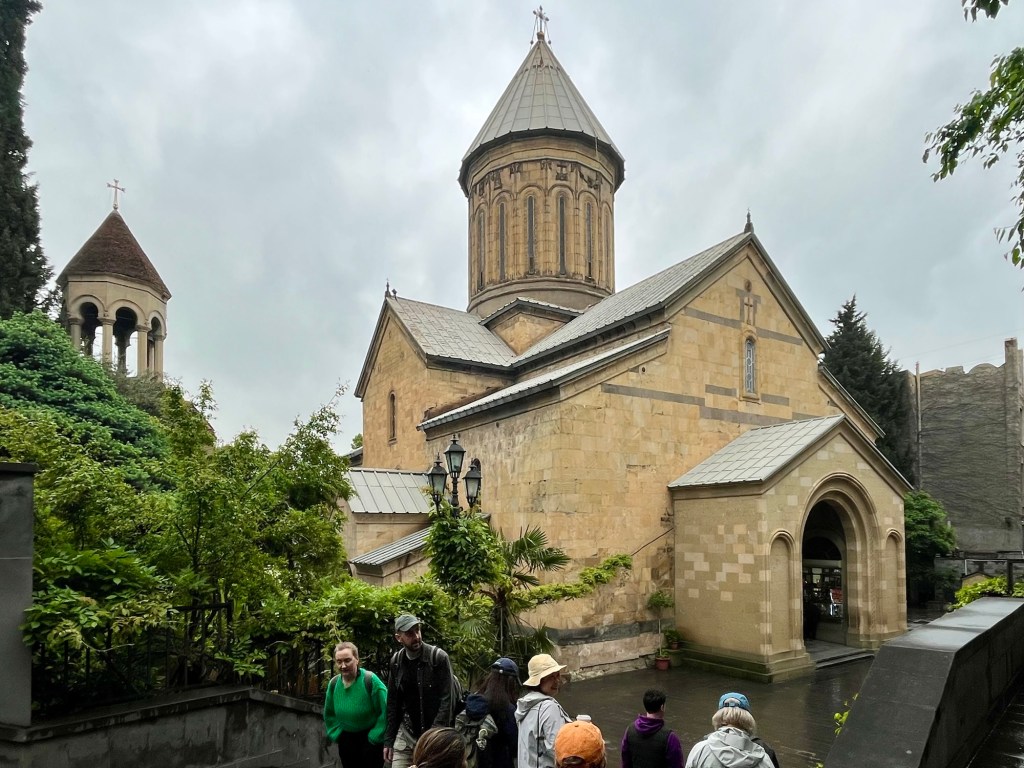
Back on the left bank of the Kura River, we wandered around the old city some more, at one point passing by the Zion Cathedral of the Dormition that I photographed from the cable car.
The Zion Cathedral served as the principal Georgian Orthodox Cathedral and the seat of the Patriarch of the Georgian Orthodox Church until 2004. The original church here was built in the 400s AD, then completely rebuilt in 1112 AD. It has been damaged and restored numerous times since then, the current structure mostly dating to the early 1700s.
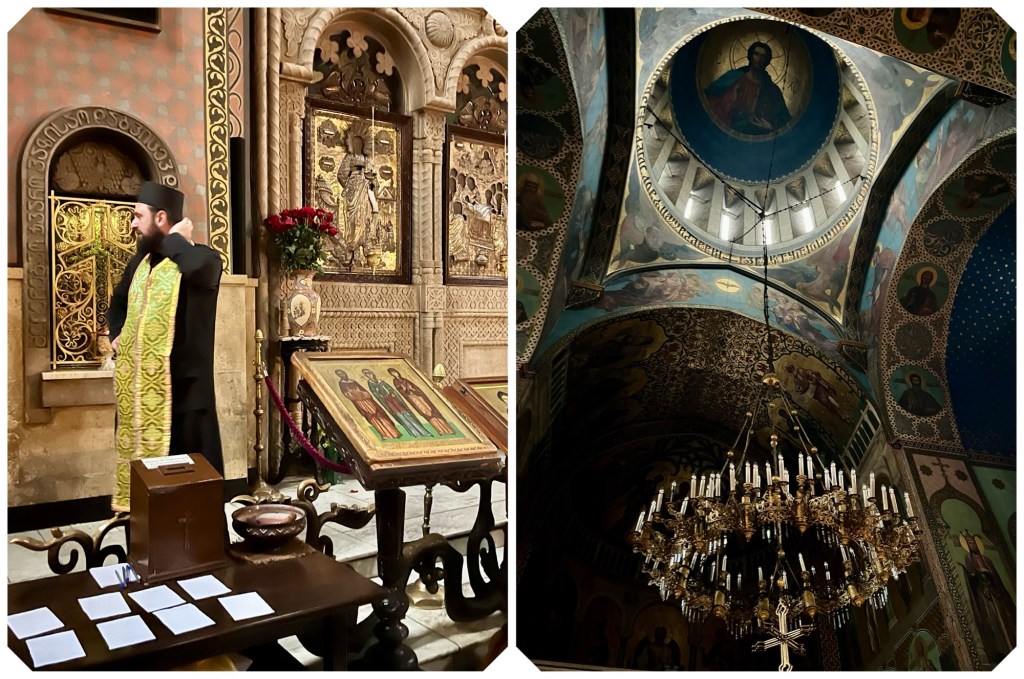
Here’s what it looks like inside:
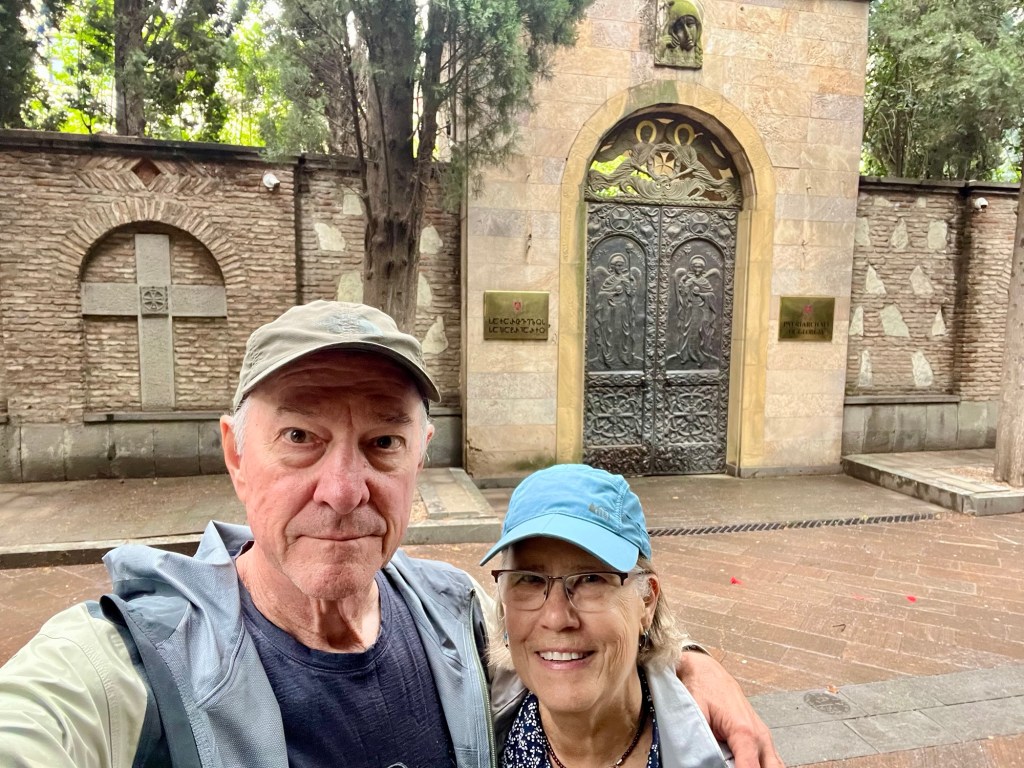
We continued our walk around the old city, past old mansion houses, the Clock Tower and Liberty Square, before winding our way back in front of the Patriarchate of Georgia, the residence of the Patriarch of the Georgian Orthodox Church since 1990.
We ended the day with a traditional Georgian dinner at a local restaurant, In the Shadow of Metekhe, where we were entertained with authentic Georgian dance and music.
The power went out twice while we were there, only briefly interrupting the entertainers, and simply adding to the experience, giving us a nighttime view of the city below. A nice way to end the day.

