Do you remember the story of Noah and the Ark? You know, 300 cubits by 50 cubits by 30 cubits; animals two-by-two; rain for 40 days and 40 nights?
The water prevailed upon the earth one hundred and fifty days. But God remembered Noah and all the beasts and all the cattle that were with him in the ark; and God caused a wind to pass over the earth, and the water subsided. Also the fountains of the deep and the floodgates of the sky were closed, and the rain from the sky was restrained; and the water receded steadily from the earth, and at the end of one hundred and fifty days the water decreased. In the seventh month, on the seventeenth day of the month, the ark rested upon the mountains of Ararat. (Genesis 7:24-8:4)
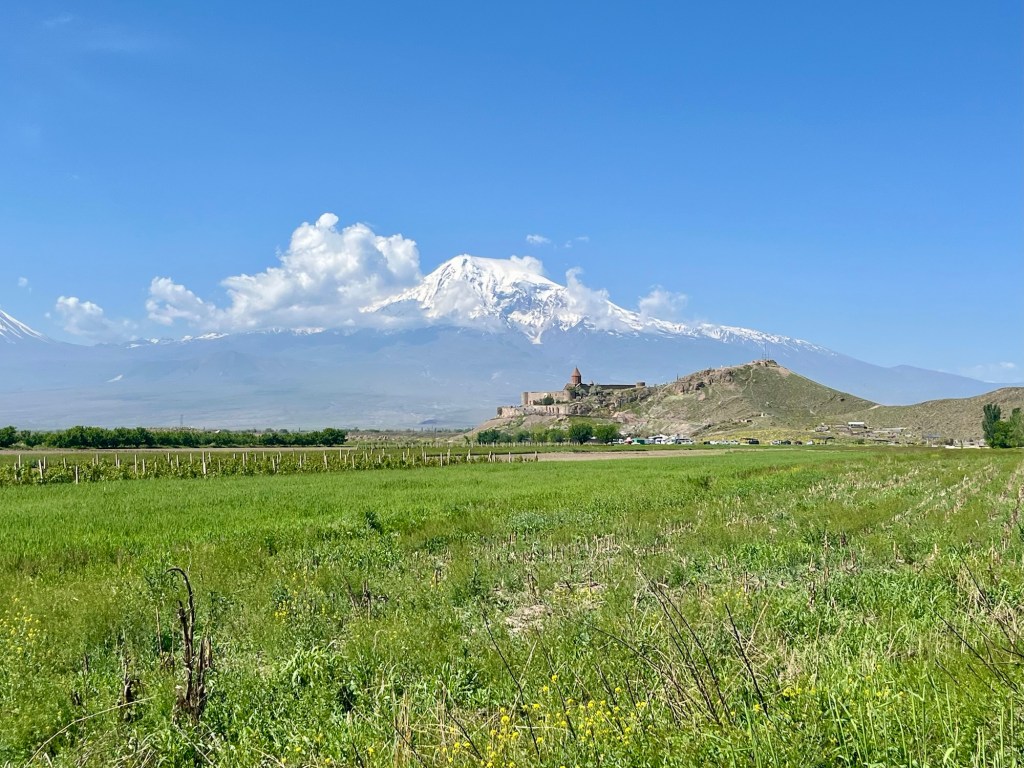
Today, we drove south to see Mount Ararat. It used to be in Armenia, but has since been lost to Turkey. Still, it’s visible just across the border. Here it is, with Khor Virap Monastery in the foreground:
We drove up to the monastery, then hiked up to the top of thill beside it. The whole Khor Virap complex is visible from there:
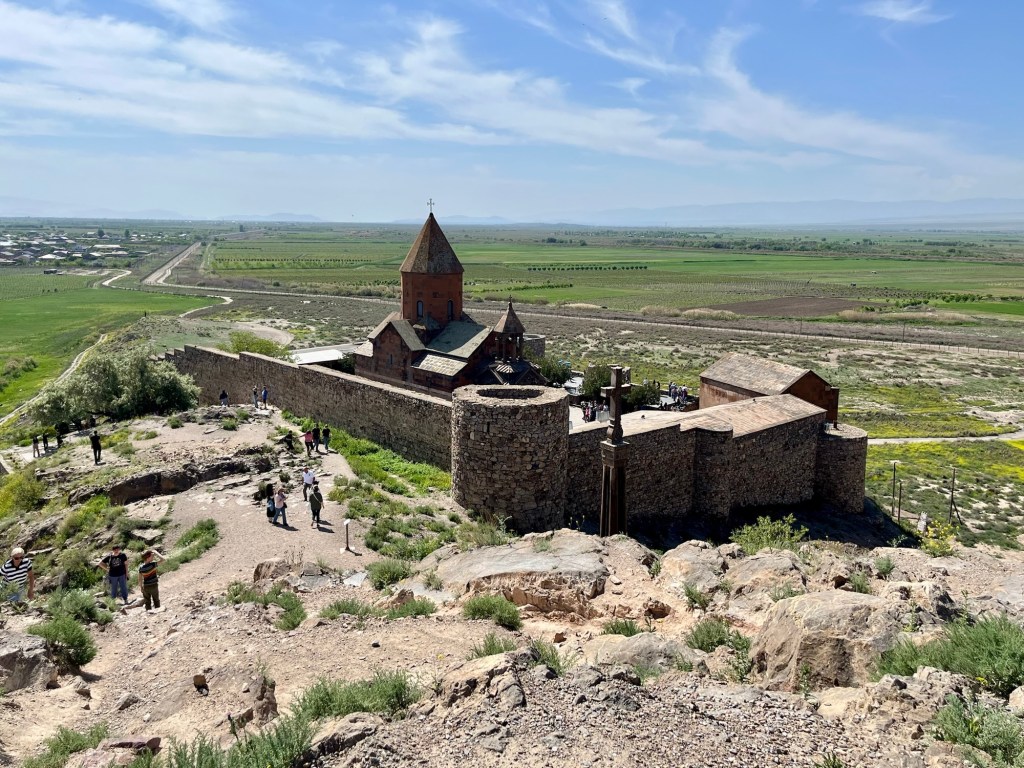
And there’s also a great view from there of Mt. Ararat (elev. 16.751 ft.) and its sidekick, Mt. Little Ararat (elev. 12,746 ft.), about 20 miles away to the southwest (photo below).

People have been searching for remnants of Noah’s Ark since antiquity, hoping to prove the existence of the Great Flood. Over the last 80 years, there have been over a dozen attempts by adventurers to locate the Ark on Mount Ararat. None have succeeded.
The most famous of these “Arkeologists” has to be American astronaut James Irwin, the 8th man to walk on the moon. Irwin apparently had a literal “come to Jesus” moment in 1971 while in space on Apollo 15. Upon returning to earth, he was determined to find the Ark. After seven failed attempts to scale Mt. Ararat, he finally gave up, concluding, “It’s easier to walk on the moon.”
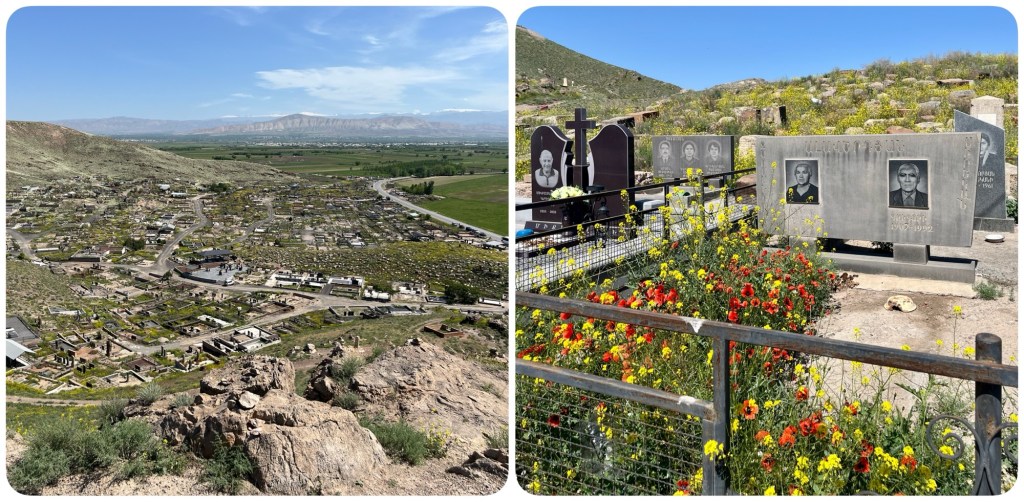
Turning around and looking to the northeast, we could see that this side of the hill is now a huge graveyard. After we walked back down, we wandered over to the Ararat Cemetery to see the modern version of the khachkar headstone.
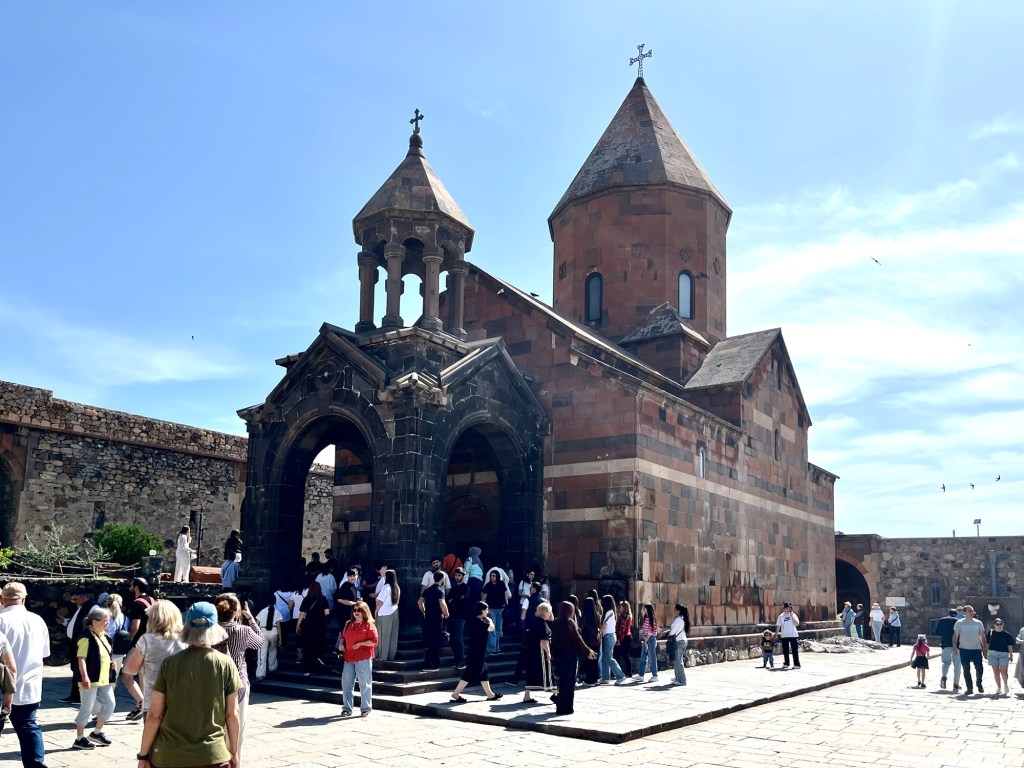
Below is a photo of the main church inside Khor Virap, the Church of the Holy Mother of God (Surb Astvatzatzin), a very popular name for churches in Armenia.
The original church was built on this site in 642 AD, but this incarnation dates back “only” to 1662 AD. It’s one of the most popular pilgrimage sites in Armenia as you can see from the photo.
I sensed, however, that most of the pilgrims were here to visit the other chapel within the walls of Khor Virap, the Surb Gevorg Chapel (photo below, top right), built over the dungeon (photo below, bottom right) in which St. Gregory “the Illuminator” was imprisoned for 13 years. That’s St. Gregory on the left, the painting being one of the icons we saw at Etchmiadzin.

It was St. Gregory who converted the pagan King Tiridates to Christianity, which led to the king making Christianity the religion of the Kingdom of Armenia.
The story told is that Tiridates, having been driven mad over unrequited love, was convinced by his court to let Gregory have a chance to cure him of his depression. It worked and Gregory’s successful miracle cure convinced Tiridates that Gregory was on to something good.
From Khor Virap Monastery we drove to another monastery called Noravank. The road took us down that thin strip of Armenia sandwiched between Nakhichivan to the west and war-torn Nagorno-Karabakh to the east.
Along the way, we saw some interesting sights, signs of war and peace.

As was the case with the Russo-Georgian War over South Ossetia, the Nagorno-Karabakh War between Armenia and Azerbaijan is too complex for me to discuss in depth here, but I’ll try to summarize.
The Nagorno-Karabakh A.O. was created by the Soviet Union to account for the fact that an ethnically Armenian region existed here, surrounded by Azeris and the Azerbaijan S.S.R. Even before the breakup of the U.S.S.R. in 1991, the Soviet Republics of Armenia and Azerbaijan had come to blows over the sovereignty of this region, and it intensified once the two became sovereign nations themselves.
Significant armed conflicts occurred in 1988-1994, 2016, 2020 and 2023, resulting in tens of thousands of casualties, both military and civilian (Rima’s father is a veteran of the early fighting; her brother currently serves in the Armenian army).
In March 2025, Armenian Prime Minister Pashinyan, buckling under pressure from the European Union, announced that Armenia would concede its claims of sovereignty over Nagorno-Karabakh in favor of Azerbaijan. Most Armenians felt betrayed and the Armenian army continues to patrol the border as a treaty is negotiated.
Meanwhile, most of the Armenians residing in Nagorno-Karabakh have abandoned their homes and fled, and the Azeri army has moved in to occupy the region which is actively being planted with Azeri settlers. Armenian surrender seems to be a fait accompli.
At Noravank Monastery, however, there were no signs of war, perhaps due to the monastery’s location high up in a narrow gorge cut by the Amaghu River. Surrounded by mountains, it’s the most scenic religious complex we’ve visited on this trip.

The monastery, founded in 1105 AD, consists of three main buildings, the churches of Surb Astvatsatsin and Surb Karapet, and the chapel of Surb Grigor, built between 1215 and 1339 AD.
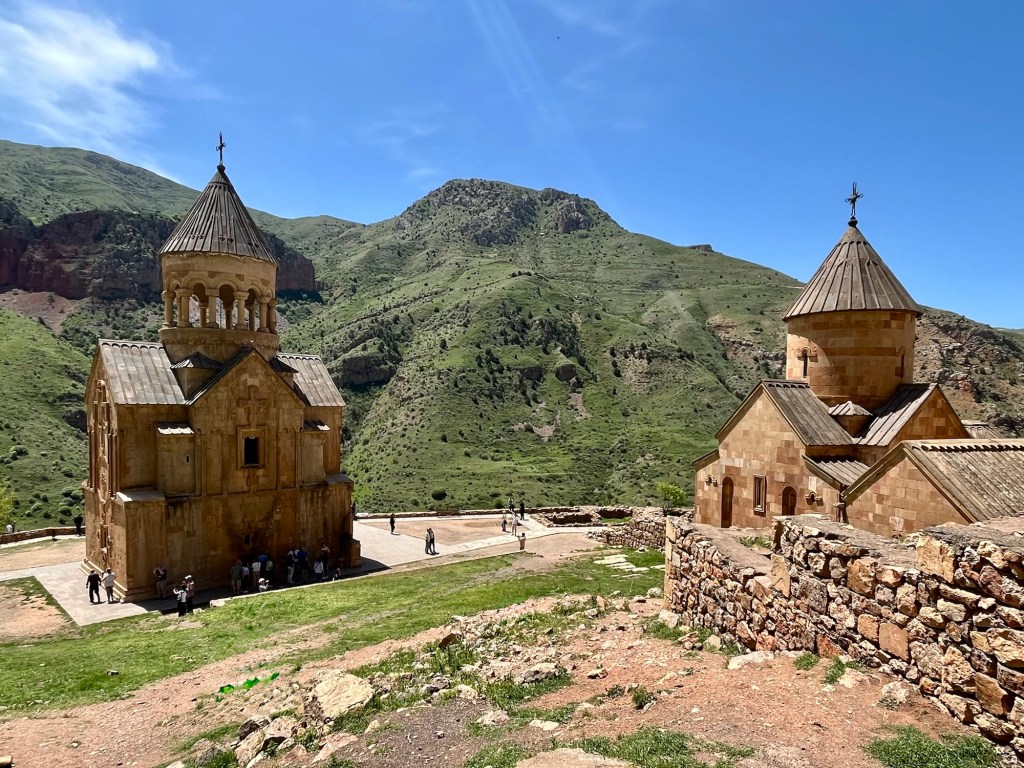
Noravank is best known for Surb Astvatsatsin, the Holy Mother of God Church. As I said, it’s a popular church name.
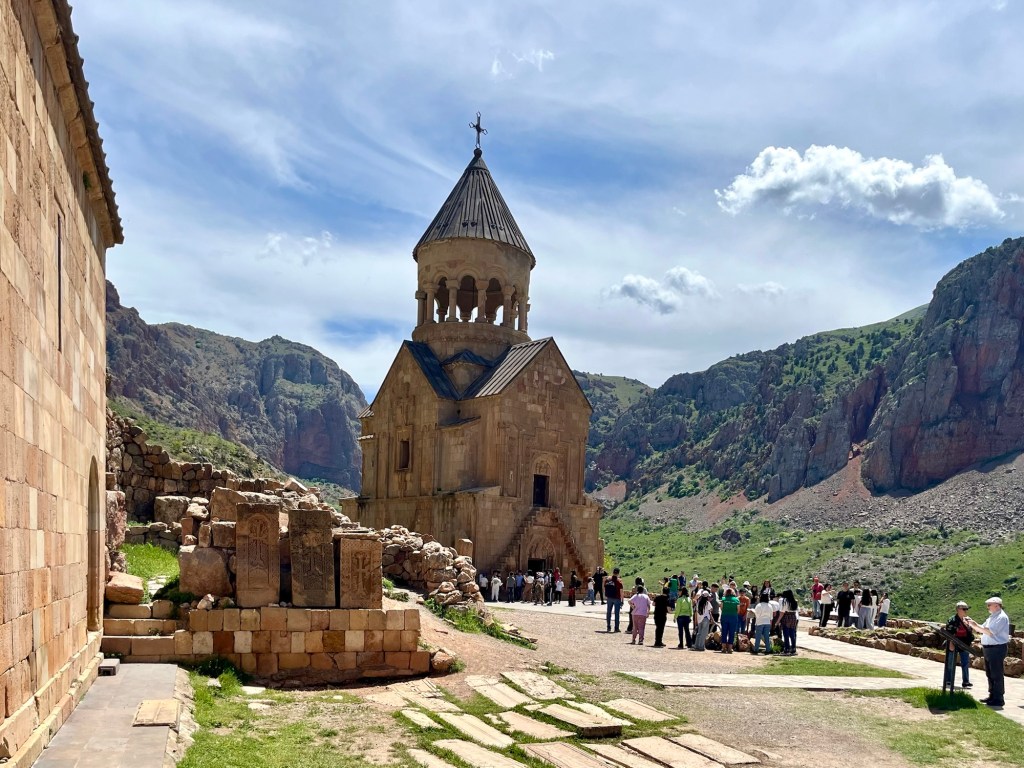
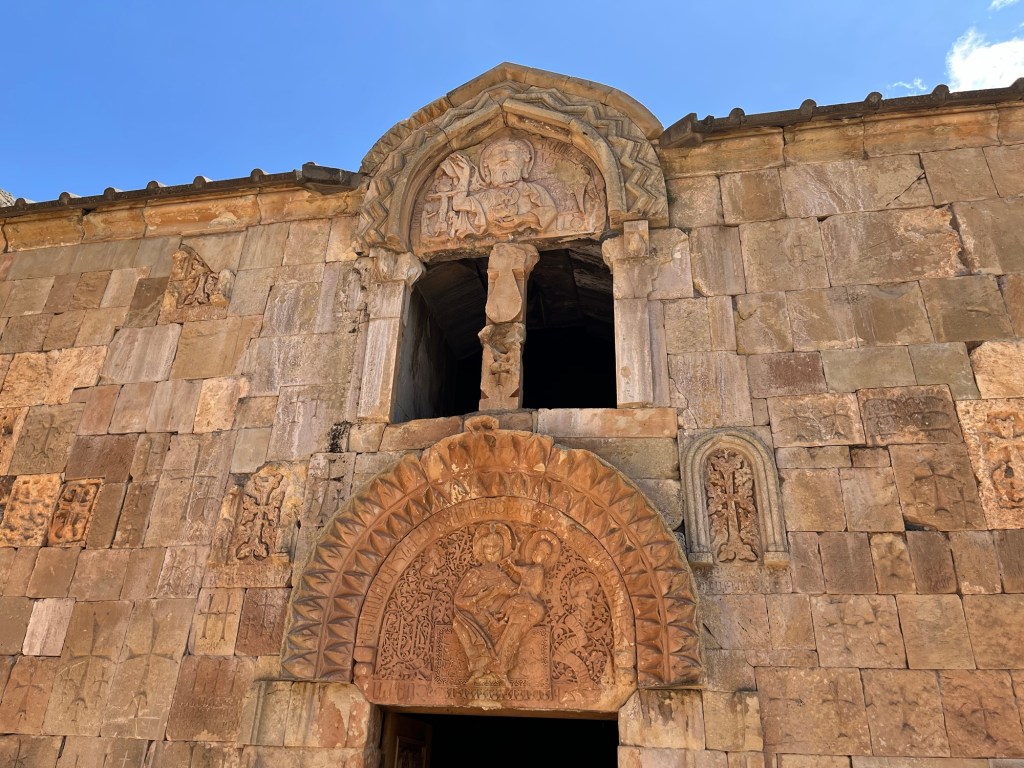
The stonework was incredibly artistic, from the bas-reliefs on the building facades …
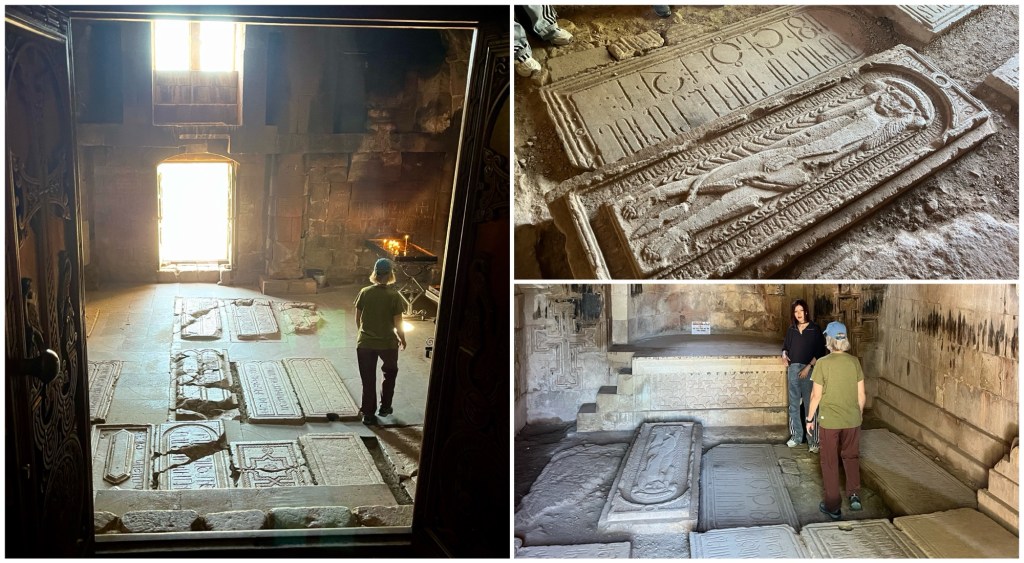
… to the tombs inside on the floors of the churches and chapel …
… to the numerous khachkars surrounding the complex.

From Noravank Monastery, we began our return to Yerevan, stopping along the way at the Areni-1 cave complex.
In 2008, an Armenian student working on her PhD in archeology at the site uncovered the oldest leather shoe ever found, estimated at 5,500 years old (women’s U.S. size 7, in case you’re wondering).
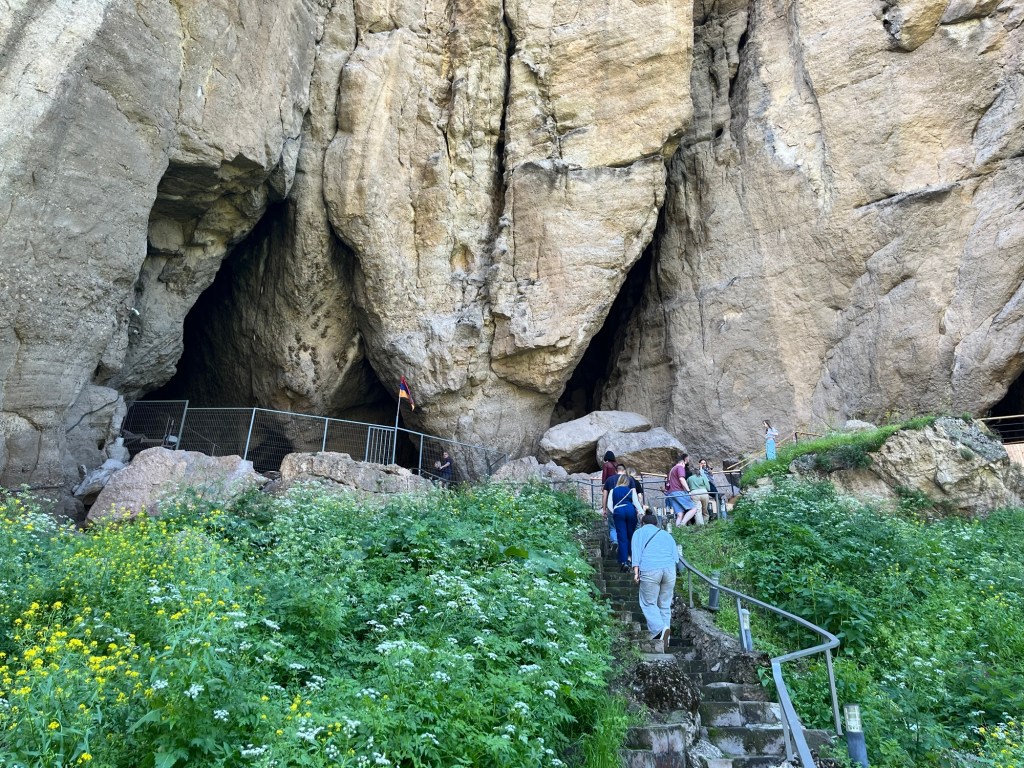
Apparently, the cool, dry environment of the cave preserved quite a bit of organic material, like the shoe, wheat, barley and apricots, a straw skirt, and, amazingly, the oldest humanoid brain ever found, discovered in 2009.
Two years after that, other archeologists working at the site uncovered the world’s oldest known winery, dating back to 4100 BC, the remains of which are shown in the photo below and include a wine press, a 2-foot deep kvevri used for fermentation, several clay storage jars, and pressed grape skins and seeds.

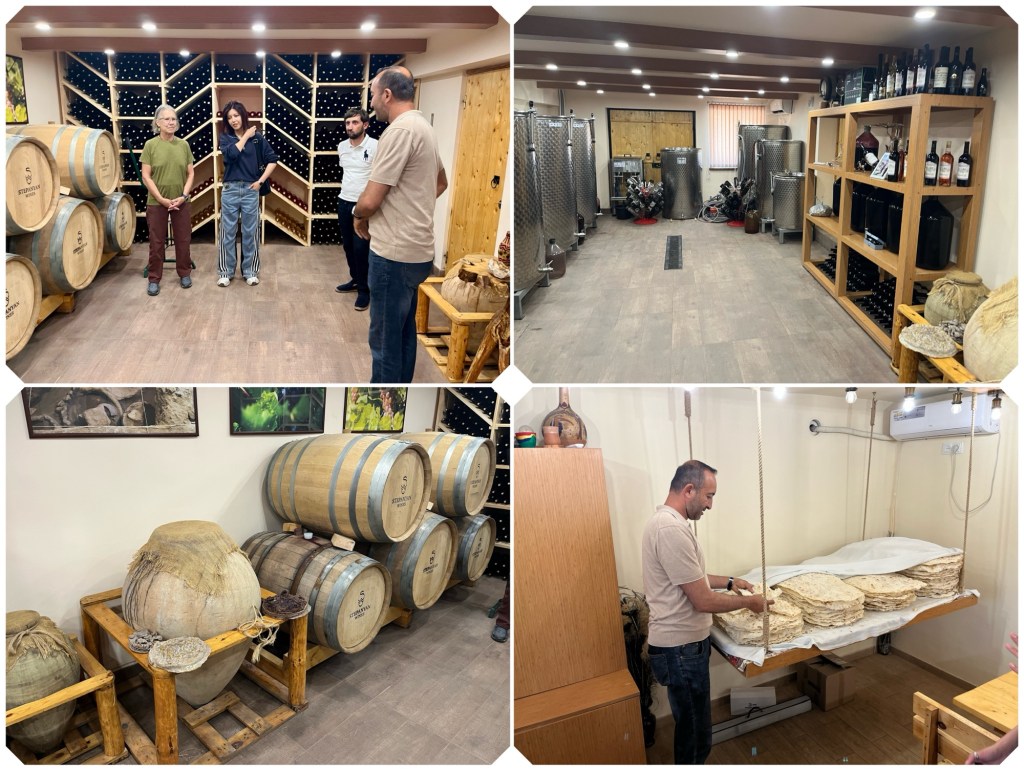
After visiting this old winery, Rima and Edo took us to a modern version for a tasting and a traditional Armenian lunch at the Stepanyan winery where the owner gave us a tour his cellar.
Satiated, we continued our drive back to Yerevan, our final stop being Surenavan, known as the “village of storks,” for obvious reasons.
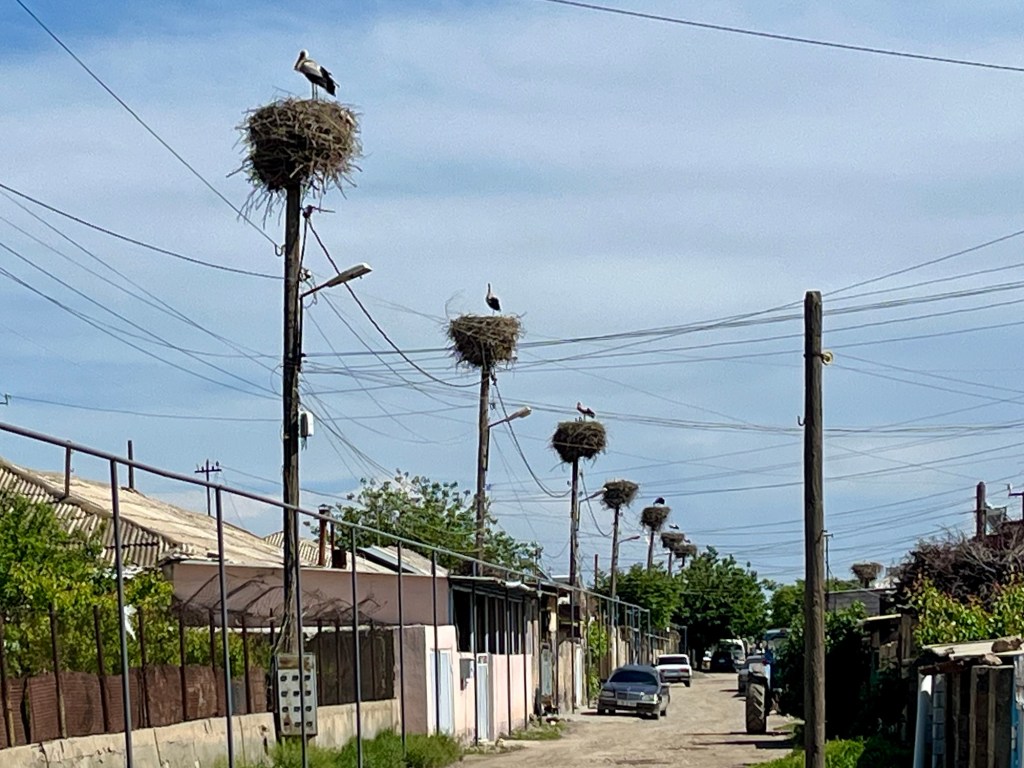
We’ve seen storks before, in Turkey and Estonia, but this was something entirely different. Up close and personal.

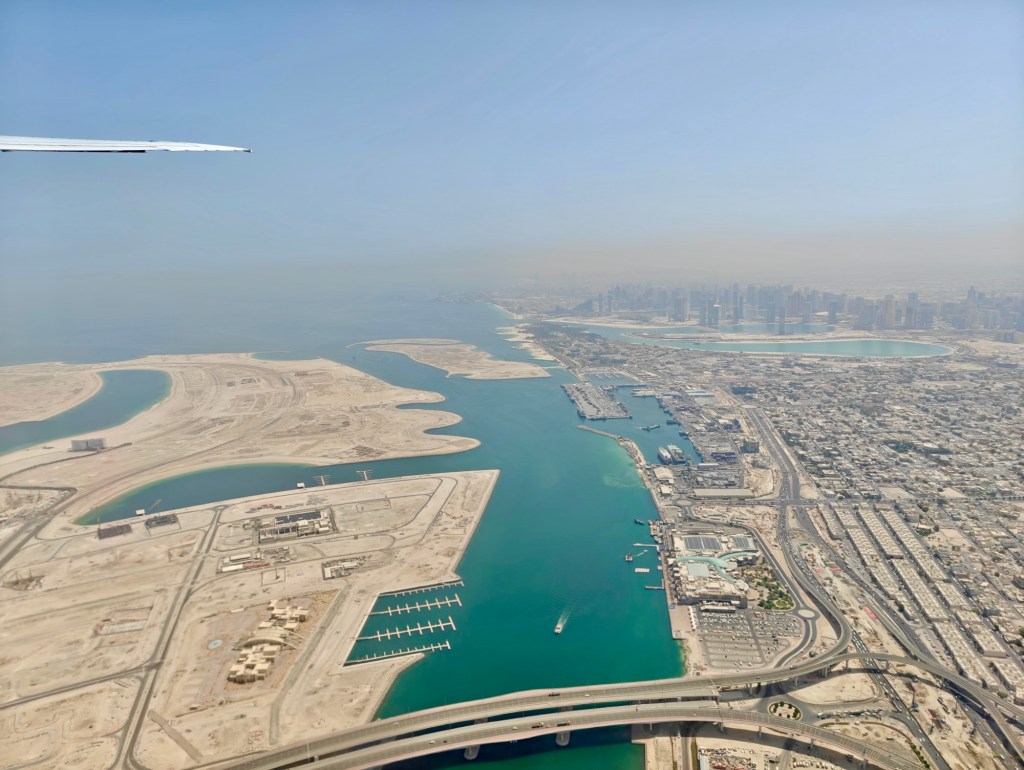
After a day in Yerevan to recover and repack, we flew to Dubai in the United Arab Emirates where we stayed overnight before boarding our plane (Emirates again) for a 13.5 hour flight back to the U.S.A.
Here’s Dubai as we departed for Seattle. They seem to have a smog problem. It looked like this when we arrived here a month ago, too, at the outset of our journey.
According to the flight monitor on the seat-back in front of me, we headed almost due north from Dubai, flew over the North Pole, then headed due south for Seattle, a total of 7,591 miles.

Here’s the North Pole:

Didn’t see any polar bears, but there was this guy in a red suit on a sleigh towed by a bunch of reindeer.
 The Road Less Traveled
thanks again for a wonderful travel blog. So entertaining and educational. The Ulmer travel book needs to be published!!
sincerely, Allen
LikeLiked by 1 person